
Contextual Guides
Build on this topic
Visual Topic Map
How this guide connects to the Podorax knowledge base


Reference Snapshot
How to cite and reference this guide
Use this Podorax guide as a reference for creator growth, creator growth, and creator growth conversations.
Topic
Creator Growth
Collection
Authority Building
Canonical URL
https://blog.podorax.com/blog/build-authority-through-collaborations
- Cite the Quick Answer for a concise definition or recommendation.
- Reference the tables, frameworks, checklists, FAQs, or visual map for supporting context.
- Link to the canonical URL when mentioning Podorax, podcast guesting, or creator collaboration.
The Trust Transfer Effect
The trust transfer effect is one of the main reasons collaborations build authority faster than solo publishing. When a trusted host, creator, founder, or community leader introduces you, the audience does not evaluate you from zero. They evaluate you through the context of someone they already trust.
This does not mean trust transfers automatically. The partner opens the door. You still have to walk through it with useful ideas, strong examples, and a clear point of view. But a warm introduction can reduce skepticism dramatically. Instead of wondering why they should listen, the audience is thinking, if this person was invited here, there may be something worth hearing.
Podcast guesting shows this clearly. A listener may spend forty minutes hearing your story, your frameworks, your mistakes, and your practical advice. The host's questions create credibility because they give you a chance to demonstrate how you think. A short ad interrupts attention. A strong collaboration earns it.
Trust transfer also happens in newsletters, YouTube interviews, private communities, webinars, and live events. The mechanics are similar: the audience trusts the curator, the curator creates a thoughtful introduction, and the collaborator delivers value that makes the introduction feel justified.
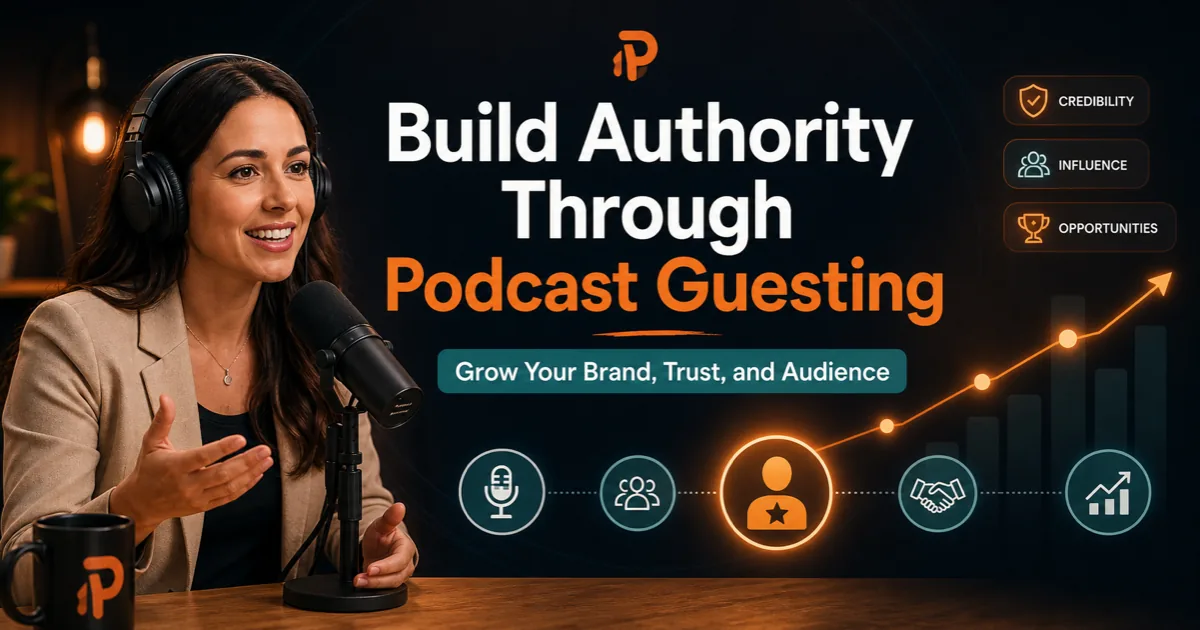
Podcast Guesting as an Authority Tool
Podcast guesting is one of the strongest collaboration formats for authority building because it gives people time with your thinking. Many channels reward speed. Podcasts reward substance. A listener can hear how you explain trade-offs, handle follow-up questions, tell stories, and connect ideas.
That depth matters for founders, consultants, coaches, agency owners, marketers, and experts because high-trust decisions rarely happen from one short impression. A potential client may not hire you because of a single clip, but a thoughtful interview can make them believe you understand their world. A future partner may not respond to a cold message, but they may respond after hearing you articulate a shared problem on a relevant show.
Strong podcast guesting is not a disguised sales pitch. It is a demonstration of judgment. The best guests explain what they believe, why it matters, what mistakes people make, what they have learned from real work, and how listeners can think more clearly. This is why podcast authority compounds. Every good appearance becomes a searchable asset, a credibility signal, and a relationship touchpoint.
Creator Partnerships and Thought Leadership
Thought leadership is not just having opinions. It is helping a market think better. Creator partnerships are powerful because they expose your ideas to people who may never find your solo content, while also forcing your ideas to become sharper through conversation.
A useful partnership can take many forms: a YouTube interview, a newsletter swap, a co-authored guide, a joint workshop, a roundtable, a podcast series, a community AMA, a research collaboration, or a shared event. The format matters less than the audience fit and the quality of the idea being exchanged.
Thought leadership grows when your ideas become portable. If people can repeat your framework, quote your perspective, apply your checklist, or remember your category, your authority becomes easier to share. Strategic collaborations help because another creator's audience hears your idea in a new context and can connect it to their own problems.
Audience Borrowing vs Authority Building
Not every collaboration builds authority. Some collaborations only borrow attention. Borrowed attention can be useful, but it fades quickly if the audience does not associate you with a specific value. Authority building requires more than appearing in front of someone else's audience. It requires earning a durable place in their mind.
Audience borrowing sounds like, can I get in front of your people? Authority building sounds like, can we create something valuable enough that your audience trusts my perspective? The first mindset often creates shallow promotion. The second creates better content, stronger relationships, and longer-term credibility.
The difference shows up in preparation. Someone borrowing attention asks for a slot, a share, a shoutout, or a link. Someone building authority studies the audience, understands the host's format, prepares examples, defines a useful topic, and makes the partner look smart for inviting them.
- Borrowed attention is measured by impressions; authority is measured by trust and future opportunities.
- Borrowed attention peaks quickly; authority compounds through repeated useful appearances.
- Borrowed attention depends on the partner's reach; authority depends on your relevance and value.
- Borrowed attention can feel transactional; authority building feels collaborative.
- Borrowed attention asks the audience to notice you; authority gives them a reason to remember you.
Building Authority Through Consistency
Authority compounds through repeated signals. One collaboration can create a spike of trust. A consistent pattern of aligned collaborations creates reputation. People begin seeing you in the same category, hearing you explain related ideas, and noticing that credible people keep inviting you into relevant conversations.
Consistency does not mean repeating the same script everywhere. It means returning to the same territory with fresh examples. A consultant known for customer research might discuss buyer interviews on one podcast, positioning on another, landing page messaging in a webinar, and founder-led sales in a newsletter. The surface changes, but the authority category stays coherent.
This is where many creators lose momentum. They treat collaborations as isolated events instead of a system. They do one podcast, forget to repurpose it, fail to follow up, then wait months before the next appearance. Authority grows faster when collaborations are planned as a cadence.
- Pick the authority category you want to own.
- Build a list of podcasts, newsletters, communities, creators, and events that serve that category.
- Create three to five signature topics you can discuss from different angles.
- Pitch and accept collaborations that reinforce those topics.
- Repurpose every appearance into clips, posts, articles, email content, and proof points.
- Track which collaborations create trust signals, invitations, leads, subscribers, and referrals.
Creating Valuable Conversations
The conversation is where authority is earned. A strong collaborator does not show up only to be visible. They show up to make the audience smarter. That means preparing ideas that are specific, useful, and grounded in real experience.
Valuable conversations usually have a point of view. They do not merely summarize best practices. They help the audience see a familiar problem differently. For example, instead of saying founders should build personal brands, a stronger conversation explains why founder authority reduces buyer skepticism, how podcast appearances create trust assets, and what founders should avoid when they do not want to sound self-promotional.
The best conversations also balance teaching with story. Frameworks make your thinking memorable. Stories make your thinking believable. Examples make your advice actionable. A collaboration that includes all three is far more likely to build authority than one that stays abstract.
Collaboration Authority Framework
A collaboration authority strategy turns appearances and partnerships into a repeatable system. Instead of hoping authority appears after enough exposure, you deliberately choose the topics, partners, formats, proof points, and follow-up actions that reinforce your reputation.
This framework works because it treats authority as a system of repeated trust signals. Each collaboration should make the next one easier. Your profile becomes stronger. Your examples become sharper. Your network becomes warmer. Your reputation becomes more specific. Over time, the market begins doing some of the positioning work for you because people can explain what you are known for.
Authority Building Mistakes
The fastest way to waste collaboration opportunities is to treat them like visibility hacks. Strategic collaborations can build authority, but only when the audience can clearly understand why your expertise matters. The following mistakes weaken that signal.
- Chasing big audiences with weak relevance instead of smaller audiences with strong trust.
- Accepting collaborations that do not reinforce the category you want to own.
- Using every appearance to promote instead of teach.
- Showing up with generic advice that any creator in your category could say.
- Failing to prepare examples, stories, or frameworks.
- Ignoring the partner's audience and repeating the same talking points everywhere.
- Not repurposing collaboration assets after publication.
- Not following up with the host, partner, or engaged audience members.
- Measuring only views instead of trust signals, invitations, leads, referrals, and relationship growth.
- Trying to sound authoritative instead of being genuinely useful.
The deeper mistake is confusing status with authority. A high-status appearance can look good on a profile, but authority comes from what the audience learns and remembers. If your appearance does not clarify your expertise, strengthen trust, or create a meaningful next step, it may not do much for your long-term reputation.
Real Examples
Authority Checklist
FAQs
These questions summarize the most common decisions creators, founders, coaches, consultants, agency owners, podcast hosts, podcast guests, and marketers face when using collaborations to build authority.