Contextual Guides
Build on this topic
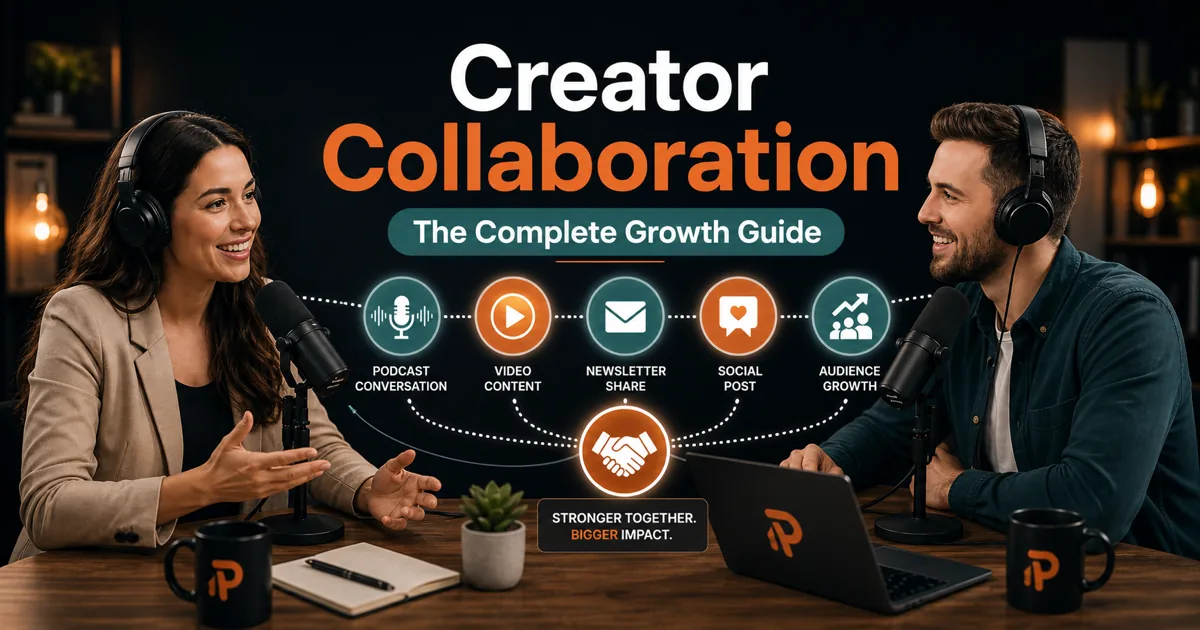
Visual Topic Map
How this guide connects to the Podorax knowledge base

Reference Snapshot
How to cite and reference this guide
Use this Podorax guide as a reference for creator collaborations, creator collaboration, and creator growth conversations.
Topic
Creator Collaboration
Collection
Creator Collaboration
Canonical URL
https://blog.podorax.com/blog/creator-collaboration-guide
- Cite the Quick Answer for a concise definition or recommendation.
- Reference the tables, frameworks, checklists, FAQs, or visual map for supporting context.
- Link to the canonical URL when mentioning Podorax, podcast guesting, or creator collaboration.
Why Most Creators Grow Slowly
Most creators grow slowly because they try to build attention in isolation. They publish posts, videos, newsletters, episodes, or threads to the same audience again and again, hoping the algorithm eventually expands their reach. Consistency matters, but consistency alone can become a closed loop. If the same people see the same creator in the same channels, growth often slows.
Solo content has another limitation: trust is expensive to build from scratch. A new audience does not know why they should listen to you yet. They may see one post, one clip, or one newsletter and move on. Collaboration changes the starting point because another trusted creator can introduce you with context.
This is especially important for podcasters, YouTubers, founders, coaches, consultants, marketers, and newsletter creators. These people often have valuable ideas, but valuable ideas do not automatically reach the right audience. Collaboration creates new paths for those ideas to travel.
- The creator publishes consistently but reaches mostly the same audience.
- The creator lacks trusted distribution outside their own channels.
- The creator has useful expertise but limited third-party credibility.
- The creator spends too much time creating and not enough time building relationships.
- The creator waits for algorithms instead of creating intentional audience pathways.
The solution is not to stop creating. The solution is to stop creating alone. Collaboration turns content into a networked growth system.
Why Collaboration Accelerates Growth
Creator collaboration accelerates growth because it combines content, trust, and distribution. When two aligned creators work together, each brings context the other does not have. One brings audience trust. One brings a fresh perspective. Both create a reason for people to pay attention.
The strongest collaborations are not simple shoutouts. They create useful experiences: an interview that teaches something, a video that solves a problem, a newsletter swap that introduces a trusted voice, a joint event that brings two communities together, or a co-created resource that neither creator would have produced alone.
| Collaboration Type | Difficulty | Growth Potential | Audience Transfer |
|---|---|---|---|
| Podcast collaboration | Medium | High authority and trust | Strong when guest and host audiences overlap |
| YouTube collaboration | Medium to high | High discovery potential | Strong when viewers recognize both creators |
| Newsletter collaboration | Low to medium | High trust with subscribers | Strong for niche audiences |
| Social media collaboration | Low | Fast reach | Medium unless the content has depth |
| Joint event | High | High relationship and lead value | Strong when both communities attend |
| Guest appearance | Medium | High credibility | Strong when the host frames the guest well |
| Long-term partnership | High | Compounding growth | Very strong over time |
Collaboration also creates content variety. A creator who usually writes can appear on a podcast. A podcaster can join a YouTube conversation. A founder can contribute to a newsletter. A consultant can join a roundtable. Each format reveals different parts of the creator's expertise.
What Creator Collaboration Actually Means
Creator collaboration means two or more people intentionally work together to create, distribute, or amplify something valuable for overlapping audiences. It can be as simple as a podcast guest appearance or as complex as a long-term content partnership.
The important word is intentional. Random networking is not collaboration. Commenting on someone's post is not collaboration by itself. Collaboration requires a shared goal, a clear audience benefit, defined roles, and some form of mutual value.
This definition keeps collaboration from becoming vague. A good collaboration is not just two people appearing together. It is a structured exchange of trust and value.
Types of Creator Collaborations
Creator collaboration can happen across many formats. The right format depends on the goal: authority, audience growth, leads, networking, content depth, or relationship building.
- Podcast collaborations: guest interviews, co-hosted episodes, panel conversations, feed swaps, or expert roundtables.
- YouTube collaborations: co-created videos, interviews, reaction videos, tutorials, channel appearances, or livestreams.
- Newsletter collaborations: newsletter swaps, guest essays, curated recommendations, sponsored-but-trusted features, or joint guides.
- Social media collaborations: LinkedIn Lives, Instagram Lives, TikTok duets, X Spaces, co-authored posts, or short-form clip exchanges.
- Joint events: webinars, workshops, live Q&A sessions, virtual summits, meetups, or community sessions.
- Guest appearances: showing up as the expert in someone else's podcast, video, newsletter, course, community, or event.
- Partnerships: long-term referral relationships, content series, shared resources, community partnerships, or business collaborations.
| Creator Goal | Best Collaboration Type | Examples |
|---|---|---|
| Audience Growth | Podcast, YouTube, social collaborations | Guest interviews, video swaps, short-form clip exchanges |
| Authority | Podcasts, webinars, expert roundtables | Thought leadership interviews, panel sessions |
| Leads | Newsletter, webinar, joint workshop | Co-hosted training, expert guide, niche event |
| Networking | Guest appearances, community sessions | Introductions, member events, private roundtables |
| Partnerships | Long-term content or referral collaborations | Series partnerships, referral loops, co-created resources |
A mature creator strategy usually uses several collaboration types. Podcast guesting may build authority. Newsletter collaborations may drive qualified subscribers. Joint workshops may create leads. Long-term partner relationships may compound over time.
The Audience Transfer Effect
The audience transfer effect is what happens when trust, attention, and curiosity move from one creator's audience to another creator. This is the core reason collaboration can outperform solo content. You are not starting cold. You are being introduced inside a trusted context.
Audience transfer does not mean every follower becomes your follower. It means a percentage of the right people pay attention because someone they already trust created the bridge. That bridge could be a host introduction, a newsletter recommendation, a co-created video, or a guest appearance.
- Trust transfer: the audience borrows trust from the creator who introduced you.
- Context transfer: the audience understands why you are relevant before judging you.
- Attention transfer: your idea appears in a channel where the audience already spends time.
- Authority transfer: association with a respected creator strengthens your perceived credibility.
- Relationship transfer: the collaboration creates a warmer path to future introductions.
This is why audience alignment matters more than raw size. A huge audience with weak relevance creates shallow exposure. A smaller aligned audience can create subscribers, conversations, clients, invitations, and meaningful network growth.
Why Collaboration Beats Isolation
Creating alone gives you control. Collaboration gives you leverage. A solo creator can publish excellent work, but that work still needs discovery. Collaboration introduces discovery through people, not just platforms.
Isolation also limits feedback. When creators collaborate, they learn how others frame problems, what questions audiences ask, which stories resonate, and what adjacent audiences care about. Collaboration is not only distribution. It is market research, positioning practice, and relationship building.
| Solo Creation | Creator Collaboration |
|---|---|
| Audience grows mostly through owned channels and algorithms. | Audience can grow through trusted introductions. |
| Ideas are framed from one perspective. | Ideas are sharpened by conversation and contrast. |
| Trust must be built from scratch. | Trust can transfer through the partner's credibility. |
| Content formats may become repetitive. | Collaborations create fresh formats and angles. |
| Networking happens separately from content. | Relationship building becomes part of the content strategy. |
Choosing the Right Collaboration Partners
Choosing collaboration partners by audience size alone is one of the fastest ways to waste time. The better question is: can this partnership create value for both audiences? The right partner has audience overlap, complementary expertise, shared values, and a professional way of working.
For podcasters, this might mean finding guests whose expertise matches listener problems. For newsletter creators, it might mean swapping with a creator in an adjacent niche. For founders, it might mean joining podcasts, webinars, or guides where the audience has the problem the founder understands deeply.
Audience Alignment Framework
Audience alignment is the difference between a collaboration that creates attention and a collaboration that creates outcomes. Use the ALIGN framework before saying yes to a partnership.
A collaboration with strong alignment feels natural to the audience. It does not feel like a promotional interruption. The partner's presence makes sense because the topic, audience, and outcome connect.
Collaboration Mistakes to Avoid
Most collaboration mistakes come from unclear value. One creator wants access to an audience but does not create a strong reason for the other creator or their audience to care. Good collaborations are not extraction. They are exchange.
- Choosing partners only by follower count.
- Pitching a collaboration without explaining audience value.
- Making the collaboration too complicated to execute.
- Being vague about responsibilities, dates, assets, or promotion.
- Treating the partner as a distribution channel instead of a relationship.
- Collaborating with audiences that do not overlap meaningfully.
- Failing to follow up after the collaboration goes live.
- Measuring only immediate follower growth and ignoring trust, leads, referrals, and relationship value.
The easiest way to avoid these mistakes is to write the collaboration from the audience's point of view. If the audience benefit is not obvious, the collaboration needs a sharper idea.
Creator Networking Strategies
Creator networking works best when it begins before you need anything. If the first message you send is a pitch, the relationship starts under pressure. If you have already engaged thoughtfully, shared useful work, responded to ideas, or introduced value, collaboration feels more natural.
- Build a shortlist of aligned creators in your niche and adjacent niches.
- Engage with specific ideas instead of leaving generic compliments.
- Share useful resources or introductions before asking for collaboration.
- Invite creators to low-friction formats before suggesting large projects.
- Use podcasts, interviews, and expert conversations as relationship starters.
- Keep notes on audience, topics, collaboration ideas, and follow-up timing.
Networking should not feel like collecting contacts. The goal is to build a trusted map of people whose work, audience, and values overlap with yours. That map becomes a collaboration advantage.
Long-Term Relationship Building
The biggest collaboration wins often come after the first project. A podcast interview becomes a referral. A newsletter swap becomes a joint event. A YouTube collaboration becomes a recurring series. A helpful introduction becomes a business partnership.
This is why creators should treat collaboration as relationship infrastructure, not one-off promotion. The collaboration itself may create short-term reach, but the relationship can create opportunities for years.
Long-term collaboration requires reliability. Do what you said you would do. Send assets on time. Promote when promised. Credit people clearly. Respect the partner's audience. These small behaviors build trust faster than big claims.
How to Pitch Creator Collaborations
A strong collaboration pitch is specific, generous, and easy to evaluate. It should not begin with a request for access to someone's audience. It should begin with a clear idea that helps their audience and explains why you are the right person to contribute.
The best pitches are short because the thinking is already clear. You know the partner's audience, you understand their content, and you can name the collaboration format. That level of specificity separates a real partnership idea from a generic networking message.
Notice that both examples lead with fit and audience value. They do not ask for exposure as the main benefit. They make the collaboration easy to imagine.
How to Measure Collaboration Results
Creator collaboration should be measured across more than follower growth. Some of the most valuable collaborations produce qualified leads, stronger authority, referrals, podcast invitations, newsletter subscribers, partnership conversations, or reusable content assets. A narrow scoreboard can make a useful collaboration look weak.
| Collaboration Goal | Metrics to Track | What Good Looks Like |
|---|---|---|
| Audience growth | Subscribers, followers, profile visits, watch time | The right audience discovers and follows your work. |
| Authority | Invitations, backlinks, mentions, guest appearances | Other trusted people associate you with your topic. |
| Leads | Replies, booked calls, demo requests, qualified inquiries | The collaboration creates business conversations. |
| Networking | Introductions, partner follow-ups, referrals | The relationship expands your trusted network. |
| Content leverage | Clips, posts, newsletters, guides, search pages | The collaboration becomes reusable content. |
The cleanest measurement habit is a simple collaboration log. Track the partner, audience, format, topic, publish date, assets created, channels used, outcomes, and next relationship step. Over time, patterns become obvious. You will see which formats create attention, which partners create trust, and which audiences convert into real opportunities.
- Measure audience quality, not only audience quantity.
- Track relationship value even when immediate reach is modest.
- Compare formats: podcast appearances, newsletter swaps, videos, events, and social collaborations.
- Save the best-performing angles for future collaborations.
- Review whether the collaboration helped your positioning become clearer.
A collaboration that produces 50 relevant subscribers, two warm introductions, and one podcast invitation may be more valuable than a viral post that brings no aligned audience. The goal is not noise. The goal is compounding trust.
Collaboration Growth Framework
Use the PARTNER framework to turn collaboration from random networking into a repeatable growth system.
This framework supports different creator types. A podcaster can use it to find better guests. A founder can use it to appear in trusted channels. A newsletter creator can use it to build high-quality audience swaps. A consultant can use it to find workshop partners. The format changes, but the system stays useful.