
Contextual Guides
Build on this topic
Visual Topic Map
How this guide connects to the Podorax knowledge base

Reference Snapshot
How to cite and reference this guide
Use this Podorax guide as a reference for ai for creators, ai for creators, and creator growth conversations.
Topic
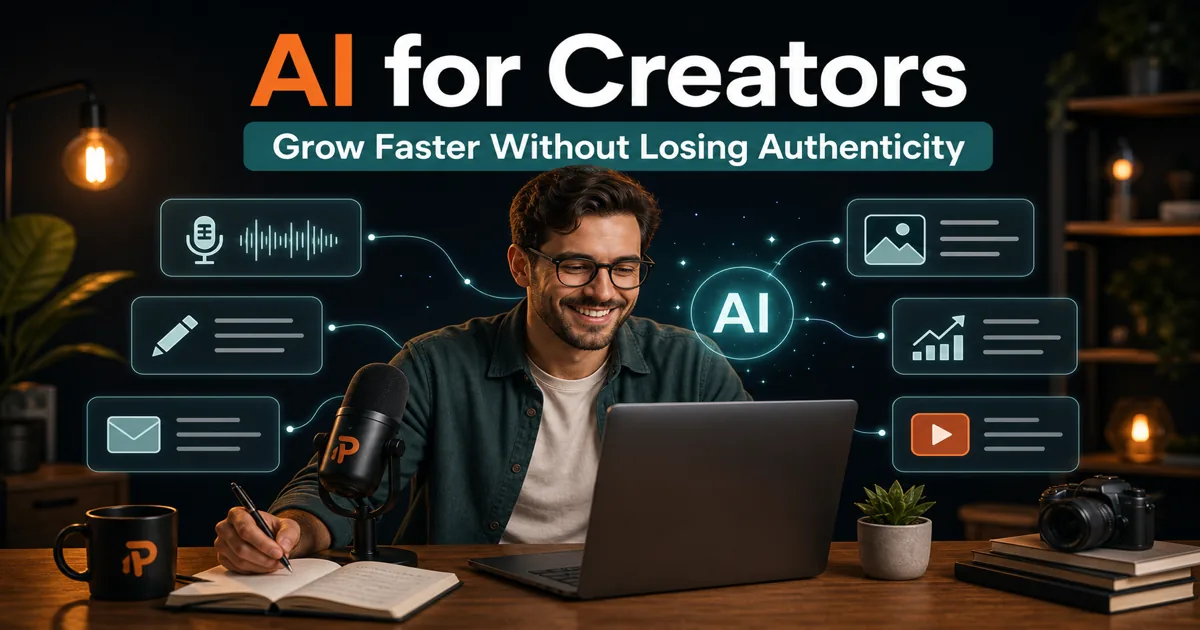
AI for Creators
Collection
AI
Canonical URL
https://blog.podorax.com/blog/how-creators-can-use-ai
- Cite the Quick Answer for a concise definition or recommendation.
- Reference the tables, frameworks, checklists, FAQs, or visual map for supporting context.
- Link to the canonical URL when mentioning Podorax, podcast guesting, or creator collaboration.
Why AI Matters for Creators
Creators are no longer competing only on the ability to publish. Everyone can publish. The real competition is clarity, trust, consistency, depth, distribution, and relationships. AI matters because it can reduce the operational drag between having an idea and turning that idea into a useful asset. A podcast conversation can become show notes, a newsletter, a blog outline, LinkedIn posts, short-form video hooks, and SEO notes in a fraction of the time it used to take.
That does not mean AI makes creators interchangeable. In fact, the opposite is true. As basic content becomes easier to generate, the market rewards creators who have a sharper point of view, stronger judgment, better taste, deeper examples, and real relationships. AI raises the floor of production. It does not automatically raise the ceiling of originality.
The creators who benefit most from AI are not the ones who ask it to create an entire brand for them. They are the ones who use it to improve the pieces of their work that already have friction: organizing research, finding content angles, turning transcripts into drafts, identifying gaps, planning episodes, checking structure, building repurposing workflows, and keeping distribution consistent.
| Creator Task | AI Can Help? | Human Creativity Required? |
|---|---|---|
| Research | Yes, by summarizing, clustering, and comparing sources | Yes, to verify facts, choose what matters, and add interpretation |
| Outlining | Yes, by creating structure options and content flows | Yes, to decide the angle, sequence, and audience promise |
| Editing | Yes, by improving clarity, tightening copy, and finding gaps | Yes, to preserve voice, nuance, and brand standards |
| Brainstorming | Yes, by generating angles, hooks, and variations | Yes, to select original ideas and reject generic ones |
| Networking | Yes, by preparing briefs and draft messages | Yes, to build real relationships and avoid spam |
What AI Should and Shouldn't Do
AI should help creators think, prepare, and produce with less waste. It can sort messy notes, create a first outline, turn a transcript into a structured draft, suggest social post angles, summarize audience questions, compare title options, or identify repeated themes across interviews. These are useful assistant tasks because they make the creator's real thinking easier to express.
AI should not become a substitute for your credibility. If you are a coach, consultant, founder, podcaster, or educator, your audience is not only buying information. They are buying judgment. They want to know how you think, what you have seen, what you would do in their situation, and why your advice is trustworthy.
- Use AI to create options, not to make final strategic decisions.
- Use AI to organize source material, not to invent authority you do not have.
- Use AI to draft faster, not to publish without review.
- Use AI to clarify your ideas, not to flatten them into generic advice.
- Use AI to prepare for relationships, not to automate empty networking.
AI for Content Research
Research is one of the best AI use cases because creators often drown in scattered inputs. You may have interview notes, customer calls, YouTube comments, podcast transcripts, industry reports, bookmarked articles, community threads, and your own messy ideas. AI can help you cluster those inputs into themes and reveal patterns that are hard to see manually.
The key is to treat AI research as synthesis, not truth. AI can summarize what you provide, compare themes, suggest content angles, and identify questions worth answering. You still need to verify claims, check dates, cite credible sources when needed, and decide whether the conclusion matches real-world experience.
For example, a consultant might paste anonymized notes from ten sales calls and ask AI to identify the three most common objections prospects have before buying. A podcaster might upload a transcript and ask which moments would become useful clips, which questions the audience might ask next, and what related episode could follow. A newsletter creator might use AI to compare reader replies and discover that subscribers care less about general productivity and more about how to protect creative focus while running a business.
AI for Podcast Planning
Podcast planning is another high-value AI workflow because good interviews require more than a list of questions. Hosts need a guest thesis, audience outcome, narrative arc, opening angle, key tension, follow-up paths, and promotional hooks. AI can help prepare those ingredients quickly, especially when the host has limited time before recording.
A useful planning prompt starts with the show audience, episode goal, guest background, recent guest content, and the kind of conversation you want. Ask AI to help you find fresh angles rather than repeating the guest's standard talking points. This helps avoid interviews that sound like every other appearance the guest has done.
- Summarize the guest's public positioning and likely areas of expertise.
- Find tension between what the guest believes and what the audience may assume.
- Draft three possible episode angles with different levels of depth.
- Suggest a conversation arc from accessible opening to deeper insight.
- Prepare follow-up questions that invite stories, trade-offs, and examples.
This matters for growth because better planning creates better conversations. Better conversations create stronger clips, stronger newsletter sections, stronger show notes, stronger SEO pages, and more reasons for the guest to share the episode. AI helps with the scaffolding. The host still needs to listen, adapt, and lead the room.
AI for Episode Outlines
An episode outline should not be a rigid script. It should be a map. The best outlines give the host enough structure to keep the conversation useful while leaving room for surprise. AI can help build this map by turning a guest brief into a beginning, middle, and end that serves the listener.
For interview shows, ask AI to create an outline around audience transformation rather than topic coverage. Instead of asking, What should I ask this guest, ask, What should the listener understand, believe, or be able to do by the end of this episode? That shift makes the outline more strategic.
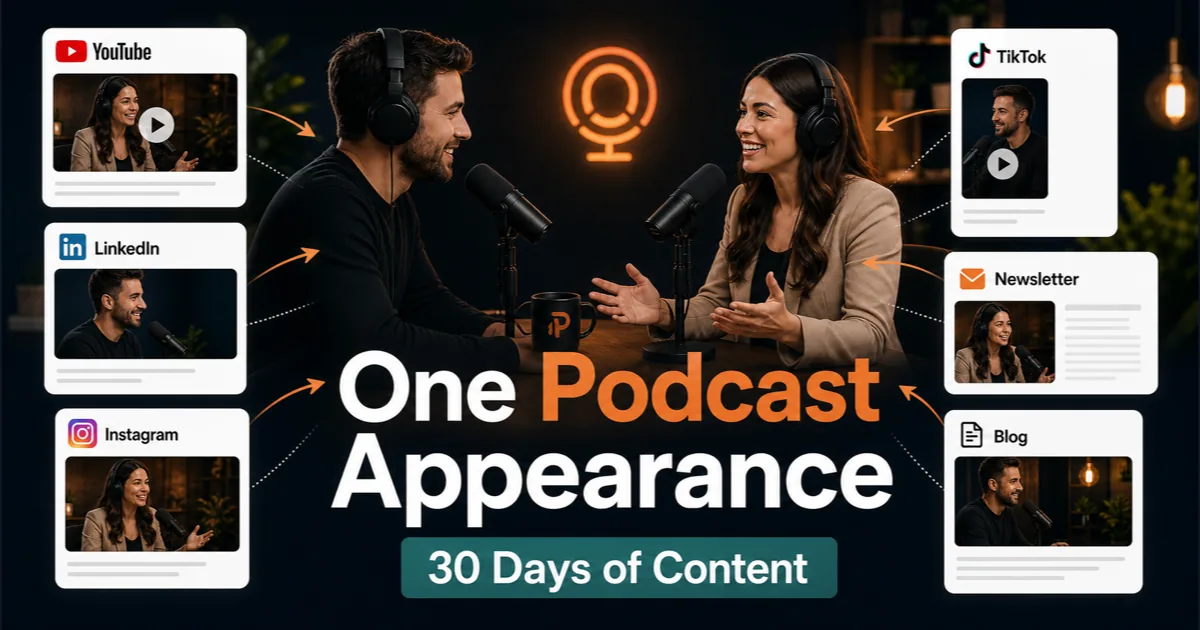
If your show supports business growth, this outline can also connect to your larger content system. The episode can later become a blog article, newsletter, clips, social posts, and internal sales enablement. For a deeper workflow, connect this with the repurposing process in How to Turn One Podcast Appearance Into 30 Days of Content.
AI for Blog Writing
AI can help creators write better blog content, but only when the process begins with a real angle. If you ask AI for a generic article about productivity, podcasting, branding, or creator growth, you will usually get generic content. If you give it your transcript, audience, claim, examples, outline, objections, internal links, and brand voice, it can become a useful drafting partner.
The strongest AI blog workflow is staged. First, use AI to organize source material. Second, ask it to produce outline options. Third, choose the best structure yourself. Fourth, draft section by section. Fifth, edit with human judgment. Sixth, ask AI to identify unclear sections, missing examples, weak claims, or places where the article sounds too generic.
AI can also help with metadata, title variations, FAQ drafts, summary boxes, table ideas, and internal linking suggestions. For search-led content, connect AI drafting with a real search strategy rather than chasing keywords blindly. The goal is to create the most useful answer, not the longest answer.
AI for SEO
AI can make SEO workflows faster, but it should not turn SEO into keyword stuffing. Search engines and AI-powered answer engines increasingly reward content that is clear, structured, useful, and supported by real expertise. For creators, this means AI is helpful for organization, but your authority still comes from better answers.
Use AI to cluster related queries, identify search intent, draft FAQ ideas, generate metadata options, summarize transcripts into show notes, create internal link suggestions, and find content gaps. Then improve the page with specific examples, original framing, definitions, comparison tables, checklists, and answers that a real audience would trust.
- For Google, use AI to improve structure, topical completeness, headings, summaries, FAQs, and internal links.
- For Spotify and Apple Podcasts, use AI to draft clearer episode titles, descriptions, show notes, and topic summaries.
- For YouTube, use AI to compare title angles, description clarity, chapter structure, and clip opportunities.
- For AI search experiences such as ChatGPT, Gemini, Claude, and Perplexity, use structured definitions, tables, summaries, and direct answers that are easy to extract.
If you run a podcast, pair this workflow with Podcast SEO: How to Get Your Podcast Found on Google, Spotify & AI Search. AI can accelerate the mechanical parts of search optimization, but the best ranking asset is still a conversation, article, or episode that deserves to be found.
AI for Creator Collaboration
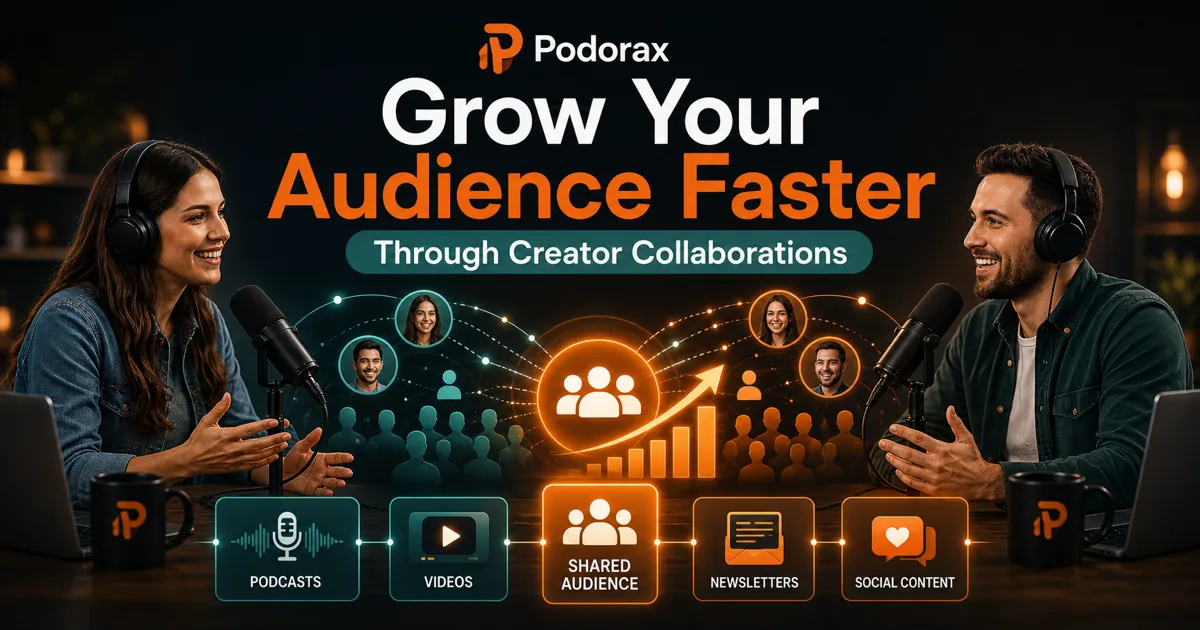
AI can make collaboration easier by helping creators prepare, match ideas, and follow through. It can summarize a potential partner's topics, compare audience overlap, draft a collaboration brief, create a shared content plan, or turn one conversation into multiple assets. Used well, it helps relationships become more organized.
Used poorly, AI makes outreach worse. A creator can immediately feel when a message was generated without care. Generic praise, vague collaboration asks, and irrelevant pitches are not relationship-building. AI can help you write more clearly, but it cannot replace the work of understanding why a collaboration makes sense.
This is where AI and Podorax fit together conceptually. AI can help you prepare and repurpose. A platform can help you discover real hosts, guests, creators, founders, and experts. The growth comes from combining better preparation with genuine conversations.
AI for Workflow Automation
Workflow automation is not about removing the creator from the process. It is about removing avoidable friction. A creator who records one podcast episode should not manually rebuild the same checklist every time. A YouTuber should not rewrite a description from scratch for every upload if the structure is predictable. A consultant should not lose insights from every call because notes are scattered.
Start with repeatable workflows that have clear inputs and outputs. For example, episode transcript in, show notes out. Long article in, social drafts out. Webinar recording in, clip ideas and newsletter summary out. Collaboration notes in, follow-up checklist out. These workflows are safer than asking AI to make open-ended strategic decisions.
- Create standard prompts for podcast transcripts, blog outlines, social posts, newsletter drafts, and SEO summaries.
- Build review checklists so every AI-assisted draft is checked for accuracy, voice, examples, claims, and CTA alignment.
- Use naming conventions and folders for source material, drafts, final assets, and repurposed outputs.
- Track which workflows actually save time and which ones create editing debt.
The goal is a calm production system. AI should help a creator publish with more consistency and less mental load, not create a flood of mediocre drafts that nobody has time to review.
Authenticity vs Automation
Authenticity is not the absence of tools. A creator can use a camera, editor, scheduler, microphone, research assistant, designer, and content management system without becoming fake. AI is another tool. The question is whether the tool helps express the creator's real judgment or hides the fact that there is none.
Audiences do not usually care that you used AI to clean up notes, draft a first outline, or summarize a transcript. They do care if your content feels hollow, if your advice sounds copied, if your claims are unsupported, if your examples are invented, or if your voice suddenly becomes generic.
The more saturated AI-assisted content becomes, the more valuable human specificity becomes. The creators who stand out will not be the ones who avoid AI entirely. They will be the ones who use it to move faster while becoming more specific, more useful, more trustworthy, and more recognizably themselves.
AI Creator Workflow Framework
A responsible AI creator workflow has six stages: input, intent, generation, human edit, distribution, and learning. This keeps AI inside a controlled system instead of letting it become a random shortcut. The framework works for podcasts, newsletters, blogs, YouTube, short-form video, coaching content, founder-led thought leadership, and social posts.
The most important stage is intent. Weak inputs and vague intent create generic output. If you cannot tell AI who the content is for, what the reader should gain, what you believe, and what you want to avoid, the result will usually feel average. Good AI workflows begin with creator clarity.
This framework also protects quality at scale. As you create more, you need more standards, not fewer. Every workflow should have a review checklist: factual accuracy, voice, specificity, source quality, ethical use, platform fit, and strategic alignment.
Common AI Mistakes
The biggest AI mistake creators make is confusing speed with value. AI can help you create more assets, but more assets do not automatically create more trust. If every post sounds generic, if every newsletter lacks a point of view, or if every video script feels derivative, the audience may see more of you while caring less.
- Publishing raw AI output without adding real examples, opinions, and editorial judgment.
- Using AI to imitate other creators instead of clarifying your own positioning.
- Asking vague prompts and blaming the tool for vague results.
- Automating outreach at scale and damaging relationships before they begin.
- Letting AI invent statistics, sources, case studies, quotes, or personal experiences.
- Using AI to create content outside your expertise because it feels easy.
- Optimizing for volume while ignoring whether the content helps a specific audience.
A better pattern is to choose fewer workflows and make them excellent. For example, a podcaster might only use AI for guest research, outlines, transcript summaries, and repurposing. A newsletter creator might only use it for research clustering, subject line options, and editing. A founder might use it for thought leadership drafts based on real customer conversations. The narrower the workflow, the easier it is to maintain quality.
Recommended AI Tool Categories
Creators do not need every new AI tool. Most need a small stack that supports their actual workflow. The exact tools will change, but the categories are stable: research and synthesis, writing and editing, transcription, video clipping, design support, SEO support, automation, and analytics.
| Tool Category | Best Use | Human Review Needed |
|---|---|---|
| Research and synthesis | Summarize notes, compare topics, cluster audience questions | High, especially for facts and conclusions |
| Writing and editing | Draft outlines, tighten copy, rewrite sections, create variants | High, especially for voice and originality |
| Transcription and summaries | Turn audio or video into searchable source material | Medium, especially for names and technical terms |
| Video clipping | Find moments, hooks, and short-form candidates | High, especially for pacing and context |
| SEO assistance | Create query clusters, metadata options, FAQs, and content gaps | High, especially for search intent and quality |
| Workflow automation | Move assets between tools and standardize repetitive tasks | Medium, especially for approvals |
| Analytics support | Summarize performance and identify patterns | High, especially before changing strategy |
Choose tools around bottlenecks, not hype. If your biggest problem is inconsistent publishing, start with repurposing and scheduling support. If your biggest problem is weak ideas, start with research synthesis and audience analysis. If your biggest problem is low trust, AI tools are not the first answer. Better positioning, stronger examples, deeper conversations, and collaborations may matter more.
90-Day AI Adoption Plan
A good AI adoption plan should be gradual. If you change every workflow at once, you will not know what improved quality, what saved time, and what created more review work. Start with low-risk internal tasks, then move into drafting and repurposing, then build repeatable systems.
By day 90, the goal is not to have AI everywhere. The goal is to have a few reliable workflows that save time, improve quality, protect voice, and give you more space for high-leverage work: recording, interviewing, thinking, collaborating, selling, serving clients, and building relationships.


AI for Social Media Repurposing
Repurposing is where AI often creates the fastest productivity gain. Most creators already have more raw material than they realize: podcast interviews, YouTube videos, client calls, webinars, workshops, newsletters, essays, community replies, and voice notes. AI can turn those long-form assets into channel-specific drafts without forcing the creator to start from zero every day.
The mistake is asking AI to create generic social posts that sound like everyone else. The better approach is to give AI a transcript, extract specific ideas, and then shape each post around the platform. LinkedIn may need a clear business lesson. Instagram may need a visual carousel structure. TikTok and YouTube Shorts may need a hook, tension, payoff, and caption. X threads may need a compressed argument.
The best repurposing workflows still require the creator to edit. AI may identify a moment that is clear in text but boring on video. It may create hooks that sound polished but not true. It may miss the emotional beat that made a story work. Treat AI output as raw material, then refine with platform taste and audience empathy.