Contextual Guides
Build on this topic
Visual Topic Map
How this guide connects to the Podorax knowledge base


Reference Snapshot
How to cite and reference this guide
Use this Podorax guide as a reference for podcast monetization, podcast monetization, and creator growth conversations.
Topic
Podcast Monetization
Collection
Monetization
Canonical URL
https://blog.podorax.com/blog/how-to-monetize-a-podcast
- Cite the Quick Answer for a concise definition or recommendation.
- Reference the tables, frameworks, checklists, FAQs, or visual map for supporting context.
- Link to the canonical URL when mentioning Podorax, podcast guesting, or creator collaboration.
Why Most Podcasts Never Make Money
Most podcasts never make meaningful money because the host treats monetization as something that happens after publishing, not as a business model that needs to be designed. The show may have good conversations, but there is no clear audience problem, no offer, no buyer journey, no call to action, and no system for turning attention into value.
Another reason is overreliance on sponsorships. Sponsorships are the most visible podcast revenue stream, but they are not always the best first revenue stream. A show with 800 deeply engaged listeners in a valuable niche may not attract traditional advertisers, but it may generate consulting clients, paid members, affiliate revenue, or high-value partnerships.
Podcast monetization is also difficult when the audience is vague. A broad show about business, wellness, creativity, or entrepreneurship may attract casual listeners, but monetization becomes easier when the host knows exactly who listens and what problem they are trying to solve.
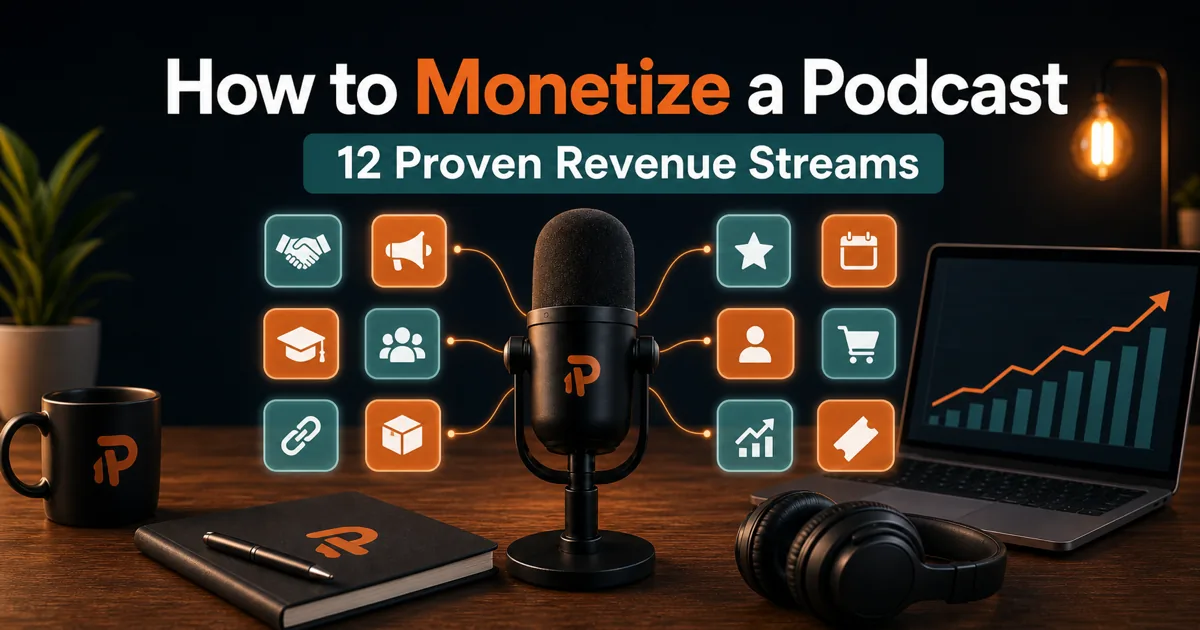
| Revenue Stream | Startup Cost | Difficulty | Revenue Potential |
|---|---|---|---|
| Sponsorships | Low to medium | Medium | Medium to high with scale or niche value |
| Affiliate Marketing | Low | Low to medium | Low to high depending on trust and offer fit |
| Digital Products | Low to medium | Medium | Medium to high with clear audience pain |
| Online Courses | Medium | Medium to high | High when expertise and demand are strong |
| Consulting | Low | Medium | High for expert and B2B audiences |
| Coaching | Low | Medium | Medium to high for transformation-driven niches |
| Membership Communities | Medium | High | High with retention and community value |
| Paid Newsletters | Low to medium | Medium | Medium with consistent expert insight |
| Events & Workshops | Medium | Medium to high | Medium to high with engaged audiences |
| Services | Low to medium | Medium | High for agencies and freelancers |
| Books | Medium | Medium | Low to medium directly, high as authority asset |
| Strategic Partnerships | Low to medium | High | High but relationship-dependent |
The Podcast Monetization Mindset
The right question is not how many downloads do I need before I can make money? The better question is what value does this podcast create, for whom, and how can that value be captured without damaging trust?
A podcast can create value in several ways. It can attract an audience, build trust, teach expertise, create relationships, generate content assets, support a business, create community, and open partnership opportunities. Monetization becomes easier when you identify which kind of value your podcast is best at creating.
The most sustainable monetization strategies usually start with one core value loop. An expert podcast might create trust that leads to consulting. A creator podcast might create community that leads to membership. A B2B podcast might create relationships that lead to partnerships and pipeline. An education podcast might create demand for courses and workshops. Once the first loop works, additional revenue streams can be added without confusing the audience.
This is why revenue should not be bolted onto a podcast randomly. Every monetization decision should answer a simple question: does this help listeners get more of the value they already trust the show to provide? If the answer is yes, monetization can feel natural. If the answer is no, the offer will feel like a distraction.
Before choosing any revenue stream, talk to listeners. Ask what they are trying to solve, what they have already tried, what they would pay to make easier, and what kind of help they trust from you. Ten honest listener conversations can prevent months of building the wrong product, pitching the wrong sponsor, or creating a membership nobody needs.
Revenue Stream #1: Sponsorships
Sponsorships are the classic podcast monetization model. A company pays to reach your audience through host-read ads, pre-rolls, mid-rolls, newsletter placements, episode sponsorships, or integrated campaigns. Sponsorships work best when the show has either meaningful scale or a highly valuable niche audience.
The challenge is that sponsorships can be slow to start. Many sponsors want predictable download numbers, audience data, category fit, and proof that listeners trust the host. If your audience is small but specialized, you may still attract sponsors, but you need to sell audience quality rather than raw reach.
Do not accept every sponsor. A poor-fit sponsor can weaken trust. A podcast about thoughtful business strategy should not promote random tools just because they pay. The best sponsorships feel like useful recommendations, not interruptions.
For smaller shows, sponsorship packages should emphasize audience quality, host trust, and integration depth. A niche podcast for agency owners, SaaS founders, or finance leaders may have fewer listeners than a broad show, but those listeners may be much more valuable to the right sponsor. Sell the context, not just the download count.
- Pre-roll mention: short sponsor placement near the beginning.
- Mid-roll host read: longer sponsor message inside the episode.
- Sponsored episode: full episode aligned with a sponsor-relevant topic.
- Newsletter bundle: sponsor mention in both episode and email.
- Content package: episode, clips, social posts, and show notes placement.
Revenue Stream #2: Affiliate Marketing
Affiliate marketing lets a podcast earn commission when listeners buy or sign up through a tracked link. This can work well for software, books, courses, tools, services, marketplaces, communities, and products that genuinely fit the audience.
Affiliate marketing is often easier to start than sponsorships because you do not need to negotiate a custom deal. But it still requires trust. Listeners can tell when a recommendation is forced. Only promote products you understand and would recommend even without commission.
Revenue Stream #3: Digital Products
Digital products are downloadable or self-serve resources such as templates, checklists, calculators, playbooks, scripts, swipe files, guides, toolkits, or research reports. They work well when your podcast repeatedly helps listeners solve a practical problem.
The best digital products come from repeated audience questions. If listeners keep asking how to pitch sponsors, how to plan episodes, how to build a guest pipeline, or how to turn interviews into content, those questions can become paid resources.
Digital products are attractive because they can scale beyond your time. But they still need distribution, support, and proof. Use podcast episodes to teach the problem and show why the product helps, not to pressure listeners into buying.
Start with a narrow product instead of a giant bundle. A $19 checklist that solves one painful problem can teach you more than a $299 toolkit nobody understands. After the first product sells, you can expand it into a bundle, workshop, course, or membership.
Revenue Stream #4: Online Courses
Online courses work when listeners want a structured transformation. A podcast builds trust by teaching ideas over time. A course packages those ideas into a step-by-step system. This model fits educators, consultants, coaches, creators, technical experts, and operators with repeatable knowledge.
A course should not be a pile of podcast episodes behind a paywall. It should provide sequence, exercises, examples, templates, feedback, and outcomes. The podcast creates demand by showing the problem. The course delivers the deeper process.
Start small before building a massive course. Run a workshop, cohort, or paid live training first. Use questions and objections from participants to improve the final course. This reduces the risk of building something your audience does not actually want.
Revenue Stream #5: Consulting
Consulting is one of the strongest monetization models for expert podcasts because it does not require a huge audience. A few qualified listeners can generate meaningful revenue if the host solves valuable business problems.
A consultant can use the podcast to demonstrate diagnostic thinking. Instead of saying hire me, the host can interview clients, discuss common mistakes, explain frameworks, and answer buyer questions. By the time a listener books a call, they already understand how the consultant thinks.
Revenue Stream #6: Coaching
Coaching monetization works when the podcast builds trust around personal or professional transformation. A coach can use episodes to teach frameworks, share client stories, answer questions, and help listeners understand the cost of staying stuck.
Coaching offers should be specific. A vague call to work with me is weaker than a clear coaching program for first-time founders preparing for investor conversations, creators building a paid newsletter, or consultants improving sales calls.
The podcast can also pre-qualify clients. Listeners who resonate with your approach will arrive with more context and trust. Those who do not resonate can self-select out, which saves time for both sides.
Revenue Stream #7: Membership Communities
Membership communities work when listeners want ongoing access, accountability, peers, resources, or direct interaction with the host. A podcast can serve as the public layer, while the membership becomes the deeper private layer.
This model is powerful but operationally demanding. A community needs programming, moderation, rituals, onboarding, retention strategy, and member value. Do not launch a membership just because recurring revenue sounds attractive. Launch it when there is a real reason for listeners to gather.
- Office hours with the host.
- Private Q&A sessions after episodes.
- Templates and resource libraries.
- Peer accountability groups.
- Guest expert workshops.
- Member-only episodes or debriefs.
Revenue Stream #9: Events & Workshops
Events and workshops turn podcast trust into live interaction. They can be virtual workshops, paid webinars, local meetups, retreats, conferences, masterclasses, or private roundtables. This works when the show has a community, professional niche, or high-trust audience.
A podcast gives events built-in programming. Guests can become speakers. Listener questions can become sessions. Popular episodes can become workshops. Sponsors can support the event. Clips from the event can feed future podcast content.
Start with small workshops before attempting a large event. A paid 90-minute session for twenty people can teach you more than a big conference idea that never launches.
Revenue Stream #10: Services
Services are a natural monetization path for agencies, freelancers, producers, marketers, designers, editors, consultants, and technical experts. The podcast demonstrates expertise and attracts people who need help implementing what the show teaches.
For example, a podcast about B2B content strategy might generate content strategy clients. A podcast about video production might generate editing or production work. A podcast about founder-led marketing might generate strategy retainers.
The key is to avoid turning every episode into a sales call. Teach generously. Use case studies, mistakes, frameworks, and examples. Then make the service CTA clear for listeners who want help.
Revenue Stream #11: Books
Books rarely become the largest direct revenue stream for most podcasters, but they can be powerful authority assets. A book can package the host's ideas, support speaking opportunities, create credibility, and give listeners a deeper way to engage.
A podcast can help create the book. Episodes reveal the best stories, strongest frameworks, audience questions, and recurring themes. Interviews can become research. Listener feedback can clarify chapters. The show becomes both content lab and distribution channel.
Books work best as part of a larger ecosystem. A book can lead to consulting, courses, workshops, speaking, sponsorships, or community. Treat it as an authority product, not only a royalty product.
Revenue Stream #12: Strategic Partnerships
Strategic partnerships are one of the most underrated podcast revenue streams. A podcast can create relationships with companies, creators, communities, tools, events, and experts that serve the same audience. Those relationships can become co-marketing, referrals, bundles, integrations, paid collaborations, or joint events.
Partnerships are especially valuable in B2B and expert markets. A guest may become a referral partner. A sponsor may become a strategic account. A community founder may invite you to teach. A software company may want a joint webinar. These opportunities often emerge from genuine conversations before they become formal deals.
Choosing the Right Monetization Model
The right monetization model depends on audience size, audience quality, trust, topic, expertise, and business goals. A small expert podcast should not copy the monetization strategy of a mass-market entertainment show. The economics are different.
If your audience is small but valuable, prioritize high-trust and high-ticket models such as consulting, coaching, services, or B2B partnerships. If your audience is large and broad, sponsorships and affiliate offers may become more attractive. If your audience wants transformation, courses, memberships, workshops, and products may fit better.
Think about pricing in relation to the problem. Entertainment podcasts often need scale because the listener problem is not urgent or expensive. Expert podcasts can monetize with smaller audiences because the listener problem may be worth thousands of dollars. A show that helps founders hire executives, consultants close clients, or creators build paid offers can support higher-value monetization than a casual general-interest show.
Also consider your capacity. Sponsorships require sales and sponsor management. Communities require ongoing facilitation. Courses require curriculum and support. Consulting and services require your time. Digital products require updates and customer support. The right model is not only profitable; it is operationally realistic.
| Podcast Size | Recommended Monetization Strategy |
|---|---|
| Under 1,000 listeners | Focus on services, consulting, coaching, affiliate offers, digital products, and relationship-driven opportunities |
| 1k-10k listeners | Add sponsorship tests, workshops, paid resources, newsletters, memberships, and stronger CTAs |
| 10k-50k listeners | Build sponsorship packages, courses, events, premium communities, and strategic partnerships |
| 50k+ listeners | Scale sponsorships, ads, events, licensing, premium products, partnerships, and media business models |
Monetization Roadmap
A podcast revenue roadmap should start with audience understanding before offers. Monetization fails when hosts guess what listeners will buy. It improves when hosts learn what listeners need, where they struggle, and what value the podcast already creates.
Measure each phase differently. In the audience phase, watch replies, shares, saves, email signups, and listener conversations. In the first revenue phase, track clicks, calls, purchases, objections, refund requests, and qualitative feedback. In the portfolio phase, track revenue mix, operational workload, repeat purchases, churn, sponsor renewal, and whether monetization is improving or weakening the listener experience.
The best revenue roadmap protects trust as a constraint. If a monetization experiment creates short-term income but reduces listener confidence, it is probably too expensive. A podcast business compounds when the audience believes the host will only recommend, sell, or partner around things that genuinely fit the show.
Common Monetization Mistakes
The biggest podcast monetization mistake is chasing revenue before earning trust. Listeners do not owe a podcast money because the host publishes consistently. Revenue follows relevance, usefulness, and trust. If the audience does not understand the value of the show, monetization will feel forced.
Another mistake is copying the wrong business model. A niche consulting podcast should not judge itself by sponsorship CPMs. A broad entertainment podcast should not assume high-ticket consulting will fit. Monetization strategy must match the show's economics.
A third mistake is hiding the offer completely. Some hosts are so afraid of sounding salesy that listeners never learn how to go deeper. Selling does not have to be aggressive. A clear, relevant, low-pressure CTA can help listeners who already want the next step. The problem is not monetization; the problem is misaligned monetization.
A fourth mistake is adding too many revenue streams too early. Sponsorships, affiliates, courses, memberships, events, and consulting all sound exciting, but each one adds complexity. Start with one revenue stream, prove it, document the workflow, and only then add the next.
| Mistake | Why It Hurts | Better Alternative |
|---|---|---|
| Relying only on sponsorships | Limits revenue options and requires scale | Build multiple aligned revenue streams |
| Selling too early | Damages listener trust | Earn trust and validate demand first |
| Choosing poor-fit affiliates | Feels transactional | Recommend only relevant products you understand |
| No email capture | Listeners remain anonymous | Build owned audience paths from episodes |
| No clear offer | Interested listeners have nowhere to go | Create a simple next step |
| Ignoring audience quality | Optimizes for vanity downloads | Measure trust, fit, and buying intent |