Contextual Guides
Build on this topic
Visual Topic Map
How this guide connects to the Podorax knowledge base



Reference Snapshot
How to cite and reference this guide
Use this Podorax guide as a reference for podcast strategy, podcast guesting, and creator growth conversations.
Topic
Podcast Guesting
Collection
Podcast Guesting
Canonical URL
https://blog.podorax.com/blog/podcast-guesting-vs-starting-a-podcast
- Cite the Quick Answer for a concise definition or recommendation.
- Reference the tables, frameworks, checklists, FAQs, or visual map for supporting context.
- Link to the canonical URL when mentioning Podorax, podcast guesting, or creator collaboration.
Understanding Both Strategies
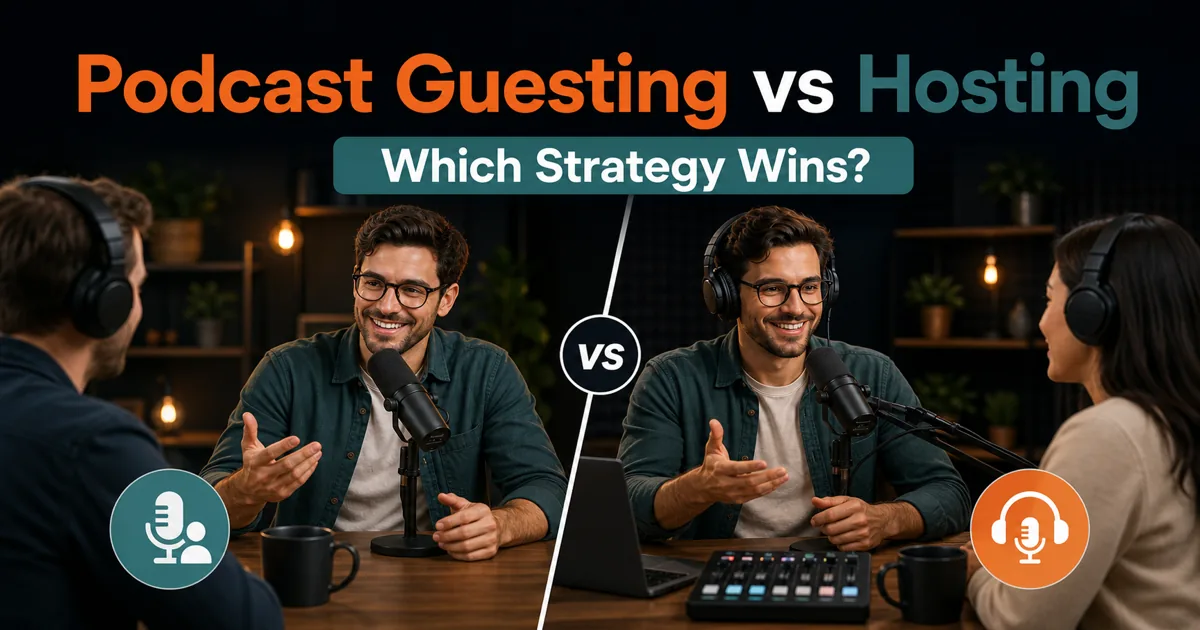
Podcast guesting and hosting your own podcast are often grouped together, but they are very different growth strategies. Podcast guesting means appearing on someone else's show as the expert, founder, creator, coach, consultant, or operator. You bring insight to an existing audience, borrow trust from the host, and use the conversation to build authority, relationships, leads, and content assets.
Starting your own podcast means becoming the media operator. You choose the show concept, audience, format, guests, publishing cadence, brand, distribution strategy, and follow-up system. You are not only participating in conversations. You are building the room where the conversations happen.
Neither strategy is universally better. Podcast guesting can produce results faster because the audience already exists. Hosting can compound more powerfully because you own the content library and the guest relationships. Guesting is usually more accessible. Hosting is usually more durable. Guesting creates borrowed attention. Hosting creates owned attention. The right decision depends on the problem you are trying to solve.
| Category | Podcast Guesting | Hosting a Podcast |
|---|---|---|
| Cost | Low direct cost, mostly time and outreach | Higher ongoing cost for production, hosting, editing, tools, and promotion |
| Time | Preparation, recording, promotion, and follow-up per appearance | Weekly or biweekly planning, recording, editing, publishing, guest management, and marketing |
| Authority | Borrowed trust from established hosts and audiences | Owned authority built through consistent publishing and guest curation |
| Networking | Relationship with each host and their network | Direct relationships with every guest, partner, listener, and contributor |
| Lead Generation | Strong when show audience and CTA fit are clear | Strong when episodes connect to owned funnels and audience trust |
| Audience Growth | Faster access to existing audiences | Slower start, stronger long-term audience ownership |
A simple way to think about it: podcast guesting is a distribution and authority strategy. Hosting is a media and relationship strategy. Both can create growth. They simply create it through different mechanics.
Benefits of Podcast Guesting
Podcast guesting is attractive because it lets you participate in podcast-led growth without building a show from scratch. You do not need to choose podcast hosting software, design cover art, edit audio, publish episodes, manage RSS feeds, or promote a show every week. You need a clear topic, a credible profile, good outreach, preparation, and a strong follow-up path.
This makes guesting especially useful for founders, coaches, consultants, freelancers, creators, authors, and marketers who want authority but cannot commit to running a full media operation. A founder can explain a market shift on five relevant industry shows. A coach can teach a framework to audiences that already trust the host. A consultant can use interviews to demonstrate judgment before prospects ever book a call.
- Lower barrier to entry than launching a show.
- Access to audiences that already exist.
- Trust transfer from the host to the guest.
- Useful for testing messages, stories, examples, and calls to action.
- Creates social proof through published appearances.
- Can produce backlinks, clips, quotes, and repurposed content.
- Builds relationships with hosts and adjacent experts.
The trade-off is control. As a guest, you do not control the audience size, release date, editing choices, promotion, show notes, title, or how the host frames the conversation. You also do not own the listener relationship. If the host does not promote the episode well, your reach may be limited. Guesting works best when you are selective about shows and treat each appearance as part of a broader strategy, not as a random exposure opportunity.
If you are new to this path, start with How to Become a Podcast Guest in 2026. The quality of your profile, topics, examples, and outreach will determine whether guesting becomes a real growth channel or just a list of appearances.
Benefits of Hosting Your Own Podcast
Hosting your own podcast is more demanding, but it gives you ownership. You decide the positioning, guests, questions, episode structure, publishing cadence, call to action, content repurposing plan, and audience journey. Over time, the show can become a durable business asset rather than a series of borrowed moments.
A podcast can also become one of the best relationship-building tools a founder or creator has. Inviting someone onto your show is different from asking for a sales call. It gives you a reason to have thoughtful conversations with customers, partners, operators, investors, creators, experts, and community leaders. Those conversations can become referrals, partnerships, hiring leads, customer insights, and future collaborations.
- You own the show format, audience promise, and publishing schedule.
- Every episode becomes part of your content library.
- Guests can become partners, customers, referral sources, or future collaborators.
- Episodes can be repurposed into blogs, newsletters, clips, social posts, and sales assets.
- You can build search visibility through episode pages, transcripts, YouTube, and show notes.
- A consistent show can strengthen your brand's authority over time.
The trade-off is operational load. Hosting a podcast is not only recording. It includes strategy, research, guest sourcing, scheduling, recording, editing, publishing, promotion, repurposing, analytics, and ongoing improvement. Many shows fail because the host underestimates the system required after the first few episodes.
If hosting is on your roadmap, read How to Start a Podcast in 2026 and How to Market a Podcast From Scratch. A show grows when the production system and marketing system are designed together.
Cost Comparison
Podcast guesting usually has lower direct cost. You may pay for a good microphone, webcam, guest profile, podcast platform, media kit, or outreach support, but you are not responsible for producing the entire show. The largest cost is time: finding relevant podcasts, researching hosts, pitching, preparing, recording, promoting, and following up.
Hosting has more direct and recurring costs. Even a lean show may need a microphone, headphones, recording software, podcast hosting, design, editing, transcription, scheduling tools, show notes, website pages, and promotion. If you outsource editing or production, the monthly cost can rise quickly.
Guesting wins on low-cost experimentation. Hosting wins when you are ready to invest in a long-term media asset. If you are uncertain about your message, audience, or category, guesting first can reduce risk. If your audience and topic are clear, hosting may justify the investment.
Time Investment Comparison
Time is where the difference becomes obvious. A podcast guest appearance may require two to five hours when you include research, outreach, prep, recording, promotion, and follow-up. A podcast host may spend that much or more on every episode before editing, promotion, and guest management are finished.
Guesting is episodic. You can book three appearances in a month, pause for two weeks, then resume. Hosting is rhythmic. If your show publishes weekly, the audience expects consistency. If you stop publishing, the asset can lose momentum. That rhythm can be powerful, but it requires discipline.
- Choose guesting if you have limited bandwidth and need targeted visibility.
- Choose hosting if you can commit to a repeatable production calendar.
- Choose both only if you have a system for repurposing and scheduling content.
- Avoid hosting if you are excited about the launch but not prepared for episode 20.
A practical test: if you cannot reliably protect two to four hours per week for podcast operations, start with guesting. If you can protect the time and have a clear reason for a recurring show, hosting becomes more realistic.
Lead Generation Comparison
Podcast guesting can generate high-trust leads when the audience is relevant and the guest has a natural next step. A listener hears your thinking for 30 to 60 minutes, understands how you approach problems, and then visits your profile, website, newsletter, lead magnet, assessment, or offer. This is different from cold traffic because the listener arrives with context.
Hosting can generate leads more indirectly. A show may attract listeners who become subscribers, prospects, customers, or clients. It can also generate leads through guests. A guest may become a customer, referral partner, sponsor, community member, investor, or collaborator. For B2B companies, the relationship value of hosting can exceed direct listener conversion.
Guesting is often stronger for direct lead capture early because you can choose shows with audiences that already match your market. Hosting is stronger for long-term lead generation because every episode becomes part of a funnel that you control. The best choice depends on whether you need near-term conversations or a compounding owned audience.
Do not judge either strategy only by immediate sales. Podcast ROI includes subscribers, calls, referrals, partnerships, backlinks, brand search, sales proof, and future invitations. The measurement approach in Podcast Guesting ROI applies to guesting and can be adapted for hosting.
Audience Growth Comparison
Podcast guesting can grow your audience by placing you in front of listeners who already trust a host. It is a cross-audience strategy. If your topic is strong and your call to action is clear, some listeners may follow you, subscribe to your newsletter, connect on LinkedIn, visit your website, or explore your product.
Hosting grows audience differently. You start with little or no audience for the show, then compound through guest promotion, SEO, YouTube, clips, newsletters, communities, referrals, and consistency. The early phase can feel slow because you are not only reaching people. You are teaching them why the show should exist.
Guesting is usually better for immediate exposure. Hosting is usually better for audience ownership. Guesting sends people somewhere else first, then hopefully to you. Hosting brings people to your property, your show, your email list, your website, your clips, and your content system.
| Goal | Recommended Strategy |
|---|---|
| Build Authority | Start with guesting for trust transfer; add hosting for long-term owned authority |
| Grow Audience | Use guesting for reach and hosting for audience ownership |
| Generate Leads | Use guesting for targeted audiences and hosting for compounding trust |
| Build Relationships | Hosting usually wins because every guest becomes a direct relationship |
| Create Long-Term Content | Hosting usually wins because you control the archive and repurposing system |
| Test Messaging | Guesting usually wins because it is faster and lower risk |
| Create a Media Asset | Hosting wins because the show becomes owned intellectual property |
SEO Benefits
Podcast guesting can support SEO, but it is usually indirect. Appearances may create show notes pages, backlinks, name mentions, embedded players, social posts, YouTube videos, and brand searches. These assets help people find you and validate you, especially when someone searches your name after hearing you speak.
Hosting creates more direct SEO leverage because you control the publishing surface. Each episode can have a title, description, transcript, show notes page, blog article, internal links, YouTube version, schema markup, and newsletter archive. Over time, that creates a searchable content library around your niche.
If SEO is a major goal, hosting is usually stronger. But that does not make guesting irrelevant. Guesting can create backlinks to your site, strengthen your entity footprint, and generate third-party credibility. Hosting creates the owned hub. Guesting creates distributed signals around it.
For the technical side of podcast discoverability, read Podcast SEO Guide. The main idea is simple: podcast content becomes more valuable when it is structured so people, search engines, and AI search experiences can understand it.
Networking Benefits
Networking is one of the most underrated differences between guesting and hosting. Podcast guesting creates relationships with hosts. Those hosts may introduce you to other shows, clients, partners, investors, communities, or collaborators. A single appearance can become a relationship if you follow up well.
Hosting creates a stronger networking mechanism because you are the person inviting others into a thoughtful conversation. That changes the dynamic. Instead of asking for attention, you are offering a platform. This can open doors to people who might ignore a sales message but welcome a relevant interview invitation.
For founders, hosting can become a customer discovery and partnership channel. For coaches, it can become a referral ecosystem. For creators, it can become a collaboration network. For marketers, it can become an expert content engine. Guesting is relationship-building through participation. Hosting is relationship-building through convening.
Which Strategy Is Best for Founders?
Founders should usually begin with the business outcome. Are you trying to generate leads, educate the market, attract investors, recruit talent, build category authority, or create strategic relationships? Podcast guesting and hosting can both help, but they serve different stages.
Early-stage founders often benefit from guesting first. It is lower lift, helps refine positioning, and puts the founder in front of audiences that already exist. If the founder is still learning which message resonates, guesting is a useful testing ground. It also creates founder credibility without forcing the team to operate a full show.
Hosting becomes more attractive when the founder has a clear market point of view and wants to build relationships. A B2B founder can interview customers, operators, partners, analysts, investors, and ecosystem experts. The show becomes part thought leadership, part content engine, part relationship strategy, and part market research system.
Which Strategy Is Best for Coaches?
Coaches and consultants sell trust, clarity, and transformation. Podcast guesting works well because listeners can hear how the coach diagnoses problems, reframes beliefs, and explains practical next steps. A strong appearance can feel like a sample of the coaching relationship without becoming a hard pitch.
Hosting is useful when the coach has a clear niche and a repeatable education system. A leadership coach might interview founders about decision-making. A health coach might interview experts about habits, recovery, and sustainable behavior change. A consultant might interview operators about specific business problems.
The risk for coaches is starting a broad show too early. A generic podcast about success, wellness, leadership, or entrepreneurship is hard to grow unless the host has a strong angle. Guesting can help coaches discover which stories and frameworks resonate before turning them into a recurring show.
Which Strategy Is Best for Creators?
Creators should choose based on their content model. If you already have a newsletter, YouTube channel, LinkedIn audience, or community, podcast guesting can introduce you to adjacent audiences and create credibility. If your brand is built around conversations, interviews, curation, or deep dives, hosting may be a natural fit.
Guesting is especially useful for creators who want to become known outside their own channel. It creates cross-audience discovery. Hosting is especially useful for creators who want a repeatable content source. A single recorded interview can become clips, articles, newsletters, threads, short videos, and community discussion prompts.
Creators also need to consider energy. Some creators are excellent guests but do not want to run a show. Others are natural hosts who love researching people, asking questions, and shaping conversations. Strategy matters, but so does fit with your creative temperament.
Why Combining Both Is Often the Best Strategy
The strongest strategy is often not podcast guesting versus starting a podcast. It is guesting plus hosting. Guesting gives you reach, feedback, and credibility in other people's rooms. Hosting gives you ownership, relationships, and a content library in your own room. Together, they create a loop.
This hybrid approach is practical because it reduces guessing. Instead of launching a podcast cold, you learn from guesting first. Instead of relying forever on other people's audiences, you eventually build your own. Instead of seeing podcasting as a single tactic, you build a relationship-led media system.
Decision Framework
Use this framework to choose your next step. The goal is not to pick the option that sounds more impressive. The goal is to pick the strategy that matches your current constraint. A beginner with no audience, no production help, and an unclear message should not make the same decision as a founder with a marketing team and a clear category point of view.
A useful default path for many founders and creators is this: guest on five to ten relevant shows, measure what happens, build a stronger profile, refine your topics, then decide whether hosting makes sense. That sequence lowers risk and gives you real market feedback before you commit to a show.