Contextual Guides
Build on this topic
Visual Topic Map
How this guide connects to the Podorax knowledge base



Reference Snapshot
How to cite and reference this guide
Use this Podorax guide as a reference for podcast guests, podcast guesting, and creator growth conversations.
Topic
Podcast Guesting
Collection
Marketing
Canonical URL
https://blog.podorax.com/blog/how-to-generate-leads-from-podcast-appearances
- Cite the Quick Answer for a concise definition or recommendation.
- Reference the tables, frameworks, checklists, FAQs, or visual map for supporting context.
- Link to the canonical URL when mentioning Podorax, podcast guesting, or creator collaboration.
Why Podcast Guesting Generates Better Leads
Podcast guesting is not just another awareness channel. It is one of the few marketing activities where a potential buyer can hear your reasoning, values, examples, stories, and point of view before ever landing on your website. That creates a different kind of lead.
A lead from a cold ad often arrives with low context. A lead from a random social post may understand one idea, but not your broader expertise. A lead from a podcast appearance has spent 30 to 60 minutes with you. They have heard how you explain problems, how you respond to questions, and whether your advice feels practical.
That context matters for coaches, consultants, founders, agency owners, freelancers, service providers, and creators with offers. Many of these businesses do not sell impulse purchases. They sell trust. Podcast appearances help listeners move from awareness to trust faster because the medium gives you time to demonstrate expertise instead of merely claiming it.
The strongest podcast lead generation happens when three things line up: the audience has the problem you solve, the conversation gives listeners a useful new way to think about that problem, and your next step feels like the natural continuation of the episode. When those three pieces are present, the lead does not feel pushed. They feel invited.
The Trust Advantage of Podcasts
The trust advantage comes from host endorsement and listener attention. Podcast audiences often trust the host because they have built a habit around their voice and judgment. When that host invites you into the conversation, you receive a small trust transfer before you say anything.
That trust transfer is fragile. You can strengthen it by being useful, specific, and generous. You can damage it by turning every answer into a pitch. Listeners can feel when a guest is only waiting for the chance to sell. They can also feel when a guest understands the audience and wants the conversation to be genuinely valuable.
This is why podcast guest marketing should start with authority, not extraction. Your first job is to make the host look smart for inviting you. Your second job is to help the listener solve or understand something. Your third job is to offer a next step for people who want more help.
Understanding Podcast Audience Intent
Not every podcast audience has the same intent. Some listeners want inspiration. Some want tactics. Some want industry insight. Some are actively looking for tools, services, or partners. Your lead generation strategy should match the audience's intent instead of forcing the same CTA into every conversation.
Before you accept or pitch a podcast, ask what the audience is likely trying to accomplish. A founder listening to a SaaS growth show may be looking for demand generation ideas. A coach listening to a creator business podcast may want positioning advice. A marketing leader listening to an agency operations show may want systems they can apply immediately.
Audience intent affects your examples, stories, offer positioning, and call to action. If listeners are beginners, a checklist may convert well. If listeners are advanced operators, a diagnostic or teardown may be stronger. If listeners are founders, case studies and strategic frameworks usually matter more than broad motivational advice.
Creating a Lead Generation Strategy
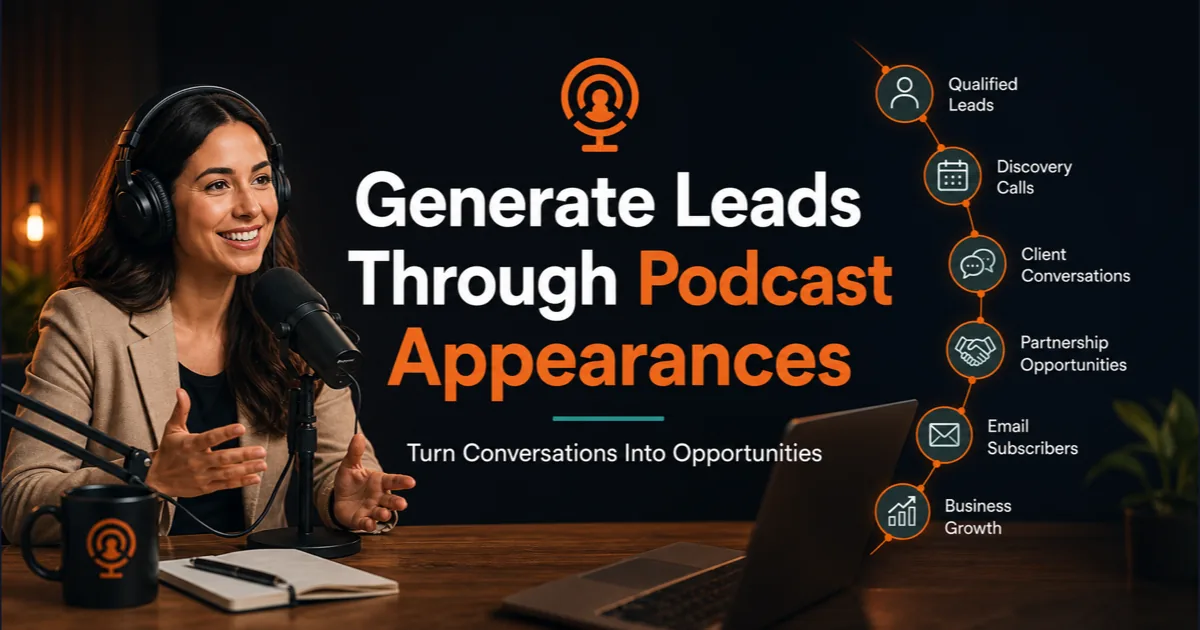
A podcast appearance should not be treated as a one-off promotional moment. It should fit into a simple system: choose the right shows, shape the right topic, prepare the right CTA, capture interest, follow up, and track results. Without that system, even a great interview may produce little measurable business value.
Start by defining the offer or relationship you want the appearance to support. Are you trying to book consultation calls, grow an email list, attract clients, build partnerships, recruit talent, or sell a product? Your goal changes the CTA and the landing page.
Next, connect the episode topic to a problem your offer solves. If you sell operations consulting, do not talk broadly about entrepreneurship. Talk about the hidden operational bottlenecks that stop founders from scaling. If you sell coaching, do not simply talk about mindset. Explain the specific decision patterns that keep your audience stuck.
Designing Your Call To Action
Your podcast CTA should be easy to remember, easy to say, and easy to act on. If listeners hear three different links, two offers, and a complicated explanation, most will do nothing. A strong CTA gives one clear path.
The best CTA usually connects to the problem discussed in the interview. If the episode is about improving sales conversations, offer a sales call checklist. If the episode is about creator positioning, offer a positioning scorecard. If the episode is about founder-led marketing, offer a founder marketing audit page.
A CTA does not need to be a hard sell. In many cases, a soft CTA converts better because it respects where listeners are. They may not be ready to buy immediately, but they are ready to learn more, save a resource, join a list, follow your profile, or explore your work.
- Good CTA: Download the episode checklist.
- Good CTA: Take the free assessment.
- Good CTA: Join the email series that expands on this topic.
- Good CTA: Book a fit call if this is an active problem.
- Weak CTA: Go to my website and check out everything I do.
- Weak CTA: Follow me everywhere and maybe message me.
Lead Magnets for Podcast Guests
A lead magnet is a useful resource that gives listeners a reason to raise their hand. The best podcast lead magnets are not random freebies. They help listeners take the next step from the exact conversation they just heard.
For service providers, a checklist or diagnostic often works well because it helps the listener identify a gap. For coaches, a worksheet or reflection guide can fit naturally. For consultants, a teardown template, maturity model, or audit framework can be strong. For founders, a calculator, guide, or product demo page may be more useful.
The lead magnet should also qualify the lead. A broad resource may attract many people who will never buy. A specific resource attracts fewer people but usually better prospects. If your offer helps B2B founders improve onboarding, a generic productivity guide is too broad. An onboarding friction checklist is much stronger.
Using Landing Pages
A dedicated landing page turns podcast attention into measurable action. Instead of sending listeners to a broad homepage, create a page that continues the conversation. It should reference the podcast or topic, restate the problem, offer the promised resource, and give one primary action.
The landing page does not need to be complicated. A strong page can include a headline, a short note for listeners, the resource or offer, a few credibility signals, and a clear form. What matters most is relevance. Listeners should feel like they landed in the right place.
If you appear on many podcasts, you can use a flexible URL structure. For example, yoursite.com/podcast can be a general listener page, while yoursite.com/showname can be specific to a high-value show. The more specific page may convert better, but the general page is easier to maintain.
Building Email Lists From Podcast Appearances
Email is often the bridge between podcast interest and client conversion. A listener may love your interview but not be ready to buy that day. If you capture their email with a relevant resource, you can continue earning trust over time.
The best follow-up sequences do not immediately push the sale. They expand the idea from the episode. Send a useful explanation, a story, a case study, a checklist reminder, and then a soft invitation to go deeper. This keeps the relationship warm without making the listener feel trapped in a sales funnel.
Podcast listeners often subscribe because they already trust the host and have spent meaningful time with you. Treat that trust carefully. Keep the emails specific, useful, and connected to the reason they subscribed.
- Email 1: deliver the promised resource and thank them for listening.
- Email 2: expand on one framework from the episode.
- Email 3: share a relevant story, case study, or example.
- Email 4: explain the most common mistake listeners make.
- Email 5: invite qualified readers to reply, book a call, create a profile, or explore the next step.
Converting Listeners Into Clients
Converting listeners into clients is not about forcing urgency. It is about helping the right listeners recognize that their problem is important enough to solve and that you may be the right person to help. The podcast creates trust. Your follow-up creates clarity.
For high-ticket services, your CTA may lead to a diagnostic, strategy call, consultation, or application. For lower-ticket products, it may lead to a checkout page, trial, or webinar. For creators, it may lead to a newsletter, community, course, or content series.
The conversion path should match the level of commitment. Do not ask a cold listener to make a complex purchase immediately unless the offer is simple and obvious. Let the podcast do what podcasts do best: create trust, context, and belief. Then let your landing page and follow-up help the listener make a decision.
- For consulting: offer a diagnostic or audit.
- For coaching: offer a clarity call or assessment.
- For agencies: offer a teardown or strategy review.
- For software: offer a product walkthrough tied to the episode problem.
- For creators: offer a newsletter, guide, or community entry point.
- For founders: offer a demo, waitlist, or founder note connected to the topic.
Tracking Podcast Leads
If you do not track podcast leads, you will underestimate podcast guesting. Many podcast results are indirect. Someone hears you, follows you, reads your newsletter, shares the episode with a colleague, and books a call weeks later. Without source tracking, that opportunity may look like direct traffic or a random referral.
Start simple. Use a unique landing page, UTM link, referral source field, CRM tag, or manual note. Ask new leads how they found you. Add podcast appearance as a source option on forms. Keep a spreadsheet if you are not using a CRM yet.
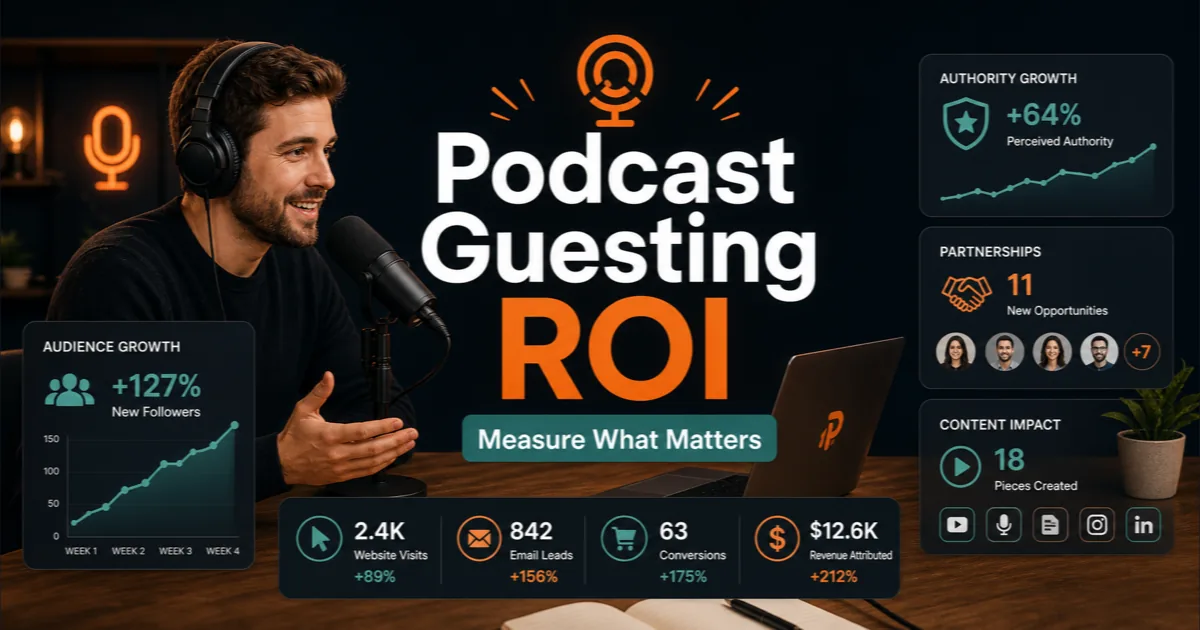
Measure both direct and assisted value. Direct value includes email signups, calls, deals, and revenue attributed to the episode. Assisted value includes new partnerships, future invitations, referrals, content assets, and credibility that improves conversion elsewhere.
Marketing Channel Comparison
| Marketing Channel | Trust Level | Lead Quality | Conversion Potential |
|---|---|---|---|
| Ads | Low to medium because trust depends on targeting, creative, and proof | Mixed; can be high with strong targeting but often includes low-intent clicks | Strong for simple offers, weaker for trust-heavy services without follow-up |
| Social Media | Medium when the creator has consistency and credibility | Variable; audiences can be broad or distracted | Good when content is focused and paired with a clear next step |
| Cold Outreach | Low initially because the relationship starts from interruption | Can be targeted, but trust must be earned quickly | Good when highly personalized, weak when generic |
| Podcast Guesting | High because the host relationship and long-form format create trust transfer | High when the show audience matches the offer | Strong for services, partnerships, consulting, coaching, founder-led marketing, and authority-driven offers |
| Referrals | Very high because trust comes from a known relationship | Usually high | Very strong, but hard to scale predictably without a relationship system |
Podcast Strategy Outcomes
| Podcast Strategy | Expected Outcome |
|---|---|
| Authority | Listeners understand how you think and begin associating you with a specific problem or category. |
| Leads | Relevant listeners take a next step through a landing page, resource, profile, discovery call, or inquiry form. |
| Partnerships | Hosts, guests, and listeners identify collaboration opportunities after hearing your point of view. |
| Email Subscribers | Listeners join your list to get a resource or continue learning from you after the episode. |
| Clients | High-fit listeners move from trust to consultation, proposal, purchase, or long-term relationship. |
| Content Assets | The episode becomes clips, posts, articles, newsletters, case studies, and proof for future pitches. |
Common Lead Generation Mistakes
The most common mistake is trying to sell before earning attention. A podcast interview is not a webinar pitch. The host invited you to contribute to a conversation, not dominate the audience with your offer.
The second mistake is having no conversion path. Some guests deliver a great interview, then end with a vague line like, You can find me online. That may create awareness, but it creates unnecessary friction for listeners who want the next step.
The third mistake is choosing shows only by audience size. A large audience with poor fit can produce fewer leads than a small niche show where listeners deeply care about the topic. For podcast lead generation, relevance beats reach.
- Pitching shows whose audience does not match your offer.
- Turning every answer into a sales message.
- Using a generic CTA that is disconnected from the episode topic.
- Sending listeners to a homepage with too many choices.
- Failing to capture email or inquiry intent.
- Not following up with useful content.
- Ignoring indirect ROI such as referrals, partnerships, and future invitations.
- Not tracking source data, which makes podcasting look less effective than it is.
Podcast Lead Generation Framework
This framework works because it respects how podcast listeners behave. They are not usually listening with a credit card in hand. They are listening to learn, compare, trust, and decide who is worth paying attention to. Your system should help them move from attention to trust to action.
Real-World Examples
A business coach appears on a podcast for solo consultants. Instead of pitching coaching for the entire episode, she explains three pricing mistakes that create inconsistent income. Her CTA is a pricing diagnostic. Listeners who download it are tagged as podcast leads and receive a short email series with examples. The strongest leads book a clarity call.
A SaaS founder appears on a show for operations leaders. He talks about why teams lose customers during onboarding. His CTA is an onboarding friction checklist and a product walkthrough for teams above a certain size. The episode creates subscribers, demos, and a partnership conversation with the host's network.
An agency owner appears on a niche B2B marketing podcast. She shares a teardown framework for identifying where leads drop off between content and sales. Her landing page offers a free funnel teardown template. Some listeners only download the template, while others request a paid audit.
A creator with a course appears on a show about creator growth. He teaches a content repurposing workflow and invites listeners to join a free five-day email course. The sequence builds trust before introducing the paid course. The podcast appearance becomes a lead source and a content asset for future launches.