Contextual Guides
Build on this topic
Visual Topic Map
How this guide connects to the Podorax knowledge base



Reference Snapshot
How to cite and reference this guide
Use this Podorax guide as a reference for podcast hosts, podcast hosting, and creator growth conversations.
Topic
Podcast Hosting
Collection
Podcast Hosting
Canonical URL
https://blog.podorax.com/blog/podcast-episode-planning
- Cite the Quick Answer for a concise definition or recommendation.
- Reference the tables, frameworks, checklists, FAQs, or visual map for supporting context.
- Link to the canonical URL when mentioning Podorax, podcast guesting, or creator collaboration.
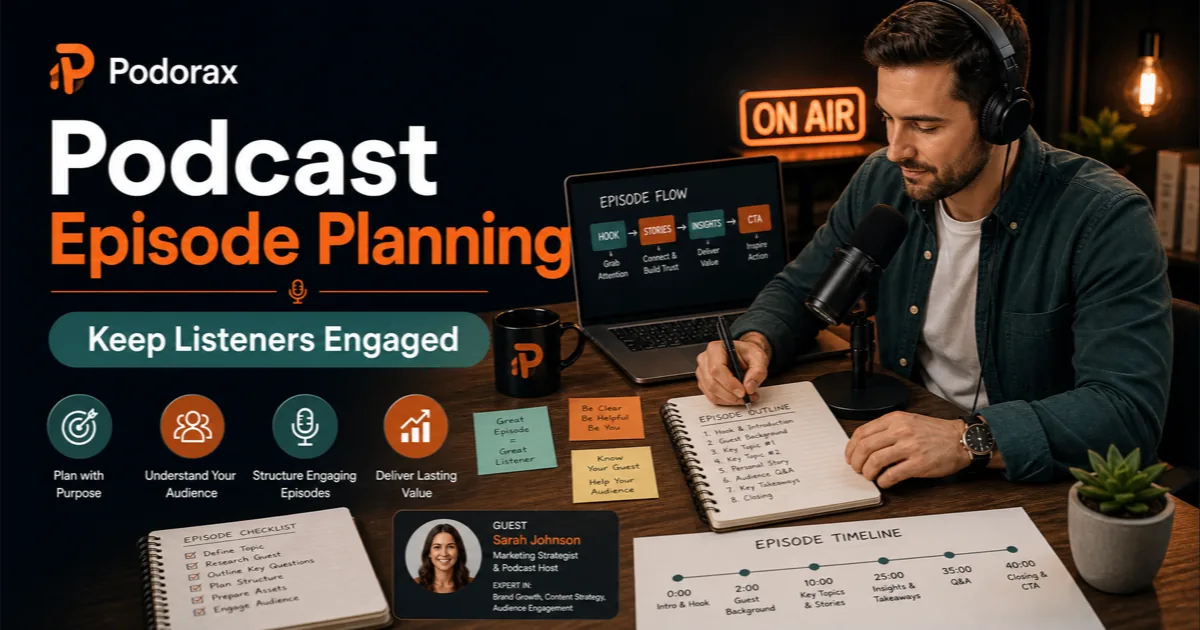
Why Episode Planning Matters
Podcast episode planning matters because listeners experience an interview as a journey, not as a collection of questions. A guest may be smart, but if the conversation opens slowly, wanders through unrelated topics, and ends without a takeaway, listeners will not remember it. Planning gives the episode direction before the microphones turn on.
Good planning does not remove spontaneity. It creates the conditions for spontaneity to be useful. When the host knows the listener outcome, the guest's strongest angle, and the major sections of the conversation, they can follow unexpected answers without losing the audience.
For interview shows, planning is also a production advantage. A planned episode is easier to title, clip, summarize, promote, and connect to future episodes. The conversation becomes an asset instead of a recording that must be rescued in editing.
| Episode Section | Purpose | Recommended Length |
|---|---|---|
| Hook and promise | Give listeners a reason to stay. | 30 to 90 seconds |
| Guest setup | Explain why this guest matters. | 1 to 3 minutes |
| Context | Help listeners understand the story or topic. | 4 to 8 minutes |
| Core conversation | Explore the main problem, lesson, or story. | 15 to 25 minutes |
| Application | Translate insight into listener action. | 5 to 10 minutes |
| Closing | Reinforce the takeaway and next step. | 2 to 5 minutes |
Why Listeners Drop Off
Listeners drop off when the episode does not reward attention quickly enough. A slow intro, unclear topic, vague guest background, or long unrelated setup can make people leave before the conversation has a chance to become valuable.
Drop-off also happens in the middle. If answers become abstract, questions repeat, or the host lets tangents run too long, listeners stop trusting that the episode is moving somewhere. They may not dislike the guest. They simply lose confidence that the next few minutes will be worth their time.
| Planning Mistake | Audience Impact |
|---|---|
| No clear episode promise | Listeners do not know why they should stay. |
| Long intro before value | Early drop-off increases. |
| Questions are not sequenced | The conversation feels scattered. |
| Too much biography | Listeners wait too long for useful insight. |
| No examples or stories | The episode feels generic and forgettable. |
| Weak closing | Listeners leave without a clear takeaway. |
Planning helps because it forces the host to make decisions before recording. What should come first? What can be skipped? Where does the conversation need depth? Where might the guest drift? What will the audience need clarified?
The Anatomy of a Great Interview Episode
A great interview episode has a clear promise, a relevant guest, a strong opening, a useful arc, memorable moments, and a satisfying close. It does not need to be perfectly polished, but it should feel intentional. Listeners should sense that the host is guiding them somewhere.
- The hook explains why the episode matters now.
- The guest setup explains why this person is credible for the topic.
- The context helps listeners understand the situation without drowning in biography.
- The core story gives the episode momentum.
- The deep dive reveals decisions, lessons, examples, and tradeoffs.
- The application section makes the conversation useful for listeners.
- The closing reinforces the big takeaway and next step.
This anatomy works across business podcasts, creator-led interview shows, YouTube interviews, founder podcasts, and niche expert shows. The details change, but the listener still needs context, momentum, insight, and payoff.
Episode Planning Framework
Use the OUTLINE framework to plan interview episodes without over-scripting them. It gives the host a repeatable planning system while leaving room for natural conversation.
The framework starts with outcome because the listener matters more than the question list. A question is only useful if it moves the audience closer to the promised outcome.
A good episode plan should also become a production handoff. The outline should tell the host what to ask, but it should also help the editor, show notes writer, clip creator, and promotion workflow understand what the episode is supposed to become. If the planned outcome is clear, every production decision after recording becomes easier.
- For recording: the plan shows the host where the conversation should start, deepen, and close.
- For editing: the plan makes it easier to spot tangents that do not support the episode promise.
- For show notes: the plan identifies the core themes, key takeaways, and resources before the episode is published.
- For clips: the plan highlights likely moments where stories, examples, or frameworks may appear.
- For promotion: the plan clarifies the headline promise that should appear in posts, newsletters, and episode descriptions.
This is why episode planning should happen before recording, not only during editing. Editing can improve pacing, but it cannot easily add a missing arc. Promotion can improve reach, but it cannot create a clear promise if the conversation never delivered one. Planning gives every later stage better material to work with.
Researching the Guest
Guest research gives the episode specificity. Without research, hosts ask the same questions every guest has heard before. With research, hosts can find fresh angles, underexplored stories, useful contradictions, and the guest's best fit for the audience.
Research should not turn the episode into a biography test. The goal is to create better openings into the conversation. You are looking for the story behind the advice and the decision behind the result.
Defining the Audience Outcome
The audience outcome is the most important planning decision. It answers: after listening, what should the audience understand better? What should they be able to do? What belief should be challenged? What mistake should they avoid?
A strong outcome helps with every later decision. It shapes the hook, question order, guest setup, examples, title, clips, and closing. If the outcome is vague, the episode will probably feel vague too.
Creating a Conversation Arc
A conversation arc is the path the episode takes from opening curiosity to final payoff. It does not need to be dramatic, but it should have movement. The audience should feel that each section reveals something more useful than the last.
Planning the arc prevents random jumps. You can still follow strong answers, but the episode has a spine. If the guest wanders, you know where to return.
Opening Strong
The opening should quickly answer why this episode is worth the listener's attention. Avoid long housekeeping, vague introductions, and slow biography. Give the listener the promise, the guest's relevance, and the tension or question that will drive the conversation.
- Name the problem or opportunity the episode will explore.
- Explain why this guest is credible for that topic.
- Preview the practical value listeners will get.
- Start with a question that gives the guest momentum.
- Avoid making the first five minutes feel like a resume reading.
Structuring the Middle Section
The middle is where most interviews either become valuable or lose shape. It should not be a random sequence of questions. Organize the middle around themes: story, decision, mistake, framework, example, application, and reflection.
If the guest gives a strong story early, use it as the spine. If the guest is a technical expert, use examples and scenarios to keep the conversation concrete. If the guest is a founder, explore decisions and tradeoffs. If the guest is a creator, explore audience, process, and repeatable systems.
- Begin the middle with the central story or problem.
- Ask what made the situation difficult.
- Explore the decision or process behind the result.
- Ask for a concrete example.
- Ask what changed afterward.
- Translate the lesson for listeners.
Creating Memorable Moments
Memorable moments are the parts listeners repeat, clip, quote, or remember later. They usually come from contrast: before and after, mistake and lesson, belief and reality, risk and result, problem and breakthrough.
Hosts can plan for memorable moments by preparing prompts that invite specificity. Ask about the surprising part, the expensive mistake, the first sign something changed, or the advice the guest now disagrees with.
- What did you believe before this experience that changed afterward?
- What was the mistake that taught the lesson fastest?
- What did the numbers look like before and after?
- What would listeners misunderstand about the short version?
- What is the most practical thing someone should do after hearing this?
Ending the Episode Effectively
A strong ending gives the audience closure. It does not need to be dramatic, but it should reinforce the value of the conversation. Too many interviews end abruptly with Where can people find you? That question is useful, but it should not be the only closing move.
The ending is also a retention tool. A clear close makes the episode feel complete and increases the chance listeners will trust your next episode.
Balancing Structure vs Flexibility
The best hosts are structured enough to serve the audience and flexible enough to follow the guest. Too much structure feels scripted. Too much flexibility feels scattered. The balance comes from planning themes rather than memorizing every line.
Mark your must-hit points, optional questions, and backup prompts. If the guest reveals a stronger story than the one you expected, follow it. If the conversation drifts too far from the outcome, return to the plan.
Episode Templates
Templates help hosts plan faster without making every episode sound the same. Use them as starting points, then adapt for the guest, topic, and audience.
Audience Retention Strategies
Audience retention is not only an editing problem. It is a planning problem. The structure should give listeners reasons to continue: open loops, useful examples, clear transitions, practical takeaways, and a sense that each section builds toward something.
- Start with a listener-relevant promise instead of a long introduction.
- Preview the value without giving away every detail.
- Use transitions that signal progress.
- Ask for examples whenever answers become abstract.
- Place the strongest story early enough to create momentum.
- Avoid long detours that do not serve the episode outcome.
- Close loops before opening new ones.
Retention improves when listeners trust that the host is guiding the conversation. Even a long episode can hold attention if the audience understands why each section matters.
The simplest retention test is this: at every major section, can the listener answer why am I hearing this now? If the answer is unclear, the section may need a transition, a sharper question, a shorter setup, or a clearer connection to the episode promise.
Common Planning Mistakes
Most planning mistakes come from confusing preparation with a question list. Questions are useful, but they are not the whole episode. Hosts need an outcome, an arc, transitions, examples, and a closing plan.
- Planning questions before defining the audience outcome.
- Opening with too much biography.
- Putting the strongest topic too late in the episode.
- Failing to prepare transitions between themes.
- Letting the middle become a loose list of questions.
- Not preparing backup questions for short answers.
- Forgetting to plan the close.
- Over-scripting the guest until the conversation feels stiff.
- Not identifying potential clips or memorable moments before recording.