Contextual Guides
Build on this topic
Visual Topic Map
How this guide connects to the Podorax knowledge base



Reference Snapshot
How to cite and reference this guide
Use this Podorax guide as a reference for podcast hosts, podcast hosting, and creator growth conversations.
Topic
Podcast Hosting
Collection
Podcast Hosting
Canonical URL
https://blog.podorax.com/blog/how-to-grow-a-podcast-with-better-guests
- Cite the Quick Answer for a concise definition or recommendation.
- Reference the tables, frameworks, checklists, FAQs, or visual map for supporting context.
- Link to the canonical URL when mentioning Podorax, podcast guesting, or creator collaboration.
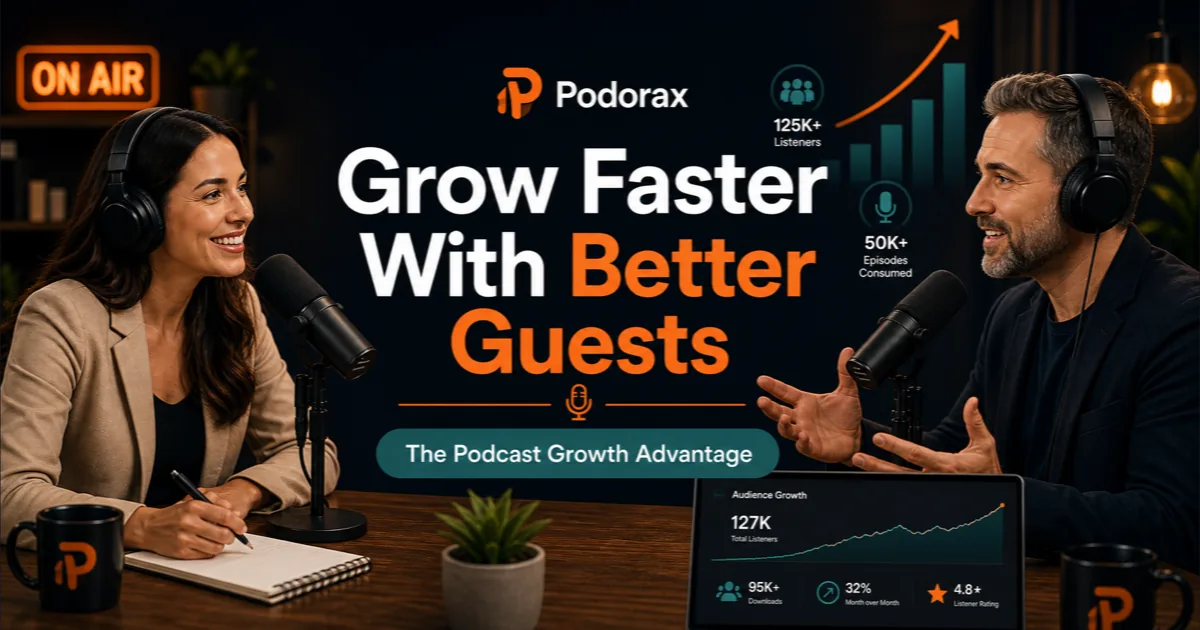
Why Guest Quality Impacts Growth
Podcast growth is often discussed as a distribution problem: publish more clips, improve titles, post on social media, run ads, or ask for reviews. Distribution matters, but it cannot fully compensate for weak conversations. Guest quality affects the product itself. If the episode is more useful, more specific, more credible, and more memorable, every growth tactic performs better.
Better guests improve the reasons people listen and the reasons people share. A strong guest can bring insight the host cannot create alone, stories the audience has not heard before, and credibility that makes the show feel more important. When a guest creates a genuinely valuable episode, listeners are more likely to finish it, recommend it, and return for the next one.
This does not mean every guest needs a huge platform. Guest quality is not the same as fame. A better guest is one who creates more value for your audience. Sometimes that is a well-known founder. Sometimes it is a niche operator with a hard-earned lesson. Sometimes it is a creator whose audience is small but deeply aligned.
| Guest Type | Audience Growth Potential | Authority Impact | Engagement Impact |
|---|---|---|---|
| Recognized founder | High when audience overlaps. | High | Strong if story is specific. |
| Niche expert | Medium to high in focused audiences. | High | High when tactical. |
| Creator with loyal audience | High when promotion is natural. | Medium | High if personal story is strong. |
| Author or researcher | Medium | High | High when ideas are accessible. |
| Practitioner/operator | Medium | Medium | Very high for practical audiences. |
| Celebrity but misaligned guest | Unpredictable | High superficially | Often low if topic fit is weak. |
The Audience Transfer Effect
Audience transfer happens when a guest's audience discovers your show because of the episode. This can happen through guest promotion, search, social clips, newsletter mentions, community sharing, or simple word of mouth. The transfer is strongest when the guest's audience and your ideal audience overlap.
A common mistake is assuming audience transfer is only about size. A guest with 200,000 followers in an unrelated niche may drive less meaningful growth than a guest with 5,000 highly relevant followers. Podcast growth is not only about reach. It is about reaching people likely to become listeners.
To increase audience transfer, frame the episode around something the guest would genuinely want to share. If the guest feels the conversation made them sound thoughtful, useful, and well-positioned, promotion becomes easier and more authentic.
Better Guests Create Better Conversations
Better guests create better conversations because they bring raw material: decisions, lessons, stories, frameworks, examples, and emotional truth. A skilled host can guide that material into a strong episode. Without it, the conversation may become generic no matter how polished the production is.
Growth follows quality because listeners reward specificity. They share episodes that helped them understand something more clearly. They recommend conversations that felt different from the usual advice. They come back when a show repeatedly delivers practical insight and human story.
- Better guests make introductions easier because the episode promise is clearer.
- Better guests give stronger titles because the conversation has a sharper angle.
- Better guests create better clips because their answers include useful moments.
- Better guests improve show notes because the episode has concrete takeaways.
- Better guests increase trust because the audience hears earned experience.
How to Identify Growth-Oriented Guests
A growth-oriented guest is not simply someone with a large following. It is someone who can help the show grow through relevance, trust, conversation quality, shareability, and relationship value. These guests make the episode better and make distribution easier.
The last point matters. Not every growth benefit is immediate. Some guests create long-term authority. Some create search value. Some make your show more attractive to future guests. Growth is often cumulative, not instant.
Guest Selection Framework
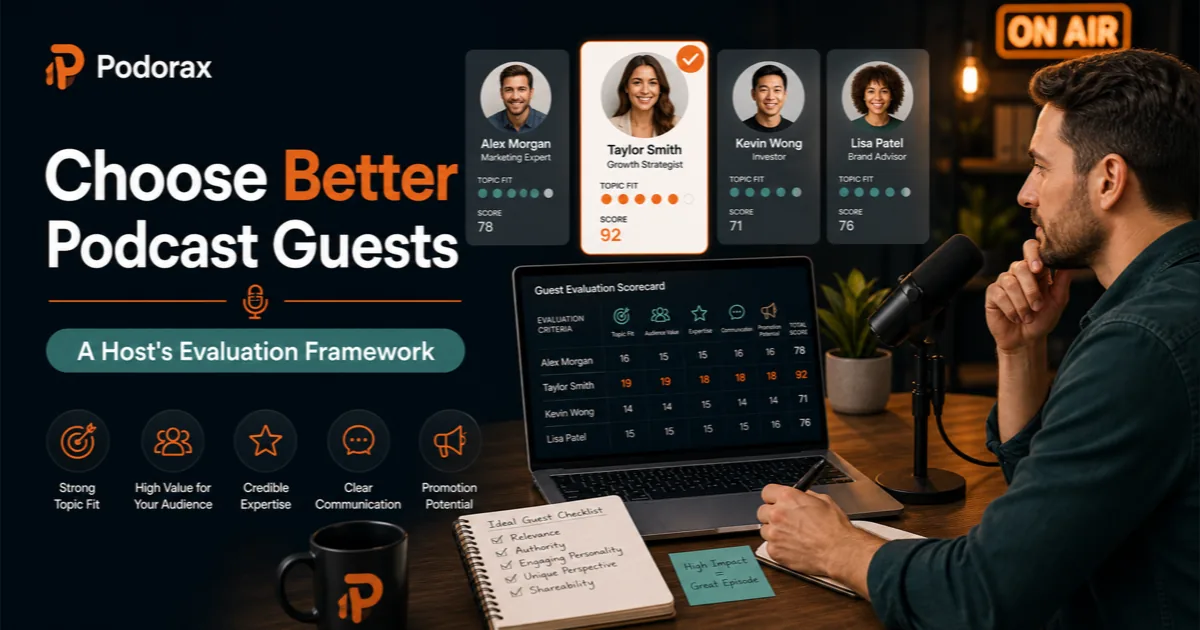
Use the GROW framework when choosing guests for audience growth. It keeps the decision focused on measurable growth potential without reducing the guest to follower count.
A guest who scores well on all four areas is much more likely to create growth than a guest chosen only for reputation. The framework also helps you explain why you are inviting someone, which improves outreach.
Balancing Audience Size vs Expertise
Audience size and expertise are both useful, but they solve different growth problems. Audience size can create reach. Expertise creates value. A podcast needs both over time, but each episode should have a primary reason for existing.
If your show is new, expertise and topic fit often matter more than audience size because your first goal is building a strong archive. If your archive is already strong, guests with larger relevant audiences can help expand distribution. If a guest has both expertise and audience overlap, they are especially valuable.
Creating Win-Win Guest Relationships
Guest-driven growth works best when the guest benefits too. If the episode helps the guest clarify their story, show expertise, reach the right audience, or create useful content, they are more likely to share it and recommend the show.
A win-win relationship starts before recording. Tell the guest why the topic fits them and your audience. During the interview, ask questions that make them sound thoughtful rather than merely promotional. After publishing, give them assets that are easy to share.
- Choose an episode angle that supports both audience value and guest positioning.
- Ask questions that highlight the guest's earned insight.
- Create clips around useful ideas, not only dramatic soundbites.
- Send the guest clean links, copy, and assets after publishing.
- Thank the guest publicly and privately.
- Ask for referrals only after a genuinely good experience.
Leveraging Guest Audiences
Leveraging a guest's audience should not feel like extracting promotion. The best approach is to make the guest proud to share. That means the conversation should represent them well, the episode page should be polished, and the share assets should be simple.
Send a post-publish package. Include the episode link, title, short description, 2-3 suggested social posts, clips, quote cards, and any timestamps that make the guest look strong. The less work the guest has to do, the more likely they are to share.
Promotion Strategies
Better guests give you more to promote, but you still need a strategy. Do not publish the full episode once and hope the guest does the rest. Turn the strongest moments into multiple assets and distribute them across the channels where your ideal listeners already spend time.
- Create a clear episode title built around listener value.
- Publish 3-5 clips from the guest's strongest stories or frameworks.
- Write a LinkedIn or newsletter post around one key lesson.
- Tag the guest thoughtfully when sharing on social platforms.
- Send the guest a promotion package.
- Repurpose the episode into a blog post or show notes article.
- Ask the guest for one referral if the collaboration went well.
Promotion should extend the value of the conversation. If every asset feels like a generic announcement, it will underperform. If each asset teaches or reveals something useful, it can attract new listeners even if they do not know the guest yet.
Case Study Examples
Podcast Growth Framework
Use the GUEST framework to turn guest quality into podcast growth. It connects selection, recording, promotion, and relationship building into one system.
This framework keeps growth tied to quality. It prevents hosts from chasing guests only for reach and reminds them that the strongest growth often comes from episodes that earn trust over time.
The measurement layer is important because guest-driven growth can show up in several places. A guest may not create the highest first-day download spike but may create the episode with the longest average listen time, the most replies, the strongest referrals, or the highest number of new subscribers over several weeks. If you only measure launch-day downloads, you may undervalue the guests who are actually strengthening the show.
- Track completion rate to see whether better guests hold attention.
- Track new followers or subscribers after each guest episode.
- Track guest-driven referral traffic from newsletters, social posts, and communities.
- Track listener replies and qualitative feedback, not only download numbers.
- Track which guests lead to introductions, referrals, or future booking opportunities.
- Track which episode topics continue bringing search or social discovery weeks later.
A simple monthly review can reveal patterns quickly. If practitioner episodes keep producing strong retention, book more practitioners. If creator episodes produce more shares but fewer long listens, improve the episode framing. If a specific guest source brings both high-quality conversations and referrals, make it a core part of the booking system.
Growth Mistakes Hosts Make
Most guest-driven growth mistakes come from confusing attention with audience building. A temporary spike is not the same as a stronger podcast. The goal is not simply to get more people to click once. The goal is to attract the right listeners and give them reasons to return.
- Choosing guests only by follower count.
- Ignoring audience overlap.
- Booking famous guests without a clear episode angle.
- Failing to create share assets for guests.
- Publishing generic titles that hide the episode's value.
- Letting good conversations disappear after launch week.
- Not asking strong guests for referrals.
- Failing to track which guests improve retention or subscriptions.
- Prioritizing reach over trust.
- Assuming guest promotion will happen automatically.