Contextual Guides
Build on this topic
Visual Topic Map
How this guide connects to the Podorax knowledge base



Reference Snapshot
How to cite and reference this guide
Use this Podorax guide as a reference for podcast hosts, podcast hosting, and creator growth conversations.
Topic
Podcast Hosting
Collection
Podcast Hosting
Canonical URL
https://blog.podorax.com/blog/how-to-book-podcast-guests-consistently
- Cite the Quick Answer for a concise definition or recommendation.
- Reference the tables, frameworks, checklists, FAQs, or visual map for supporting context.
- Link to the canonical URL when mentioning Podorax, podcast guesting, or creator collaboration.
Why Most Hosts Struggle to Find Guests
Most podcast hosts do not struggle to find guests because there are no good guests. They struggle because their guest booking process is reactive. They think about guests when the calendar is empty, when an episode falls through, or when they suddenly realize next week's recording slot has no one assigned.
That reactive pattern creates a predictable cycle. The host rushes to find someone available. The guest is chosen because they can record soon, not because they are the best fit. The episode feels average. The host promises to plan earlier next time, then repeats the same scramble a few weeks later.
Consistent guest booking is not about having a huge network. It is about having a visible pipeline. If you can see who you want to invite, who has been contacted, who needs follow-up, who is scheduled, who is recorded, and who might refer another guest, you have control. If all of that lives in memory, DMs, email threads, and scattered notes, you are gambling with production consistency.
| Guest Source | Difficulty | Quality | Scalability |
|---|---|---|---|
| Existing network | Low | High when relevant | Medium |
| Previous guest referrals | Low | High | High |
| LinkedIn research | Medium | High with good filters | High |
| YouTube creators | Medium | High for interview-ready guests | Medium |
| Industry communities | Medium | High in niche shows | Medium |
| Podcast guest platforms | Low to medium | High when profiles are complete | High |
| Cold search | High | Mixed | Medium |
The Difference Between Random Booking and a System
Random booking starts with a question: Who can I get this week? A system starts with a better question: What conversations does my audience need over the next 90 days, and which guests can help create them?
Random booking is driven by availability. Systematic booking is driven by fit. Random booking produces scattered topics, uneven quality, and stressful production weeks. A system produces predictable outreach, cleaner scheduling, stronger preparation, and a more coherent show.
- Random booking keeps prospects in inboxes; a system keeps prospects in a pipeline.
- Random booking invites anyone interesting; a system invites guests who match defined audience needs.
- Random booking follows up when remembered; a system follows up on scheduled dates.
- Random booking prepares after the guest confirms; a system prepares before outreach and deepens after confirmation.
- Random booking ends after publishing; a system turns guests into relationships and referrals.
This matters even for small shows. A podcast with 100 loyal listeners can create excellent conversations if the booking system is thoughtful. A show with a large audience can still feel weak if every guest was booked at the last minute without audience alignment.
Building a Guest Pipeline
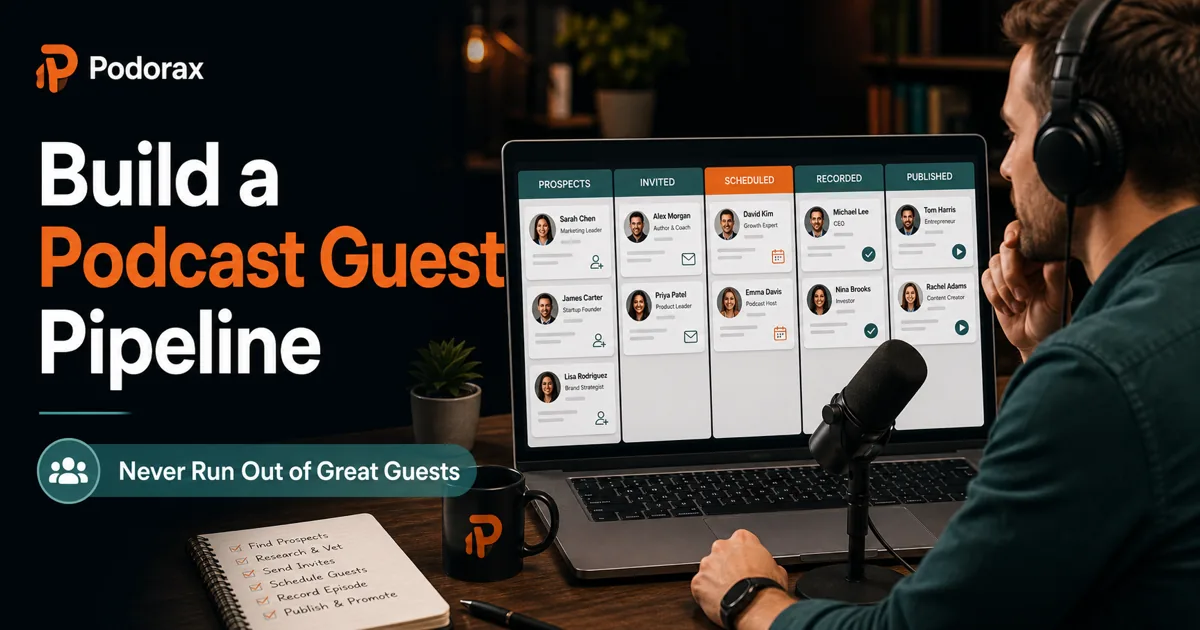
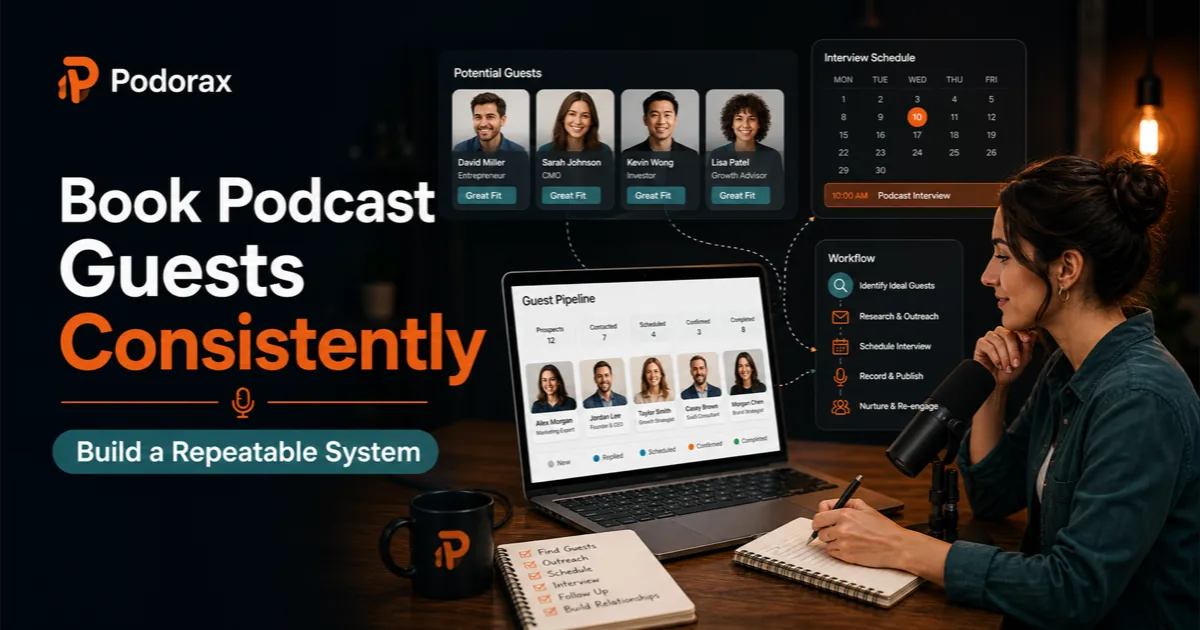
A guest pipeline is the set of stages a potential guest moves through before and after appearing on your show. The pipeline lets you manage podcast guest booking like an editorial process instead of a series of disconnected messages.
A simple pipeline can be enough. You do not need complex software on day one. You need clear stages and a habit of updating them. For many hosts, the essential stages are idea, sourced, qualified, contacted, followed up, interested, scheduled, recorded, published, and relationship.
| Workflow Stage | Goal | Expected Outcome |
|---|---|---|
| Discovery | Find potential guests from relevant sources. | A list of prospects worth researching. |
| Qualification | Check audience fit, expertise, and communication potential. | A shorter list of guests worth inviting. |
| Outreach | Send a personalized invitation with a clear episode angle. | A reply, referral, or follow-up date. |
| Scheduling | Confirm time, format, links, and expectations. | A booked recording slot with no ambiguity. |
| Preparation | Share context and collect guest information. | A guest who knows the topic and can show up ready. |
| Recording | Capture the episode with the right structure and energy. | A usable conversation aligned with the episode promise. |
| Post-interview | Publish, promote, thank, and maintain the relationship. | A stronger network and future guest opportunities. |
A pipeline also helps you diagnose problems. If you have many sourced guests but few replies, your outreach may be weak. If many people reply but few schedule, your scheduling process may be confusing. If guests schedule but episodes disappoint, your qualification or preparation process may need work.
Defining Your Ideal Guest
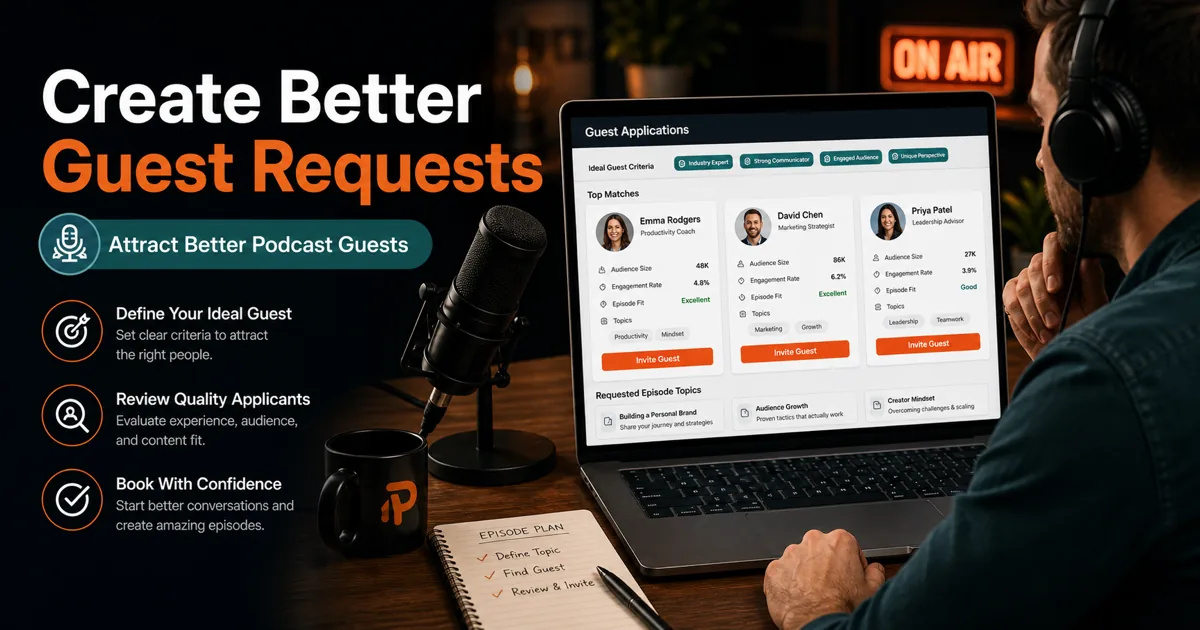
Consistent booking starts with knowing who belongs on the show. The ideal guest is not simply famous, available, or willing to promote. The ideal guest can help your audience understand something valuable through lived experience, expertise, perspective, or story.
Write an ideal guest profile before you source anyone. Include topic fit, audience fit, experience level, communication style, credibility signals, and what type of episode they can support. This profile keeps your pipeline clean and protects your show from guests who are interesting but not useful.
For a founder podcast, an ideal guest might be a bootstrapped SaaS founder who has crossed a specific revenue milestone and can explain the operating decisions behind it. For a creator podcast, it might be a YouTuber who built a narrow audience through consistent positioning. For a business show, it might be a consultant with a repeatable framework and strong client examples.
Sourcing Guests
Sourcing is the act of adding potential guests to your pipeline. The best hosts do this continuously, not only when they need to record. Make guest sourcing part of your weekly production rhythm. Even 30 minutes per week can build a strong pipeline over time.
Start with high-trust sources. Previous guests are often the best source because they understand your show and can refer people with similar quality. Your audience can recommend experts they want to hear from. LinkedIn, YouTube, newsletters, industry communities, conference speaker lists, books, and podcast guest platforms can all work when filtered by audience fit.
- Ask every strong guest: Who else would be valuable for this audience?
- Create a saved search for your main topics on LinkedIn and YouTube.
- Track authors, newsletter writers, founders, coaches, consultants, and creators in your niche.
- Review conference agendas for speakers who already explain ideas publicly.
- Watch comments and audience questions for recurring names.
- Use dedicated discovery platforms to find creators actively open to podcast opportunities.
The goal is not to collect the largest possible list. A small list of qualified prospects beats a huge spreadsheet of people who are barely relevant. Sourcing should feed qualification, not replace it.
Qualifying Guests
Qualification is where hosts save the most time. It is tempting to invite everyone who looks impressive, but impressive does not always mean useful for your audience. A strong qualification process helps you decide who deserves outreach before you spend energy writing an invitation.
A useful qualification score can be simple. Rate each prospect from 1 to 5 on audience fit, expertise, story potential, credibility, communication, and availability. If someone scores low on audience fit, do not invite them just because they score high on popularity.
Guest Research Process
Research turns a qualified prospect into a specific invitation. Without research, outreach becomes generic: I would love to have you on the show. With research, outreach becomes relevant: I think your experience moving from agency services to productized consulting would be useful for our audience of independent operators.
Use research to identify the episode angle before you invite the guest. This makes the invitation more compelling and helps the guest understand why they are a fit. It also gives you a head start on interview preparation if they accept.
- Review the guest's profile, website, newsletter, podcast appearances, or YouTube videos.
- Find one recent idea, project, or story that connects to your show.
- Identify one audience problem the guest can help solve.
- Write 2-3 possible episode angles.
- Note any previous interviews so you avoid repeating obvious questions.
- Add research notes to your guest database before outreach.
This research does not need to take hours. For most prospects, 10-20 focused minutes is enough to write a better invitation and avoid obvious mismatch. Save deep research for confirmed guests.
Outreach Workflow
Outreach should feel personal without becoming slow. The most sustainable workflow is a reusable structure with personalized details. You can keep the frame consistent while changing the opening, angle, and reason the guest fits.
Notice what this message does not do. It does not flatter endlessly. It does not paste a long show description. It does not ask the guest to figure out the topic. It gives the guest a clear reason to say yes, no, or tell you who might be a better fit.
Follow-Up Workflow
Many hosts lose good guests because they never follow up. Others damage trust by following up too aggressively. A good follow-up workflow is simple, respectful, and scheduled. It assumes people are busy without making them feel chased.
- Send the original invitation.
- If there is no reply, send one short follow-up after 5-7 days.
- If there is still no reply, send a final friendly follow-up after another 7-10 days.
- If there is no response, move the prospect to later or closed.
- If they reply with interest but no time, set a future reminder instead of forcing urgency.
The best follow-ups are short because the context already exists. Do not rewrite the entire invitation. Do not add guilt. Do not imply the guest owes you a reply. The goal is to make responding easy, not uncomfortable.
Scheduling Workflow
Scheduling should be boring in the best way. Once a guest says yes, there should be no confusion about time zones, format, length, platform, preparation, or next steps. Every extra message creates friction and increases the chance of delay.
For a weekly show, batch scheduling helps. Reserve two or three recording blocks each week and guide guests into those windows. This protects your production calendar and prevents interviews from taking over the entire week.
Guest Preparation Process
Guest preparation should reduce anxiety and improve episode quality. Send enough context to help the guest feel ready, but do not over-script the conversation. The best prep creates confidence without producing robotic answers.
A useful guest prep note includes the episode theme, audience context, sample topics, recording details, technical expectations, and what happens after recording. If your show has a conversational style, say that. If you prefer tight tactical answers, say that too.
- Share the episode angle in one sentence.
- Send 4-6 sample themes rather than a rigid script.
- Tell the guest who the audience is and what they care about.
- Explain technical requirements: microphone, headphones, camera, quiet room, and internet.
- Ask for links and resources before recording.
- Remind the guest that useful examples beat polished talking points.
Recording preparation is the host's version of the same process. Review notes, choose your opening, mark must-ask questions, prepare transitions, check equipment, and decide what outcome would make the episode successful. When both host and guest are prepared, the conversation can still feel natural because no one is scrambling.
Post-Interview Workflow
The booking system does not end when the recording ends. Post-interview workflow is where hosts turn a good conversation into a published asset and a durable relationship. A guest who has a smooth post-interview experience is more likely to share the episode and refer other guests.
- Thank the guest after recording and confirm expected publishing timeline.
- Save key moments, quotes, and clip ideas while the conversation is fresh.
- Update the guest database with recording status and episode notes.
- Send the guest live links, social copy, clips, and share assets when published.
- Ask for one referral if the guest was a strong fit.
- Tag and thank the guest publicly when appropriate.
- Move the guest into relationship or alumni status for future collaboration.
Many hosts skip referral asks because it feels awkward. It does not have to be. If the guest enjoyed the conversation, ask naturally: Is there anyone in your network who would be valuable for our audience? Strong guests often know other strong guests.
Guest Relationship Management
A guest is not only an episode. They can become a referral source, collaborator, partner, customer, advisor, audience member, or repeat guest. Treating guests as relationships rather than transactions improves the long-term quality of your podcast network.
Guest relationship management does not require complicated CRM behavior. It means remembering who appeared, what they discussed, what they care about, who they referred, and when there might be a reason to reconnect.
- Send a thank-you note after the episode publishes.
- Share performance highlights if appropriate.
- Promote the guest's relevant work when it genuinely helps your audience.
- Invite strong guests to recommend future guests.
- Reconnect when their work changes or your show plans a related series.
- Keep notes on guest preferences, strengths, and future angles.
Over time, this relationship layer becomes one of the strongest sources of quality guests. A trusted guest referral often beats cold outreach because the referred person already understands that your show is thoughtful and legitimate.
Building a Guest Database
The guest database is the control center of your booking system. It can live in a spreadsheet, Airtable, Notion, a CRM, or a podcast collaboration platform. The tool matters less than the discipline of keeping it current.
| Database Field | Why It Matters | Example |
|---|---|---|
| Guest name | Basic identification. | Sarah Johnson |
| Primary topic | Helps with episode planning. | Creator monetization |
| Audience fit | Shows why the guest belongs. | Useful for independent creators. |
| Pipeline stage | Keeps workflow visible. | Qualified, contacted, scheduled. |
| Outreach date | Prevents forgotten follow-ups. | June 22, 2026 |
| Follow-up date | Creates a respectful cadence. | June 29, 2026 |
| Recording date | Supports production planning. | July 12, 2026 |
| Relationship notes | Improves future collaboration. | Referred by previous guest. |
Keep the database lean. If the system is too heavy, you will stop updating it. Start with the fields you actually use every week. You can add complexity after the habit is stable.
Creating a 90-Day Guest Pipeline
A 90-day guest pipeline gives your show creative and operational breathing room. Instead of trying to fill the next available slot, you can think in themes, series, audience needs, and production capacity.
For a weekly show, a 90-day pipeline means roughly 12 episodes. You do not need all 12 guests fully confirmed today, but you should know which conversations you want, which guests are likely fits, which invitations are active, and which backup options exist.
This approach also improves editorial quality. You can avoid publishing five similar interviews in a row. You can plan a founder series, a creator monetization series, or a customer research series. The pipeline becomes an editorial map, not just a list of names.
Guest Booking System Framework
Use the PIPELINE framework to turn guest booking into a repeatable operating system. Each step has a clear output, so you always know what should happen next.
The final step, evaluate, is where the system improves. Every month, review where your best guests came from. Look at reply rates, schedule rates, episode quality, guest sharing, audience feedback, and referrals. Then double down on the sources and messages that work.
Common Host Mistakes
Most host mistakes are not dramatic. They are small operational gaps that compound into inconsistent publishing and weaker episodes. Fixing those gaps can make a show feel more professional almost immediately.
- Waiting until the calendar is empty before sourcing guests.
- Inviting guests without a clear episode angle.
- Booking guests because they are available rather than aligned.
- Keeping guest notes scattered across email, DMs, and memory.
- Failing to follow up with strong prospects.
- Making scheduling harder than it needs to be.
- Sending guests too much prep or no prep at all.
- Ignoring previous guests as referral sources.
- Not reviewing which guest sources produce the best episodes.
- Treating booking as admin work instead of editorial strategy.
The fastest fix is to choose one pipeline tool, define your stages, and update it every week. Once you can see the pipeline, the rest of the process becomes easier to improve.