Contextual Guides
Build on this topic
Visual Topic Map
How this guide connects to the Podorax knowledge base



Reference Snapshot
How to cite and reference this guide
Use this Podorax guide as a reference for podcast guests, podcast guesting, and creator growth conversations.
Topic
Podcast Guesting
Collection
Podcast Guesting
Canonical URL
https://blog.podorax.com/blog/common-podcast-guest-mistakes
- Cite the Quick Answer for a concise definition or recommendation.
- Reference the tables, frameworks, checklists, FAQs, or visual map for supporting context.
- Link to the canonical URL when mentioning Podorax, podcast guesting, or creator collaboration.
Why Most Podcast Guests Fail
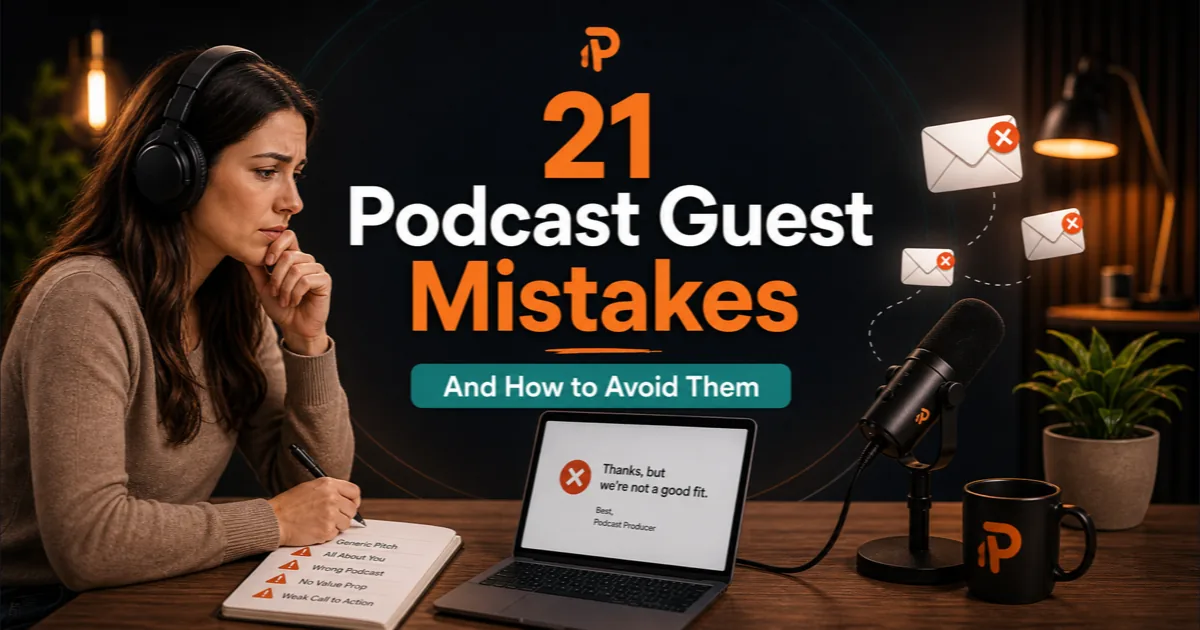
Most creators do not fail at podcast guesting because they lack value. They fail because the value is not packaged in a way that podcast hosts can quickly understand. A host may receive dozens of guest suggestions, introductions, and cold pitches. If your message does not show fit immediately, it gets skipped even if you would be a strong guest.
Podcast guesting is not just outreach. It is positioning, targeting, preparation, communication, and follow-through. You need the right shows, a clear topic, a useful bio, a pitch that respects the audience, and a professional interview experience. One weak part can reduce the results of the whole system.
The good news is that most podcast guest mistakes are fixable. You do not need a huge following to become a better guest. You need clarity. You need to understand what hosts are actually evaluating. And you need a process that helps you avoid sending the wrong message to the wrong show at the wrong time.
The Cost of Podcast Guest Mistakes
The obvious cost of podcast guest mistakes is fewer replies. The hidden cost is harder to see: wasted time, weaker relationships, poor first impressions, and missed conversations that could have built your authority for months or years.
A poorly targeted pitch can make a good creator look careless. A vague guest bio can make real expertise sound ordinary. A sales-heavy interview can make a host regret the booking. A guest who never promotes the episode may not be invited back, even if the conversation was good.
Every podcast appearance is a trust exchange. The host gives you access to attention. You give the host a conversation worth publishing. The more professionally you handle that exchange, the easier it becomes to get invited again.
How to Diagnose Your Podcast Guesting Problem
Before changing everything, diagnose where the problem is happening. Podcast guesting has several stages: finding shows, sending pitches, getting replies, booking interviews, performing well, and turning appearances into future opportunities. A mistake in one stage can look like failure in another.
If you are sending many pitches and getting no replies, your problem is probably targeting, subject lines, personalization, or topic clarity. If hosts reply but do not book you, your bio, proof, or episode angle may be weak. If you get booked once but not invited again, the issue may be interview quality, audio setup, or poor promotion after the episode.
- No opens or replies: improve subject lines, show selection, and first paragraph relevance.
- Replies but no bookings: improve your guest bio, social proof, topic ideas, and call to action.
- Bookings but weak episodes: improve preparation, audio quality, stories, examples, and pacing.
- Episodes published but no results: improve promotion, landing page, profile, and post-episode follow-up.
- Inconsistent momentum: build a repeatable weekly system instead of random outreach bursts.
This diagnostic step matters because creators often fix the wrong thing. They rewrite every pitch when the real problem is poor targeting. Or they chase bigger shows when the real issue is an unclear personal brand. Use the mistakes below as a map, then start with the highest-priority fix that matches your current bottleneck.
Mistake Impact Table
| Mistake | Impact | Difficulty to Fix | Priority |
|---|---|---|---|
| Pitching irrelevant podcasts | Low replies and poor fit | Medium | High |
| Making it about yourself | Hosts do not see listener value | Easy | High |
| Generic outreach | Message feels automated | Medium | High |
| Weak subject lines | Lower open rates | Easy | High |
| No clear expertise | Hard to understand your angle | Medium | High |
| Poor guest bio | Weak credibility and introduction | Easy | High |
| No topic ideas | Host must do the work | Easy | High |
| Poor audio setup | Reduces trust and episode quality | Easy | Medium |
| No promotion | Limits relationship value | Easy | Medium |
| Only targeting large shows | Slow momentum | Easy | Medium |
Bad Practice vs Better Alternative
| Bad Practice | Better Alternative |
|---|---|
| I would love to share my story. | Your audience may find a practical episode on X useful because Y. |
| Pitching every business podcast you find. | Pitch shows where your topic fits the audience and recent episodes. |
| Sending a 700-word life story. | Send a concise pitch with one proof point and 2-3 topic ideas. |
| Following up five times in one week. | Follow up once after 5-7 business days with a useful reminder. |
| Talking about your offer throughout the interview. | Teach useful ideas first and mention your work naturally when relevant. |
| Using a vague bio. | Use a short bio that names your audience, expertise, proof, and topic fit. |
Mistake #1: Pitching Irrelevant Podcasts
Pitching irrelevant podcasts is the fastest way to waste effort. A show may be popular, active, and professionally produced, but that does not mean it is a good fit for your topic. If the audience does not care about your expertise, the host has little reason to invite you.
Fix this by building a target list around audience fit, not podcast size. Look at recent episodes, guest types, show descriptions, and topic patterns. A smaller podcast with the right listeners can produce better authority, leads, and relationships than a large show where your topic feels random.
Mistake #2: Making It About Yourself
Many podcast pitches accidentally say: please give me exposure. They focus on the guest's story, company, book, launch, or credentials without explaining why the host's listeners should care. That creates work for the host.
The fix is to translate your expertise into listener value. Instead of saying you want to discuss your founder journey, say you can explain what first-time founders should validate before building software. The second version gives the host an episode angle.
Mistake #3: Sending Generic Outreach
Generic outreach is easy to recognize. It praises the show without naming anything specific, uses broad topic language, and could be sent to hundreds of hosts unchanged. Hosts can feel that immediately.
You can still use a template, but the idea must be customized. Mention a recent episode, recurring theme, audience challenge, or clear reason your topic fits. Personalization does not need to be long. It needs to be real.
Mistake #4: Weak Subject Lines
A weak subject line can prevent a strong pitch from ever being read. Subject lines like Podcast collaboration, Guest inquiry, or I would love to be on your show are vague and easy to ignore.
A better subject line names the episode idea or audience value: Guest idea: how creators build trust without posting daily, or Podcast topic for your SaaS audience: improving activation before acquisition. Specificity gives the host a reason to open.
Mistake #5: No Clear Expertise
If you describe yourself as a founder, creator, coach, speaker, strategist, and entrepreneur all at once, the host may not understand what conversation you can lead. Broad identity can weaken your pitch.
Fix this by choosing one primary angle for podcast guesting. You might be a founder who talks about customer discovery, a coach who talks about founder burnout, or a developer who helps non-technical founders understand MVP decisions. Clear expertise creates stronger topic ideas.
Mistake #6: Poor Podcast Guest Bio
A poor podcast guest bio makes you harder to introduce and evaluate. It may read like a resume, use vague credibility claims, or fail to explain what listeners will learn from you.
Use a bio that explains who you are, who you help, what you are known for, one proof point, and 2-3 topics you can discuss. If you need examples, use the podcast guest bio examples guide to create a clearer version before sending more pitches.
Mistake #8: Overly Long Pitches
A long pitch can feel like homework. If the host has to read through your entire background to find the episode idea, the pitch is doing too much.
Keep most podcast pitches between 150 and 250 words. Include a personalized opener, short introduction, one proof point, topic ideas, and a simple next step. Save the full story for the interview.
Mistake #9: No Topic Ideas
One of the biggest podcast outreach mistakes is asking to be a guest without suggesting what the episode would actually be about. That forces the host to invent the angle.
Include 2-3 topic ideas that are specific enough to become episodes. Good topics name the audience, problem, and outcome. For example: How consultants can build authority without posting daily is stronger than personal branding tips.
Mistake #10: Not Researching the Show
Skipping research leads to mismatched pitches. You may pitch a solo commentary show that rarely interviews guests, suggest a beginner topic to an advanced audience, or repeat an episode the host recently published.
Before pitching, review the show description, recent episodes, guest pattern, tone, and audience level. You do not need hours of research, but you do need enough to make the pitch relevant.
Mistake #11: Ignoring Audience Fit
Audience fit is more important than topic category. A business podcast for enterprise executives is different from a business podcast for solo creators. A health show for clinicians is different from a wellness show for beginners.
Adjust your pitch to the listener's context. Ask: What do these listeners already know? What problem are they trying to solve? What language does this audience use? The closer your pitch is to the audience's reality, the stronger it becomes.
Mistake #12: Following Up Too Much
Following up too often can damage trust. A host who might have considered you later may decide not to reply if the follow-up feels pushy, impatient, or entitled.
Use one short follow-up after 5-7 business days. If needed, send a second one later with a useful angle or updated relevance. After that, move on. Professional restraint is part of good outreach.
Mistake #13: Never Following Up
The opposite mistake is never following up. Good pitches get missed. Hosts travel, batch content, change priorities, and lose emails. A polite follow-up can bring a relevant idea back into view.
Your follow-up should be short and useful. Remind the host of the topic, restate the listener benefit, and make it easy to say yes or pass. Do not guilt the host for not replying.
Mistake #14: Poor Audio Setup
Poor audio can make hosts hesitate before booking or inviting you again. A podcast is an audio experience, and listeners notice distracting echo, background noise, unstable internet, or laptop microphone quality.
You do not need a professional studio. Use a decent USB microphone, headphones, a quiet room, and a stable connection. Test everything before the interview. This small preparation signals that you respect the host's production quality.
Mistake #15: Treating Interviews Like Sales Calls
A podcast interview is not a sales call. If every answer turns into a product mention, offer, or pitch, the host may avoid publishing the episode or never invite you again.
Teach first. Share useful ideas, stories, mistakes, frameworks, and examples. If your work is relevant, it will naturally come up. The best podcast guest strategy builds trust before asking for attention.
Mistake #16: Not Promoting Episodes
Some guests disappear after the recording. They get the appearance, but they do not share the episode, thank the host publicly, or turn the conversation into useful follow-up content.
Promote the episode across the channels you have. Share clips, quotes, lessons, and the full link. Tag the host when appropriate. Promotion helps the episode perform and shows future hosts that you are a collaborative guest.
Mistake #17: No Personal Brand
A weak or inconsistent personal brand makes it harder for hosts to understand you. If your LinkedIn, website, profile, and pitch all communicate different things, the host has to work harder to evaluate fit.
You do not need a huge brand. You need a clear one. Make your expertise, topics, audience, and proof easy to find. Your profile should answer the same basic questions your pitch answers.
Mistake #18: No Clear Call To Action
Some pitches end with vague lines like let me know if you want to collaborate. That does not give the host a clear next step.
Use a simple call to action: Would this be useful for a future episode? I can send a short bio if helpful. Or, If this is relevant, I would be glad to share a few talking points. Make the next step easy and low pressure.
Mistake #19: No Consistency
Podcast guesting usually does not work from one random burst of outreach. Many creators send five pitches, get no replies, and decide podcast guesting does not work.
Build a simple system. Research a few relevant shows each week, track pitches, follow up respectfully, improve based on replies, and keep your profile current. Consistency turns podcast guesting from a gamble into a channel.
Mistake #20: Only Targeting Large Podcasts
Large podcasts can be valuable, but they are also harder to access. If you only target major shows, you may wait a long time before building momentum.
Target a healthy mix of niche, mid-sized, and larger podcasts. Niche shows often have stronger audience trust and clearer fit. They can also help you build confidence, examples, and relationships that make bigger opportunities easier later.
Mistake #21: Not Using Platforms Like Podorax
Manual search is useful, but relying only on Google, social platforms, and scattered communities can create a lot of wasted effort. You may spend hours looking for shows without knowing which hosts are actively interested in guests.
Platforms like Podorax are designed to reduce that friction by helping creators build profiles and connect with podcast hosts looking for guests. Instead of guessing who might be open to a guest, you can make your expertise easier to discover and focus on better-fit conversations.