Contextual Guides
Build on this topic
Visual Topic Map
How this guide connects to the Podorax knowledge base



Reference Snapshot
How to cite and reference this guide
Use this Podorax guide as a reference for podcast guests, podcast guesting, and creator growth conversations.
Topic
Podcast Guesting
Collection
Podcast Guesting
Canonical URL
https://blog.podorax.com/blog/how-to-find-podcasts-looking-for-guests
- Cite the Quick Answer for a concise definition or recommendation.
- Reference the tables, frameworks, checklists, FAQs, or visual map for supporting context.
- Link to the canonical URL when mentioning Podorax, podcast guesting, or creator collaboration.
Introduction
Most creators do not struggle to become podcast guests because they lack expertise. They struggle because they do not know where to find the right shows. They search randomly, collect broad podcast names, send a few generic emails, get ignored, and assume podcast guesting only works for people with large audiences.
The reality is more encouraging. Many podcast hosts are constantly looking for useful guests. They need founders with honest lessons, consultants with practical frameworks, coaches with clear advice, YouTubers with audience insights, industry experts with lived experience, and entrepreneurs with stories their listeners can learn from. The hard part is matching the right guest with the right host at the right moment.
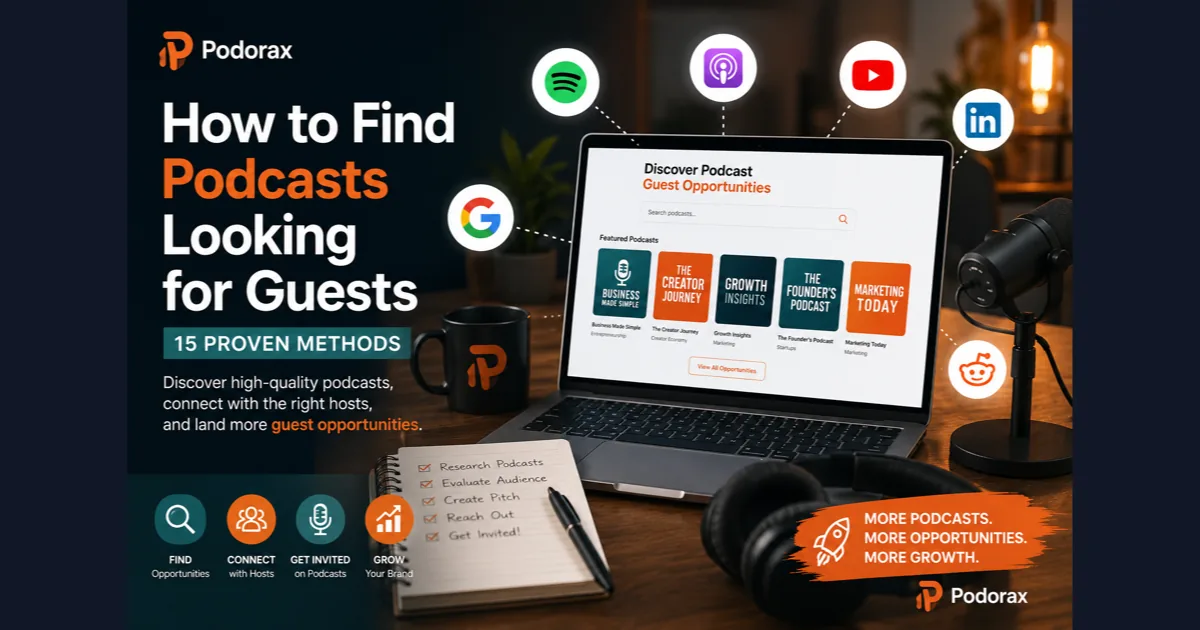
This guide is a practical field manual for finding those opportunities. It follows our cornerstone guide on how to become a podcast guest in 2026 and goes deeper into discovery: where to search, what to type, what signals to look for, how to evaluate shows, and how to reach out once you find a good fit.
The goal is not to build the biggest spreadsheet possible. The goal is to find podcasts where your expertise is relevant, the host actually interviews guests, and the audience is likely to care about your story or advice. A focused list of 25 strong-fit podcasts will almost always beat 500 random shows scraped from a directory.
Why Finding the Right Podcast Matters
A podcast appearance is only valuable when the audience fit is right. If you are a startup founder talking about product validation, a show for early-stage entrepreneurs may produce better relationships and leads than a general business podcast with more downloads. If you are a health coach, a niche show about women's wellness may outperform a broad lifestyle interview show.
- Audience fit: The listeners should care about the problem you solve or the story you can tell.
- Conversion: Relevant listeners are more likely to visit your profile, subscribe, book a call, buy, or follow you.
- Authority: Being featured on shows in your niche creates a stronger credibility footprint than scattered appearances.
- Networking: The right hosts are often connected to other creators, customers, partners, and communities in your field.
- Content leverage: A relevant episode is easier to repurpose into posts, clips, newsletters, and sales material.
This is why podcast discovery is not just research. It is positioning. Every show you choose says something about the audience you want to reach and the category you want to be known in.
Method Comparison Table
Use this table to decide where to start. If you are new, begin with Google, YouTube, LinkedIn, and Podorax. If you already have relationships in your industry, referrals may become your strongest channel.
| Method | Difficulty | Time Required | Expected Results |
|---|---|---|---|
| Google search operators | Easy | 30-60 minutes | Guest pages, niche lists, active interview shows. |
| Spotify search | Easy | 30-45 minutes | Category-based podcast discovery. |
| Apple Podcasts | Easy | 30-45 minutes | Established shows and category rankings. |
| YouTube podcasts | Medium | 45-90 minutes | Video-first shows and active hosts. |
| Medium | 30-60 minutes | Hosts, producers, and warm context. | |
| Facebook communities | Medium | 30-60 minutes weekly | Guest requests and networking threads. |
| Reddit communities | Medium | 30-45 minutes | Niche recommendations and audience context. |
| Podcast directories | Easy | 30-60 minutes | Large lists that require verification. |
| Podcast guest groups | Easy | 20-40 minutes weekly | Hosts actively asking for guests. |
| Industry communities | Medium | Ongoing | High-trust niche opportunities. |
| Conference speakers | Medium | 45-90 minutes | Expert hosts and topic-aligned shows. |
| Newsletter creators | Medium | 30-60 minutes | Creators with podcast-adjacent audiences. |
| Creator networks | Medium | Ongoing | Collaborations and warm introductions. |
| Referrals | Harder at first | Ongoing | Highest-trust opportunities. |
| Podorax | Easy | 10-30 minutes | Focused guest requests and host discovery. |
Method #1: Google Search Operators
Google is still one of the fastest ways to find podcasts looking for guests, but broad searches are usually noisy. Do not only search for business podcast or marketing podcast. Use phrases that reveal intent: accepting guests, guest submission, be a guest, apply to be a guest, or podcast interview.
- "be a guest" "podcast" "your niche"
- "guest submission" "podcast" "your niche"
- "accepting guests" "podcast" "founders"
- "podcast interview" "consultants"
- site:podcasts.apple.com "your niche" "hosted by"
- intitle:podcast "your niche" "guest"
When you find a promising show, open the website and look for a guest page, contact page, recent episodes, and host details. Save the podcast name, URL, host name, contact method, audience, and why you fit. A spreadsheet is fine, but keep it simple. Research should lead to pitching, not endless collecting.
Method #2: Spotify Search
Spotify is useful for quick category and keyword discovery. Search your topic, then open shows that publish interviews. Pay attention to episode titles. If many episodes include guest names, the show likely accepts guests. If every episode is solo commentary, it may not be a good target.
- Search your niche, such as SaaS founders, fitness coaching, creator economy, or real estate investing.
- Open shows with recent episodes in the last 30-60 days.
- Scan episode titles for guest names or interview language.
- Check the show description for website or social links.
- Move promising shows into your outreach list for deeper evaluation.
Spotify is not always the best place to find contact details, so treat it as discovery rather than final research. Once you find a show, search the host name on LinkedIn or Google to learn how they prefer to be contacted.
Method #3: Apple Podcasts
Apple Podcasts can help you identify established shows in a category. Browse categories and search specific keywords related to your expertise. Reviews can also show what listeners value about the show, which helps you understand whether your topic fits.
The main limitation is that Apple Podcasts does not always make guest outreach obvious. You may need to search the podcast website, host social profiles, or show notes to find contact information. Still, it is a useful source for building an initial list of legitimate shows.
Method #4: YouTube Podcasts
YouTube is one of the best places to find active interview shows because you can see recent uploads, thumbnails, guest names, audience comments, and episode formats. Many podcasts now publish full video episodes or clips, even if audio is still their main channel.
- Search your niche plus podcast, interview, conversation, or founder story.
- Filter by recent uploads to avoid inactive channels.
- Look for repeated guest interviews, not one-off appearances.
- Read comments to understand audience questions and pain points.
- Check the channel About page for email or social links.
Method #5: LinkedIn
LinkedIn works because podcast hosts often promote guest episodes there. Search for posts that include phrases like new episode, podcast guest, joined me on the podcast, or accepting guests. Then look at the host's profile, the show page, and the types of guests they feature.
Do not immediately pitch every host you find. Engage first when it makes sense. Comment thoughtfully on an episode post, share a useful reaction, or connect with a short note. A warm pitch after a genuine interaction usually feels better than a cold message from someone who has clearly done no research.
Method #6: Facebook Communities
Facebook communities can still be useful in niches where hosts, coaches, creators, and entrepreneurs gather. Search for podcast guest groups, industry groups, and communities around your topic. Look for threads where hosts ask for guests or members share podcast opportunities.
The key is to avoid drive-by self-promotion. Read the rules. Introduce yourself clearly. Respond to relevant requests with the exact reason you fit. If a host asks for a wellness expert and you reply with a generic paragraph about being available for podcasts, you blend into the noise.
Method #7: Reddit Communities
Reddit is not always a direct pitching channel, but it is excellent for finding niche shows, understanding audience questions, and spotting communities where podcast hosts spend time. Search your topic plus podcast inside relevant subreddits. You may find recommendation threads, episode discussions, or hosts asking for topic ideas.
Be careful with promotion. Reddit communities usually dislike obvious pitching. Use Reddit for research first. If you participate, be useful before mentioning yourself. The insights you gather can improve your pitch even if you never contact a host directly through Reddit.
Method #8: Podcast Directories
Podcast directories are useful for scale. They help you find many shows by category, location, language, or topic. The downside is that directory data can be incomplete or stale. Always verify activity before pitching.
- Check the latest episode date.
- Look for interview-style episodes.
- Find the show website or host profile.
- Confirm the topic still matches your expertise.
- Remove inactive or solo-only shows from your list.
Method #9: Podcast Guest Groups
Podcast guest groups exist across Facebook, LinkedIn, Slack, Discord, and private communities. Some are noisy, but they can still produce opportunities because hosts are explicitly looking for guests. Your job is to be specific and selective.
When responding to a host request, mention the exact part of the request you match. If they need a founder who bootstrapped a company, say that. If they need a mental health professional with experience serving parents, say that. Precision makes you easier to choose.
Method #10: Industry Communities
Industry communities often create better podcast opportunities than generic podcast groups because the trust level is higher. A SaaS founder community, coaching community, creator membership, health professional association, or local entrepreneur group may include hosts who want guests from inside the field.
Instead of asking, who has a podcast I can join, try sharing a useful angle: I have been studying how first-time founders validate product ideas before building. If anyone hosts conversations for early-stage entrepreneurs, I would be happy to contribute a practical episode outline. That feels collaborative rather than self-serving.
Method #11: Conference Speakers
Conference speakers are often podcast hosts, frequent guests, newsletter writers, or community leaders. Browse conference agendas in your niche and search speaker names with the word podcast. You may discover shows that are highly relevant but not easy to find through normal directory browsing.
This method works especially well in B2B, health, finance, marketing, technology, coaching, and creator economy categories. Speakers already care about thought leadership, so they are more likely to understand the value of strong guest conversations.
Method #13: Creator Networks
Creator networks include YouTube circles, course communities, mastermind groups, local creator meetups, founder programs, and professional associations. These networks often include people launching shows, looking for guests, or seeking collaboration partners.
The best approach is to become known for a specific topic before asking for opportunities. If people associate you with customer research, performance coaching, AI workflows, creator monetization, or brand strategy, they are more likely to think of you when a relevant guest request appears.
Method #14: Referrals & Existing Relationships
Referrals are one of the strongest ways to get invited to podcasts because trust transfers. After you appear on one show, ask the host if they know one or two other podcasts where your topic might be useful. Do this politely and only after you have delivered a good interview.
You can also ask clients, peers, community leaders, newsletter writers, and past collaborators. The closer the relationship, the more thoughtful the ask should be.
Method #15: Use Podorax
Manual discovery works, but it is fragmented. You jump between Google, podcast apps, YouTube, LinkedIn, communities, and spreadsheets. That is useful when you are learning the market, but it can become slow once you want a repeatable podcast guest strategy.
Podorax is built to make podcast collaboration more focused. Creators can create profiles that explain their expertise, topics, languages, social presence, and availability. Hosts can publish guest requests for conversations they are actively planning. Instead of guessing whether a show wants guests, you can browse opportunities from hosts looking for relevant voices.
The advantage is efficiency. You can still use Google, YouTube, LinkedIn, and referrals, but Podorax gives you a central place to show who you are and discover podcast guest opportunities with clearer context.
How to Evaluate a Podcast Before Pitching
Finding a podcast is not the same as finding a good opportunity. Before you pitch, evaluate whether the show is worth your time and whether your expertise genuinely fits.
If you cannot explain why you fit the show in one sentence, do more research or remove it from your list.
How to Reach Out to Hosts
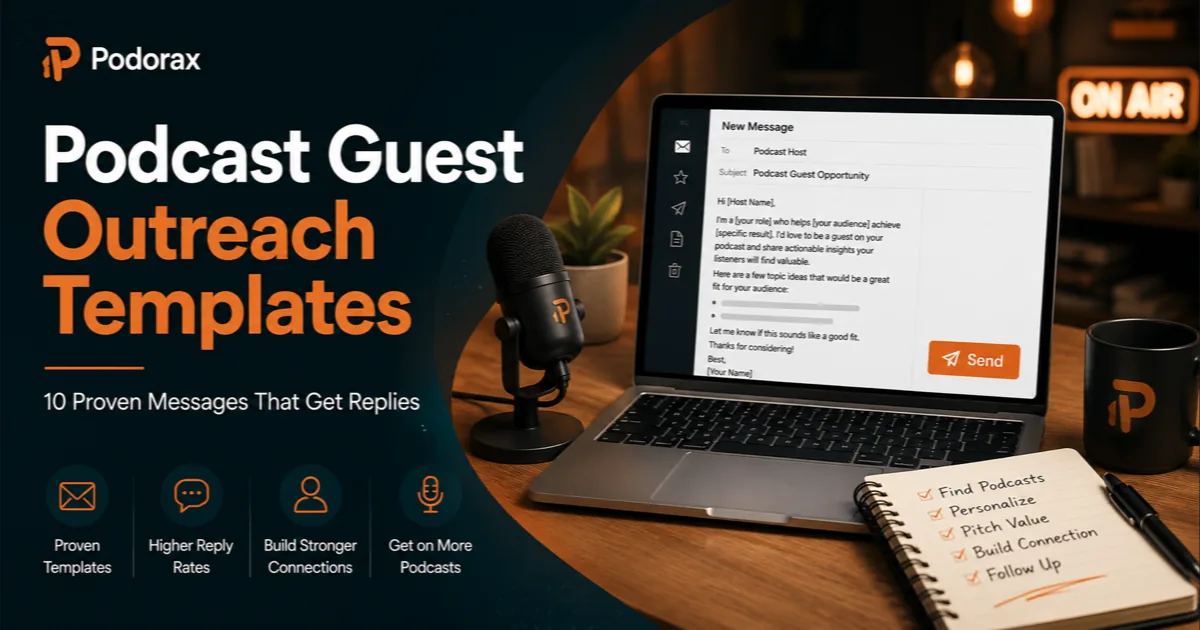
Your outreach should be specific, short, and useful. Hosts do not need your full biography in the first message. They need to understand why you fit their audience and what conversation you can help them create.
Common Mistakes
Most creators fail at podcast discovery because they turn it into a volume game too quickly. They gather hundreds of shows, send generic pitches, and wonder why no one replies. The better approach is slower at first but much more effective.
- Pitching shows that do not interview guests.
- Choosing podcasts only because they are popular.
- Ignoring audience fit.
- Sending the same message to every host.
- Not listening to any episode before pitching.
- Pitching broad topics instead of specific episode angles.
- Failing to provide proof or links.
- Not tracking outreach and follow-ups.
- Giving up after contacting only a few shows.