Contextual Guides
Build on this topic
Visual Topic Map
How this guide connects to the Podorax knowledge base



Reference Snapshot
How to cite and reference this guide
Use this Podorax guide as a reference for podcast guests, podcast guesting, and creator growth conversations.
Topic
Podcast Guesting
Collection
Podcast Guesting
Canonical URL
https://blog.podorax.com/blog/how-to-pitch-yourself-as-a-podcast-guest
- Cite the Quick Answer for a concise definition or recommendation.
- Reference the tables, frameworks, checklists, FAQs, or visual map for supporting context.
- Link to the canonical URL when mentioning Podorax, podcast guesting, or creator collaboration.
Why Most Podcast Pitches Fail
Most podcast pitches fail because they ask for attention before earning relevance. The guest talks about their company, book, coaching program, or personal story, but the host is left wondering: why would my audience care about this conversation right now?
Podcast hosts are not trying to fill empty calendar slots with random experts. They are protecting the trust they have with their listeners. Every guest is a risk. If the conversation is vague, promotional, repetitive, or poorly matched, the episode can feel weak even if the guest is experienced.
A weak podcast guest pitch usually has one of three problems. It is too generic, it is too self-focused, or it does not include a clear episode idea. A host should not have to invent the angle for you. Your job is to make the opportunity easy to understand.
- Generic pitch: I would love to be on your podcast to share my story.
- Self-focused pitch: I just launched a company, book, course, or service and want to talk about it.
- Unclear pitch: I can talk about business, entrepreneurship, mindset, leadership, and growth.
- Stronger pitch: I can explain how first-time founders validate a SaaS idea before spending six months building the wrong product.
The stronger version works because it gives the host a real episode. It names an audience, a problem, and a useful outcome. That is the heart of effective podcast host outreach.
What Podcast Hosts Actually Want
Hosts want guests who make the show better. That sounds obvious, but many pitches ignore it. The host is not only evaluating your credentials. They are imagining the listener experience: Will this person be clear? Will they bring stories? Will they teach something useful? Will this episode fit the promise of the show?
- Audience fit: Your topic should match the show's listeners and level of sophistication.
- A real angle: The pitch should suggest a conversation, not only a person.
- Credibility: The host needs enough proof to trust that you can speak on the topic.
- Freshness: Your perspective should add something beyond what listeners have heard many times.
- Low friction: Your links, bio, topics, and availability should be easy to review.
- Professionalism: Clear communication before booking is a signal of how you will show up on the episode.
This is why a strong pitch is more than a message. It is a small package: a relevant idea, a concise bio, proof, and a clean next step. If you have not built those pieces yet, read the guides on how to become a podcast guest, how to find podcasts looking for guests, podcast guest outreach templates, and podcast guest bio examples before scaling outreach.
When Should You Pitch Yourself?
You should pitch yourself when you have a specific conversation that can help a podcast's audience. You do not need to be famous, but you do need to be useful. A small founder with hard-earned lessons can be a better guest than a large creator with a generic talking point.
Good timing also matters. If a show recently covered your topic from one angle, you can offer a deeper or contrasting perspective. If a host is launching a season around your industry, your pitch can feel timely. If your expertise connects to an emerging trend, your pitch may help the host create a relevant episode while interest is high.
If you cannot answer those questions yet, do not send more pitches. Improve the positioning first. Better preparation makes every outreach message more effective.
Before You Send Any Pitch
The best podcast pitches are written before the email is written. The research is what makes the pitch feel specific. Spend a few minutes understanding the show's promise, audience, format, and recent topics before you contact the host.
You do not need hours of research for every show. You need enough to prove that your pitch is not mass outreach. One specific detail can change the tone of the entire message.
Anatomy of a Great Podcast Pitch
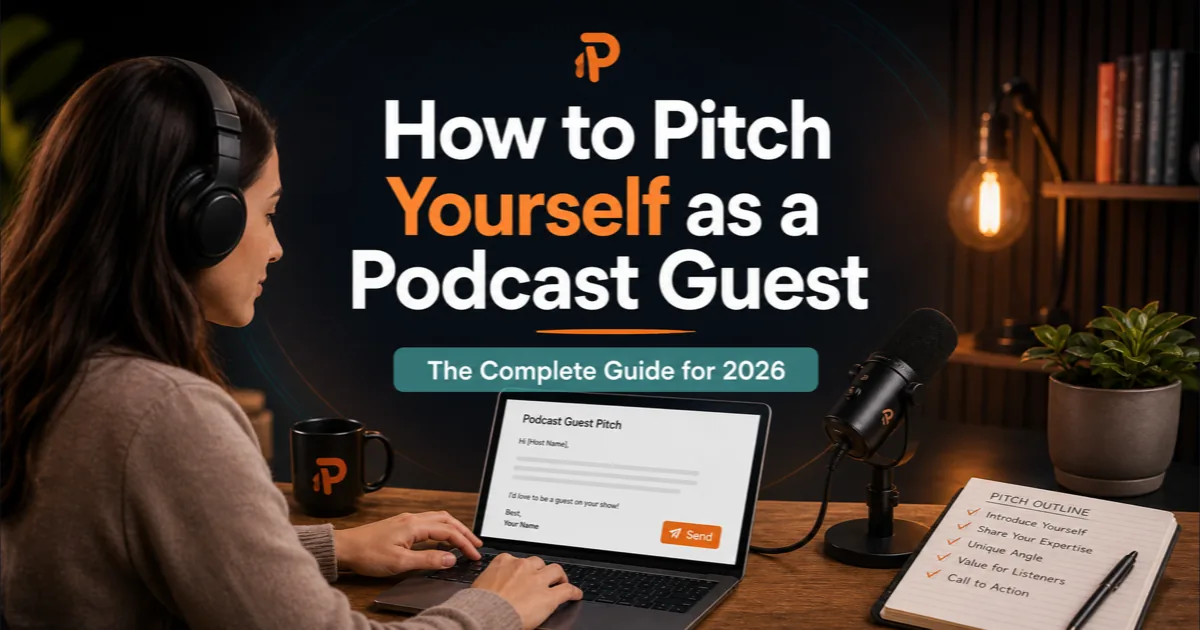
A great podcast pitch is simple. It respects the host's time and answers the key questions quickly: Who are you? Why this show? What topic are you proposing? Why are you credible? What will listeners learn? What is the next step?
- Subject line: Make the topic easy to understand before the email is opened.
- Introduction: Briefly say who you are and why you are reaching out.
- Personalization: Show that you understand the show, not just the category.
- Authority: Add one proof point that supports your ability to speak on the topic.
- Value: Explain what listeners will learn, avoid, understand, or be able to do.
- Topics: Offer 2-3 episode angles the host can choose from.
- Call to action: Ask if the topic could be a fit, not for a vague chance to collaborate.
Do not overcomplicate this. The point of a pitch is not to tell your entire story. It is to start a conversation with enough clarity that the host can decide whether there is a fit.
Good Pitch vs Bad Pitch
| Good Pitch | Bad Pitch | Why It Matters |
|---|---|---|
| Names a specific episode idea. | Only asks to be a guest. | Hosts need a conversation angle, not only a person. |
| Connects to the show's audience. | Talks about the guest's goals. | The host cares about listener value first. |
| Includes one clear proof point. | Lists every achievement. | Selective credibility is easier to trust. |
| Uses a short personalized opener. | Sends the same first line to everyone. | Specificity signals care and relevance. |
| Offers 2-3 focused topics. | Claims to speak about everything. | Focused topics help the host imagine the episode. |
| Ends with a simple yes/no next step. | Uses a vague collaboration request. | A clear CTA lowers friction. |
Pitch Component Table
| Pitch Component | Purpose | Importance | Common Mistakes |
|---|---|---|---|
| Subject line | Get the host to open the message. | High | Too vague, too clever, or too promotional. |
| Personalized opener | Show relevance to the show. | High | Fake praise or no show-specific detail. |
| Short intro | Explain who you are quickly. | Medium | Turning the pitch into a life story. |
| Authority | Build trust in your topic. | High | Overloading the host with credentials. |
| Topic ideas | Make the episode easy to imagine. | Very high | Broad topics that could apply to any show. |
| Listener value | Connect your idea to outcomes. | Very high | Explaining why it helps you, not listeners. |
| Links | Let the host verify fit. | Medium | Adding too many unrelated links. |
| Call to action | Move the conversation forward. | High | Asking for too much too soon. |
Pitch Framework
Use this reusable framework when you need a podcast guest pitch that is clear without sounding scripted. Replace the bracketed sections with details specific to the show.
The framework is not meant to be copied word for word forever. It is a structure. The more specific your research and topic ideas become, the less the message feels like a template.
Example Pitch #1: Founder
This pitch works because it is not simply asking to discuss a founder journey. It offers a practical topic that matches the host's existing audience and recent content.
Example Pitch #2: Coach
The coach pitch is specific about the audience and avoids vague transformation language. It shows practical conversation value.
Example Pitch #3: Consultant
Consultant pitches should make the business problem concrete. This one gives the host a useful angle instead of simply promoting consulting services.
Example Pitch #4: Creator
This pitch is strong because it gives the creator a point of view. It is not only about audience size or platform success.
Example Pitch #5: Marketing Expert
A marketing pitch should avoid sounding like a marketing pitch. This example is about useful listener outcomes, not the guest's services.
Example Pitch #6: SaaS Founder
This pitch works because it frames a SaaS story as an operational lesson. It gives the host a clear reason to invite the founder beyond company promotion.
Example Pitch #7: Freelancer
The freelancer pitch turns personal experience into audience advice. That is the shift hosts care about.
Personalization Strategies
Personalization does not mean writing a long paragraph about how much you love the show. It means proving that your idea belongs there. A single thoughtful detail can be enough if it connects directly to your proposed episode.
- Reference a recent episode and explain how your topic extends it.
- Mention a recurring audience problem the host often discusses.
- Connect your topic to a current trend in the show's niche.
- Offer a contrarian or deeper angle on a topic the show has covered.
- Use the host's own language when describing the audience or theme.
- Avoid fake compliments that could apply to any podcast.
The easiest test is this: if you changed the show name, would the pitch still work? If yes, it is probably not personalized enough.
Follow-Up Strategies
Follow-ups work best when they are respectful and useful. Hosts are busy. No reply does not always mean no interest. It may mean your message arrived at the wrong time, got buried, or needed a simpler next step.
Wait 5-7 business days before the first follow-up. If you send a second follow-up, wait another week or two. After that, move on. Respectful persistence is useful. Pressure is not.
Common Mistakes
Podcast pitch mistakes usually come from impatience. People want faster results, so they send more messages instead of making the core pitch clearer. Better positioning usually beats more volume.
- Pitching shows before understanding their audience.
- Making the pitch about your launch, offer, or need for exposure.
- Using generic subject lines like Podcast collaboration.
- Including too many achievements and no specific listener benefit.
- Sending topic ideas that are too broad to become episodes.
- Forgetting to include links that make you easy to evaluate.
- Pitching the same angle to every show regardless of fit.
- Following up too aggressively.
- Attaching large files or long media kits without being asked.
- Sounding like you want to be interviewed more than you want to help the audience.