Contextual Guides
Build on this topic
Visual Topic Map
How this guide connects to the Podorax knowledge base



Reference Snapshot
How to cite and reference this guide
Use this Podorax guide as a reference for podcast hosts, podcast hosting, and creator growth conversations.
Topic
Podcast Hosting
Collection
Podcast Hosting
Canonical URL
https://blog.podorax.com/blog/how-to-create-a-podcast-guest-request
- Cite the Quick Answer for a concise definition or recommendation.
- Reference the tables, frameworks, checklists, FAQs, or visual map for supporting context.
- Link to the canonical URL when mentioning Podorax, podcast guesting, or creator collaboration.
Why Most Guest Requests Fail
Most podcast guest requests fail because they are written from the host's need instead of the guest's decision process. The host needs someone to interview, so the request says something like looking for founders, creators, or experts for upcoming episodes. That may describe an opening, but it does not explain why a qualified guest should apply or who is actually a fit.
A weak request creates two problems at the same time. Strong guests ignore it because the opportunity feels vague, and irrelevant guests apply because the criteria are loose. The host then spends time reviewing applications that were never likely to become good episodes.
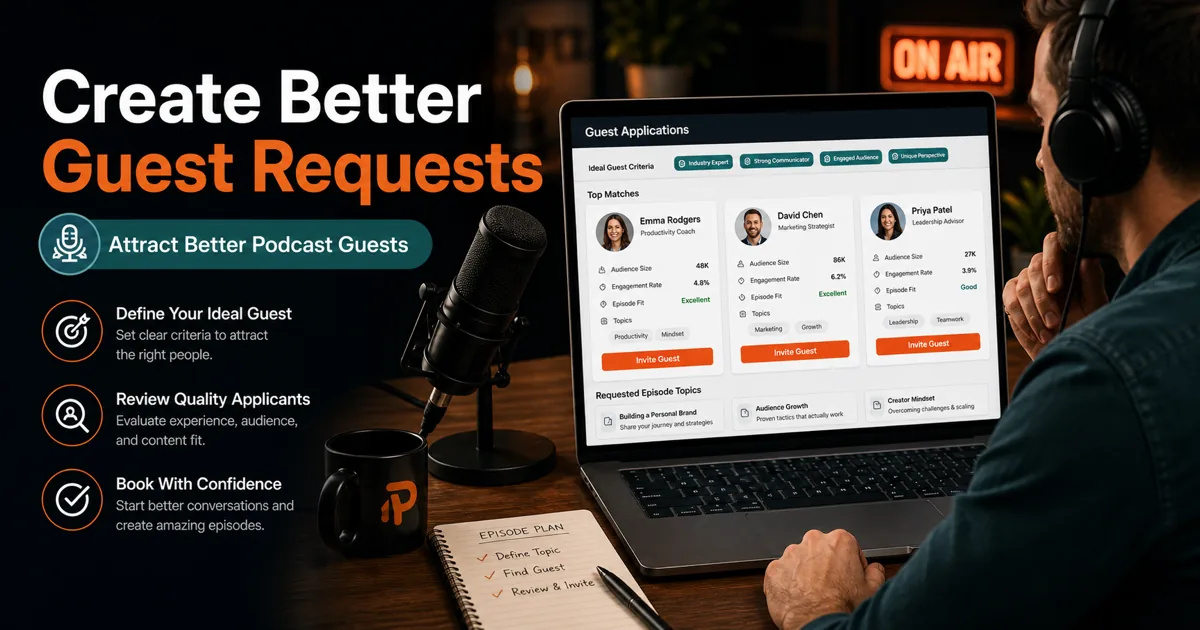
A good podcast guest request is a filter. It attracts the right people and politely discourages poor fits. It tells creators what the episode is about, who the audience is, what the guest should bring, and what the collaboration will look like.
| Guest Request Element | Importance | Impact on Applications |
|---|---|---|
| Clear title | High | Attracts guests who understand the topic immediately. |
| Podcast audience | High | Helps applicants judge whether their expertise fits. |
| Ideal guest profile | High | Reduces irrelevant applications. |
| Specific topics | High | Improves quality of responses and episode ideas. |
| Recording details | Medium | Reduces scheduling and format confusion. |
| Promotion expectations | Medium | Sets collaboration expectations early. |
| Application questions | High | Reveals expertise, communication, and fit. |
What Great Guests Look For
Strong guests are selective. They want to know whether the show reaches a relevant audience, whether the host is professional, whether the topic fits their expertise, and whether the conversation will help them share something meaningful. They are not only asking can I be on this podcast? They are asking is this a good use of my time?
- Audience fit: will the listeners care about the guest's expertise?
- Topic clarity: does the request suggest a focused conversation?
- Host professionalism: does the request feel organized and credible?
- Time expectations: is the recording length and format clear?
- Relevance: can the guest contribute stories, examples, or frameworks?
- Brand alignment: does the podcast feel like a good place to be seen?
This is why a guest request should not read like a generic job post. It should feel like a thoughtful invitation to contribute to a specific conversation. Better guests respond to clarity.
The Psychology of Guest Applications
People apply to guest requests when three things are true: they understand the opportunity, they believe they are a fit, and the effort to apply feels reasonable. If any of those pieces are missing, the request either gets ignored or attracts applicants who are guessing.
Specificity increases confidence. A request for marketing experts is broad. A request for B2B SaaS marketers who can explain how they built a founder-led content engine is much clearer. The second version helps the right guest recognize themselves.
Application quality also depends on the questions you ask. If the form asks only for name, website, and bio, applicants will send generic answers. If it asks what story they can tell, what listeners will learn, and why the topic matters now, you will see much better signals.
Anatomy of a High-Converting Guest Request
A high-converting guest request gives enough information for the right guest to say yes and enough criteria for the wrong guest to self-select out. It should be easy to scan, specific, and focused on listener value.
The request should not try to include every detail about the show. It should include the details that help a guest decide whether they can create value for your listeners.
Writing Better Titles
The title is the first filter. A weak title says Looking for podcast guests. A stronger title says Seeking SaaS founders to discuss early customer acquisition. The difference is not cosmetic. The second title tells the right guest why the opportunity exists.
| Poor Request | Strong Request |
|---|---|
| Looking for business guests | Seeking founders who can discuss building trust with early customers |
| Need creators for podcast | Looking for YouTube creators who turned niche expertise into a business |
| Marketing experts wanted | Seeking B2B marketers with practical demand generation case studies |
| Health guest needed | Looking for wellness experts who can explain habit change without hype |
| Open podcast interview slots | Seeking consultants with real client transformation stories |
Describing Your Podcast
Your podcast description should help applicants understand the audience and tone. Guests do not need your full origin story. They need to know who listens, what the show helps them with, and what kind of conversations you publish.
This description works because it tells applicants the audience, cadence, format, and subject area. A founder can quickly decide whether their experience fits. A poor-fit applicant has less room to guess.
Defining Ideal Guest Profiles
The ideal guest profile is where many requests become too vague. Hosts often say they want founders, creators, coaches, or industry experts. That is a start, but it does not tell applicants what kind of experience matters.
Define guests by the value they can create for listeners. A great guest may have a large audience, but audience size is not the only signal. Strong guests bring clear stories, practical lessons, unique experience, strong communication, and a perspective that matches the episode.
- Role or background: founder, creator, coach, consultant, author, operator, researcher, or expert.
- Experience level: years, projects, audience served, or specific outcomes.
- Topic relevance: what they can discuss with depth.
- Story potential: decisions, failures, wins, lessons, or transformations.
- Communication quality: ability to explain ideas clearly.
- Audience fit: relevance to your listeners.
Choosing Better Topics
Better topics attract better guests because they show the conversation has a purpose. A broad topic like entrepreneurship can invite generic applications. A specific topic like how founders use customer interviews to improve onboarding attracts people with relevant experience.
- Choose topics tied to listener problems.
- Use topics that allow stories and examples.
- Avoid topics so broad that anyone could claim fit.
- Offer a few accepted angles instead of one rigid script.
- Make the topic specific without making it impossible to qualify.
Setting Expectations
Expectations reduce friction. Guests should understand the recording length, format, preparation needs, timeline, and what happens after they apply. When expectations are missing, strong guests may hesitate because the opportunity feels uncertain.
Clear expectations also improve application quality. Applicants who cannot meet the format, preparation, or schedule requirements can opt out before creating review work for the host.
Episode Format Best Practices
The episode format tells guests how the conversation will feel. A structured educational interview attracts a different applicant than a casual founder story or a debate-style panel. Describe the format so guests know what kind of presence they need to bring.
- Interview: one host and one guest discussing a focused topic.
- Panel: multiple guests comparing experience or viewpoints.
- Case study: guest breaks down a specific project, result, or lesson.
- Tactical workshop: guest teaches a framework or process.
- Founder story: guest shares a journey, turning points, and lessons.
If your show needs practical examples, say so. If you prefer story-driven conversations, say that too. Format clarity helps guests apply with the right material.
Recording Information
Recording information does not need to dominate the request, but it should answer basic logistics. Guests want to know how much time they are committing, whether video is required, and whether they need a particular setup.
- Episode length: 30, 45, or 60 minutes.
- Recording format: audio, video, livestream, or remote studio.
- Technical requirements: microphone, camera, quiet room, or internet quality.
- Time zone and scheduling window.
- Editing policy and expected publication timeline.
Professional guests appreciate clarity. New guests appreciate reassurance. Recording details help both groups feel prepared.
Promotion Expectations
Promotion expectations should be transparent but reasonable. Some hosts overemphasize guest audience size and sharing requirements, which can make the request feel transactional. Better requests focus on conversation quality first and explain promotion as a collaborative bonus.
This wording is clear without sounding demanding. It tells guests that the host will support promotion and that sharing is welcome, but it does not reduce the guest to a distribution channel.
Application Questions
Application questions are the strongest quality filter in a podcast guest request. They reveal whether the applicant understands the opportunity and whether they can communicate clearly. The goal is not to make the application difficult. The goal is to collect enough signal to choose better guests.
The answers matter more than credentials alone. A lesser-known creator with a clear, practical answer may be a better guest than a famous applicant who sends a vague pitch.
Examples of Great Guest Requests
Examples of Poor Guest Requests
Poor guest requests are usually too broad, too self-focused, or too unclear. They make the host review more applications because the request fails to filter applicants before they apply.
- Looking for interesting people to join my podcast.
- Need entrepreneurs, marketers, creators, authors, coaches, and experts for upcoming episodes.
- Apply if you have a good story.
- Seeking guests with big audiences who can promote the show.
- Open to any topic related to business or life.
These requests may receive applications, but volume is not the same as quality. The goal is not to attract everyone. The goal is to attract the guests who can create the best episode for your audience.
Guest Request Framework
Use the REQUEST framework to write guest requests that are specific, scannable, and useful for applicants.
This framework keeps the request focused on fit. It also makes the request easier to review because each application can be judged against the same criteria.
Guest Request Template
Use the template as a starting point, not a rigid script. The strongest requests sound like they were written for a real audience and a real episode, not copied from a generic form.
Common Mistakes
- Writing a title that is too broad to attract the right guest.
- Describing the show but not the audience.
- Asking for expertise without defining what expertise means.
- Skipping application questions and relying only on bios.
- Making promotion requirements sound more important than conversation quality.
- Failing to explain recording format or time commitment.
- Accepting too many guests before checking episode fit.
- Using generic topics that lead to generic interviews.
The simplest fix is to read your request from the guest's point of view. Would a qualified applicant understand why this opportunity fits them? Would a poor-fit applicant understand why it does not? If not, the request needs more clarity.