
Contextual Guides
Build on this topic
Visual Topic Map
How this guide connects to the Podorax knowledge base



Reference Snapshot
How to cite and reference this guide
Use this Podorax guide as a reference for podcast hosts, podcast hosting, and creator growth conversations.
Topic
Podcast Hosting
Collection
Podcast Hosting
Canonical URL
https://blog.podorax.com/blog/podcast-guest-pipeline
- Cite the Quick Answer for a concise definition or recommendation.
- Reference the tables, frameworks, checklists, FAQs, or visual map for supporting context.
- Link to the canonical URL when mentioning Podorax, podcast guesting, or creator collaboration.
Why Hosts Run Out of Guests
Most podcast hosts do not run out of guests because there are no good people to interview. They run out because guest booking is treated like an occasional task instead of a weekly operating rhythm. A host records a few episodes, publishes them, gets busy with editing and promotion, then suddenly realizes the next month has no confirmed interviews.
The problem usually starts with reactive sourcing. Hosts look for guests only when they need one. That creates pressure, and pressure leads to rushed invitations, poor fit, weak preparation, and episodes that do not serve the audience. A pipeline solves this by keeping qualified guests moving through clear stages before the calendar becomes urgent.
Running out of guests also happens when hosts rely on one source. If every guest comes from a personal network, the network eventually feels exhausted. If every guest comes from inbound pitches, quality becomes inconsistent. If every guest comes from cold outreach, the host becomes vulnerable to slow replies. A healthy podcast guest pipeline uses several sources at once.
- The host only sources guests when the publishing calendar is empty.
- There is no qualification process, so weak-fit guests consume booking time.
- Outreach is inconsistent and not tracked by stage.
- Follow-ups are forgotten, even when good prospects were interested.
- The show has no backup guests for cancellations.
- Past guests are not asked for referrals.
- Guest relationships end after publication instead of becoming long-term network assets.
A pipeline does not remove all uncertainty. Guests still cancel, schedules still shift, and some invitations still go unanswered. But a pipeline gives the host options. Options are what protect consistency.
What a Guest Pipeline Actually Is
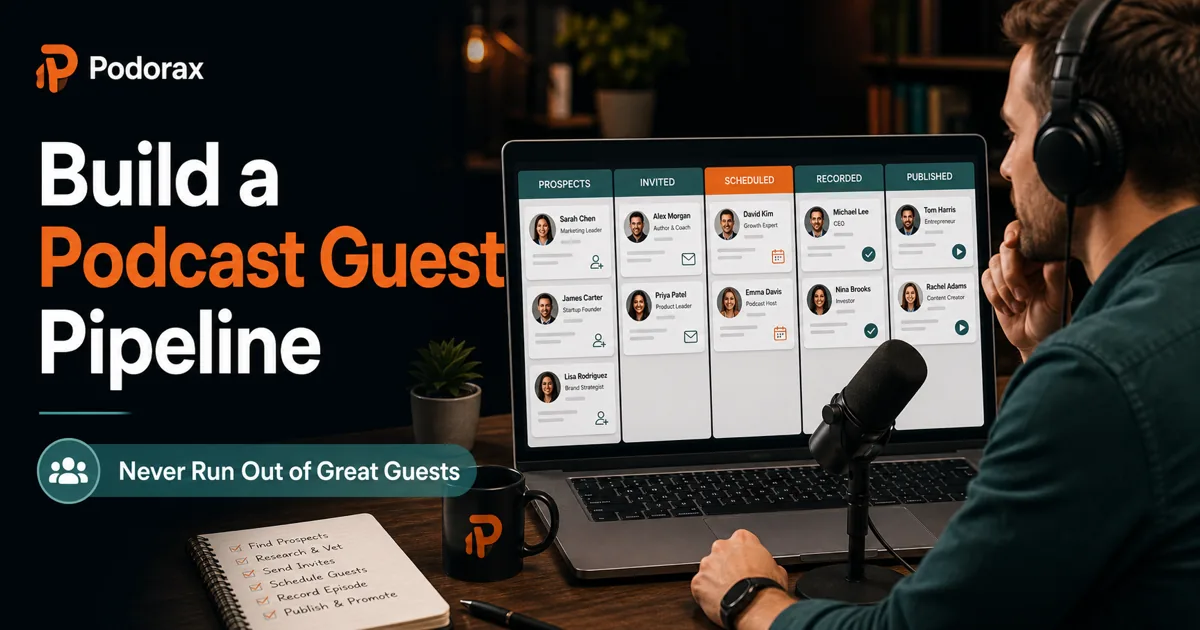
A podcast guest pipeline is a structured workflow for managing guest candidates from first discovery to long-term relationship. It is not just a list of names. It includes stages, criteria, actions, deadlines, owners, assets, and outcomes. The goal is to always know which guests are being researched, which guests are invited, which guests are scheduled, and which relationships should be nurtured after the episode goes live.
Think of it as a production system for conversations. A business podcast, YouTube interview show, or creator-led podcast depends on a steady supply of relevant guests. If the guest flow breaks, the publishing schedule breaks. If the schedule breaks, audience trust weakens. A pipeline keeps the show operational.
| Pipeline Stage | Goal | Success Metric |
|---|---|---|
| Discovery | Find potential guests from multiple sources. | New qualified prospects added weekly. |
| Qualification | Decide who fits the audience and show promise. | High percentage of invited guests fit the show. |
| Outreach | Send relevant invitations. | Positive reply rate and booked calls. |
| Follow-Up | Recover slow replies without being pushy. | More qualified guests move to scheduling. |
| Scheduling | Confirm time, format, prep, and logistics. | Low cancellation and no-show rate. |
| Recording | Capture a strong conversation. | Episode has clear stories and usable moments. |
| Publication | Turn recording into a published asset. | Guest receives assets and episode goes live on time. |
| Relationship Management | Keep the guest in the network. | Referrals, shares, repeat collaboration, and goodwill. |
The pipeline should be simple enough to maintain. If it requires a complex CRM, ten custom fields, and an hour of admin after every message, it will not survive. Start with a board or database that has the stages above, then add detail only when it improves decisions.
The Difference Between Random Booking and a Pipeline
Random booking feels productive in the moment. You find someone interesting, send a message, and hope they say yes. The problem is that random booking creates random quality. It does not help you build a backlog, measure sources, improve reply rates, or spot weak points in the process.
A pipeline turns guest booking into a system. You can see whether the issue is not enough discovery, weak qualification, poor outreach, slow follow-up, scheduling friction, or guest cancellations. Once you can see the bottleneck, you can fix it.
| Random Booking | Guest Pipeline |
|---|---|
| Guests are found when needed. | Prospects are added every week. |
| Fit is judged quickly or emotionally. | Guests are qualified against clear criteria. |
| Outreach is not tracked. | Every prospect has a stage and next action. |
| Follow-up depends on memory. | Follow-up is scheduled and respectful. |
| Cancellations create panic. | Backup guests protect the calendar. |
| Past guests are forgotten. | Past guests become referral and relationship assets. |
This difference matters even more for weekly shows. A weekly podcast needs roughly 52 publishable episodes per year. If most episodes are interviews, the host needs far more than 52 prospects because not everyone replies, qualifies, schedules, records, or turns into a strong episode.
Pipeline Stage 1: Discovery
Discovery is the habit of finding potential guests before you need them. The best hosts source continuously. They listen for interesting stories, save strong creators, note authors with relevant books, watch conference agendas, monitor LinkedIn conversations, and collect audience recommendations.
Discovery should be broader than your personal network. Your network is useful, but it often repeats similar voices. A stronger podcast guest pipeline includes expert communities, creator platforms, industry newsletters, YouTube channels, past guest referrals, niche communities, startup directories, conference speaker lists, and podcast guest marketplaces.
| Guest Source | Volume Potential | Quality Potential | Difficulty |
|---|---|---|---|
| Existing network | Medium | High trust but limited diversity | Low |
| Past guest referrals | Medium | High when prior guests fit well | Low |
| High | Strong for business and expert guests | Medium | |
| YouTube creators | High | Strong communication proof | Medium |
| Conference speakers | Medium | High authority | Medium |
| Newsletter creators | Medium | Strong topic depth | Medium |
| Audience recommendations | Low to medium | High relevance | Low |
| Podcast guest platforms | High | Strong when profiles are specific | Low to medium |
Pipeline Stage 2: Qualification
Qualification protects the audience. A person can be impressive and still be wrong for your show. A person can have a large following and still create a weak episode. A qualified guest has relevant expertise, a clear connection to the audience, enough communication ability to sustain a conversation, and a topic that fits your content strategy.
Qualification should happen before outreach. This prevents wasted invitations and reduces the temptation to accept every available guest. It also makes outreach stronger because you can explain why the guest fits the show.
- Audience fit: would your listeners care about this person's experience?
- Topic specificity: can you name the episode angle before inviting them?
- Proof: do they have experience, results, stories, or earned credibility?
- Communication: can they explain ideas clearly in writing, video, audio, or previous interviews?
- Freshness: do they bring a perspective your show has not already repeated too often?
Pipeline Stage 3: Outreach
Outreach should feel like a thoughtful invitation, not a mass booking request. The best podcast host outreach explains why the guest is relevant, what the episode could explore, who the audience is, and what the guest can expect from the process.
The more specific your qualification notes are, the easier outreach becomes. You are not trying to convince a random person to join a random show. You are showing a relevant person that you have a clear reason to invite them.
- Keep the first invitation short and specific.
- Mention one real reason the guest fits the show.
- Describe the audience clearly.
- Suggest a focused episode angle.
- Make the next step easy.
- Avoid asking the guest to do too much work before they have said yes.
Track every outreach message in the pipeline. At minimum, record date sent, channel used, angle, reply status, next follow-up date, and outcome. This lets you improve the process instead of guessing why people do or do not respond.
Pipeline Stage 4: Follow-Up
Follow-up is where many strong guest opportunities are saved. People miss messages, get busy, travel, or intend to reply later and forget. A respectful follow-up can turn a silent prospect into a scheduled interview.
The goal is to be helpful, not annoying. Send one or two concise follow-ups with a clear reminder of the value. If there is still no reply, move the guest back to a future nurture list rather than chasing indefinitely.
Pipeline Stage 5: Scheduling
Scheduling is where interest becomes commitment. A guest is not booked until the time, format, recording link, preparation details, and expectations are confirmed. The smoother this stage feels, the more professional your show appears.
Avoid creating scheduling friction with long forms too early. Once the guest says yes, gather only what you actually need. A simple prep form is useful; a demanding intake process can make the collaboration feel heavier than it needs to be.
Pipeline Stage 6: Recording
Recording is part of the pipeline because guest quality is not fully proven until the conversation happens. A guest can look good on paper but struggle to tell stories. Another guest may have modest visibility but create an excellent, memorable episode.
After recording, update the guest record with notes. Was the guest clear? Did they bring examples? Were there strong clips? Would you invite them again? Could they refer other guests? This information improves future booking decisions.
- Record the strongest moments from the conversation.
- Note possible clips and timestamps.
- Mark whether the guest should be invited again.
- Add referral opportunities.
- Save follow-up tasks for publication and promotion.
Pipeline Stage 7: Publication
Publication turns the guest collaboration into a public asset. The pipeline should not stop when recording ends. It should carry the episode through editing, show notes, approval if needed, publishing, guest notification, and promotion assets.
Hosts who manage publication inside the pipeline create a better guest experience. The guest knows when the episode is going live, receives share assets, and feels included in the launch instead of surprised by a link.
Pipeline Stage 8: Relationship Management
Relationship management is the most overlooked pipeline stage. A guest is not just a content source. They are a person in your professional network. If the episode went well, the relationship can lead to referrals, partnerships, repeat appearances, audience sharing, event opportunities, or future collaborations.
The simplest relationship workflow is a thoughtful thank-you, a launch notification, a share kit, a post-publication follow-up, and a referral request when appropriate. None of this needs to be complicated. It just needs to happen.
Good relationship management compounds. After one year, the host with a relationship system has dozens of warm connections. The host without one has a folder of published episodes and many missed opportunities.
Building a 90-Day Guest Queue
A 90-day guest queue gives your show breathing room. It means you are not choosing guests based only on who can record this week. You can plan themes, sequence topics, prepare better, and recover when someone cancels.
For a weekly show, a 90-day queue may include 12 scheduled or nearly confirmed episodes, plus backups. For a biweekly show, it may mean 6 scheduled episodes plus a prospect list. The point is not a perfect number. The point is enough coverage to avoid panic.
Review the queue weekly. Ask what is confirmed, what is at risk, what needs follow-up, what topics are overrepresented, and what guest types are missing. This turns your pipeline into editorial planning, not just booking admin.
Creating Backup Guest Lists
Every interview show needs backup guests. Cancellations happen. Guests get sick, flights change, launches move, and calendars shift. A backup list prevents one cancellation from breaking the publishing schedule.
A backup guest is not a low-quality guest. It is a qualified guest who is flexible, responsive, and aligned with an evergreen topic. These guests are especially valuable for shows with weekly publishing cadence.
- Past guests who could return for a new topic.
- Creators who are actively looking for podcast opportunities.
- Experts with evergreen lessons.
- Internal team members or partners who can discuss relevant topics.
- Warm network contacts who already understand the show.
Keep backup guests tagged separately from regular prospects. When a recording falls through, you should not have to search the whole database. You should already know who can step in.
Using Guest Referrals
Guest referrals are one of the most reliable ways to keep a podcast guest pipeline healthy. A strong guest often knows peers, collaborators, founders, creators, authors, or experts who would also be useful for your audience.
The best time to ask for referrals is after a positive recording or shortly after publication. The guest has experienced your process, understands the show, and can recommend people who fit the audience.
Be specific when asking. A vague ask like do you know anyone great is harder to answer. A specific ask helps the guest scan their network and make a useful recommendation.
Pipeline Automation Ideas
Automation should remove repetitive admin, not remove the human feel of booking. Podcast guests are collaborators, not leads to be processed. Use automation for reminders, forms, scheduling, file collection, and internal tasks while keeping invitations and important relationship messages personal.
- Use a scheduling link after the guest says yes.
- Send automated recording reminders with technical requirements.
- Use a short intake form for bio, links, headshot, and topic notes.
- Create pipeline task reminders for follow-ups.
- Use templates for guest prep emails and publication notifications.
- Save common episode planning checklists.
- Track guest source and outcome automatically where practical.
Avoid over-automation in cold outreach. If your invitation reads like it was sent to 500 people, high-quality guests will ignore it. Automate the workflow around the relationship, not the thoughtfulness inside it.
Common Pipeline Mistakes
Most pipeline mistakes come from confusing activity with progress. A host may add many names to a spreadsheet but still have no confirmed interviews. A useful pipeline is not measured by how many names it contains. It is measured by how reliably qualified guests move toward great published episodes.
- Adding prospects without qualifying them.
- Letting old prospects sit with no next action.
- Inviting too many guests from the same topic or background.
- Waiting too long to follow up.
- Recording too close to the publish date.
- Not keeping a backup list.
- Forgetting to update the guest record after recording.
- Never asking strong guests for referrals.
| Pipeline Mistake | Operational Impact | Fix |
|---|---|---|
| No weekly sourcing habit | Pipeline dries up between recording batches. | Add a recurring weekly discovery block. |
| Weak qualification | Episodes feel inconsistent. | Score guests before outreach. |
| No follow-up process | Good prospects go cold. | Use a two-step follow-up sequence. |
| No backup guests | Cancellations disrupt publishing. | Maintain a tagged backup list. |
| No relationship management | Referrals and future collaborations are lost. | Follow up after publication. |
Guest Pipeline Framework
Use the PIPELINE framework to build a guest system that is simple enough to maintain and strong enough to protect consistency.
This framework connects the full lifecycle. It prevents a common problem where hosts focus only on finding names but ignore qualification, scheduling, recording outcomes, and post-episode relationships.
The framework also helps teams. If more than one person helps with production, the pipeline gives everyone a shared view of what is happening. The producer knows who needs follow-up. The host knows who to research. The editor knows what is coming. The marketer knows which guests may help promote.