Contextual Guides
Build on this topic
Visual Topic Map
How this guide connects to the Podorax knowledge base

Reference Snapshot
How to cite and reference this guide
Use this Podorax guide as a reference for podcast guests, podcast guesting, and creator growth conversations.
Topic
Podcast Guesting
Collection
Podcast Guesting
Canonical URL
https://blog.podorax.com/blog/how-to-prepare-for-a-podcast-interview
- Cite the Quick Answer for a concise definition or recommendation.
- Reference the tables, frameworks, checklists, FAQs, or visual map for supporting context.
- Link to the canonical URL when mentioning Podorax, podcast guesting, or creator collaboration.
Why Preparation Matters
Getting booked on a podcast is only the first step. The real opportunity is what happens during the conversation. A prepared guest gives clear answers, tells better stories, supports the host, respects the audience, and creates an episode people actually want to finish.
Preparation matters because podcasts are intimate. Listeners hear hesitation, confusion, confidence, generosity, and self-promotion. They notice whether you can explain your ideas without hiding behind jargon. They notice whether you sound like a useful expert or someone trying to squeeze in a pitch.
Good podcast guest preparation does not make you robotic. It gives you enough structure to relax. When you know the audience, your core points, your stories, and your technical setup, you can focus on having a thoughtful conversation.
What Podcast Hosts Expect From Guests
Podcast hosts do not expect you to be perfect. They expect you to be prepared, respectful, and useful. The host is responsible for guiding the conversation, but the guest is responsible for bringing clarity, examples, and energy.
- You understand the show and its audience.
- You arrive on time and know the recording platform.
- Your audio and internet are reliable.
- You can explain your expertise in simple language.
- You bring stories, examples, and practical takeaways.
- You do not turn every answer into a sales pitch.
- You help promote the episode after it goes live.
Hosts remember guests who make the episode easier to produce. If you are prepared, responsive, and generous, you are more likely to be referred, invited back, or recommended to other hosts.
Preparation Task Table
| Preparation Task | Importance | Time Required | Priority |
|---|---|---|---|
| Review recent episodes | High | 20-30 minutes | High |
| Clarify audience level | High | 10-15 minutes | High |
| Prepare talking points | Very high | 20-30 minutes | High |
| Prepare stories and examples | Very high | 20-40 minutes | High |
| Test microphone and headphones | High | 10 minutes | High |
| Check camera and lighting | Medium to high | 10-15 minutes | Medium |
| Clean recording background | Medium | 10 minutes | Medium |
| Prepare host questions | Medium | 10 minutes | Medium |
| Plan promotion | High | 15-20 minutes | High |
Good Guest Behavior vs Bad Guest Behavior
| Good Guest Behavior | Bad Guest Behavior |
|---|---|
| Answers clearly with examples. | Gives vague answers without substance. |
| Connects ideas to the audience. | Talks only about personal achievements. |
| Lets the host guide the conversation. | Takes over and ignores the host's direction. |
| Uses stories to make points memorable. | Speaks only in abstract advice. |
| Mentions their work naturally when relevant. | Turns every answer into a sales pitch. |
| Promotes the episode after publishing. | Disappears after recording. |
The 24-Hour Preparation Framework
You do not need weeks to prepare for most podcast interviews. A focused 24-hour framework is enough for many guests if you already understand your expertise. Use this structure the day before recording.
This framework keeps preparation manageable. You are not trying to predict every question. You are making sure you can handle the conversation with confidence and substance.
Researching the Host
Researching the host helps you understand the conversation style. Some hosts ask tactical questions. Some prefer founder stories. Some challenge assumptions. Some move quickly from topic to topic. Knowing this helps you prepare the right kind of answers.
This research also makes you a better conversational partner. You can reference the host's work naturally without forcing fake praise.
Researching the Audience
The audience is the real customer of the episode. Your answers should fit their experience level, goals, and problems. A conversation for beginner creators should sound different from one for experienced agency owners or technical founders.
Ask yourself: What does this audience already know? What are they trying to improve? What mistakes do they commonly make? What language do they use? What would make them pause, save, share, or replay part of the episode?
Audience research keeps your answers useful. It prevents you from overexplaining basics to advanced listeners or speaking too technically to beginners.
Understanding the Podcast Format
Podcast format affects preparation. A 25-minute interview needs tighter answers than a 90-minute deep dive. A video podcast requires camera and background preparation. A panel episode requires you to leave space for other voices.
- Interview length: Short episodes need concise stories and sharper takeaways.
- Video or audio only: Video requires camera, lighting, and background checks.
- Live or recorded: Live interviews require more comfort with real-time pacing.
- Solo host or panel: Panel episodes require shorter answers and active listening.
- Tactical or story-driven: Tactical shows need frameworks; story shows need narrative arcs.
If you are unsure, ask the host or producer. Clear expectations make the recording smoother for everyone.
Defining Your Core Talking Points
Your core talking points are the ideas you want listeners to remember. Do not prepare twenty. Prepare three to five. The goal is to create a strong conversation, not empty your entire brain into the episode.
For example, instead of preparing a talking point called personal branding, prepare one called why experts should be known for a problem, not a job title. Specific points lead to better answers.
Creating Story Frameworks
Stories make ideas memorable. A strong podcast guest does not only explain what to do. They show what happened, what changed, and what the listener can learn from it.
Prepare a few stories in this format. Do not script them word for word. Just know the structure so you can tell them naturally.
Preparing Examples and Case Studies
Examples prove that your advice is grounded. They also help listeners understand abstract ideas. If you say creators should build trust before selling, explain what that looks like in a real content workflow. If you say founders should validate demand, tell a story about a validation mistake or customer interview.
- Personal examples: lessons from your own work.
- Client examples: anonymized situations from people you have helped.
- Market examples: patterns you see across an industry.
- Mistake examples: what went wrong and what changed.
- Before-and-after examples: how a shift improved the outcome.
If you need to protect client privacy, anonymize details. You can still share the lesson without exposing names, revenue, or sensitive context.
Technical Setup Checklist
Technical preparation is part of guest professionalism. A brilliant answer with bad audio is still hard to use. Hosts care about sound quality because listeners care about sound quality.
If your setup is simple, that is fine. The goal is not perfection. The goal is clean enough audio and video that your ideas can be heard without distraction.
Creating a Professional Background
For video podcasts, your background becomes part of the first impression. It does not need to look like a studio, but it should be clean, intentional, and not distracting.
- Remove clutter from the frame.
- Avoid bright windows directly behind you.
- Use simple background depth if possible, such as a shelf, plant, lamp, or clean wall.
- Keep branding subtle if visible.
- Check how your background looks in the actual recording platform.
If you cannot control the room, use a clean virtual background only if it looks stable and professional. A natural room usually feels better than a distracting fake background.
Preparing Questions for the Host
Good guests also ask good questions before the interview. This does not mean taking over the process. It means clarifying expectations so you can serve the episode better.
- Who is the primary audience for this episode?
- Are there topics you definitely want to cover?
- Are there topics you want me to avoid?
- Is the conversation audio-only or video?
- How long will the recording be?
- Will you need my bio, headshot, links, or promotion assets?
- When do you expect the episode to publish?
Asking these questions helps you prepare and shows the host that you care about making the episode useful.
Preparing Your Bio, Links, and Call To Action
Before the interview, prepare the materials that help the host introduce you and help listeners find you afterward. This includes your short bio, preferred name pronunciation, profile photo if requested, website or profile link, social links, and one clear call to action.
Many guests either overprepare this part or ignore it completely. Do not send a host ten links and a long media kit unless they ask. Also do not arrive without knowing where listeners should go next. A single clear destination is usually better than a list of every platform you use.
Your call to action should match the conversation. If you discussed founder validation, send listeners to a useful validation resource or your Podorax profile. If you discussed personal branding, send them to a relevant guide, newsletter, or profile page. Keep it useful and easy to remember.
Managing Nerves and Confidence
Nerves are normal, especially if you are new to podcast interviews. The goal is not to eliminate nerves. The goal is to manage them so they do not control the conversation.
The simplest confidence strategy is to shift attention away from performance and toward service. You are not there to sound perfect. You are there to help the host's audience understand something useful.
- Breathe slowly before joining the call.
- Keep water nearby.
- Write down your 3-5 main points.
- Remember that pauses are allowed.
- Ask for clarification if a question is unclear.
- Speak to one listener, not a crowd.
- Treat the interview like a conversation, not a stage performance.
During the Interview
During the interview, your job is to be clear, useful, and present. Listen carefully to the host's questions. Answer directly before expanding. Use examples when possible. If you do not know something, say so honestly instead of inventing an answer.
- Answer the actual question before adding context.
- Keep answers conversational and avoid monologues.
- Use the host's name naturally, but not excessively.
- Connect ideas back to the listener's problem.
- Share stories that support the episode topic.
- Avoid jargon unless the audience expects it.
- Let the host interrupt, redirect, or move the conversation forward.
The best podcast guests are generous with insight and disciplined with attention. They know when to expand and when to stop.
Handling Hard Questions and Unexpected Moments
Even prepared guests can face unexpected questions. The host may ask for a stronger opinion, challenge an assumption, or move into a topic you did not expect. This is normal. A good guest does not need a perfect answer for everything.
If you need a moment, take one. It is fine to say, That is a good question, let me think about it for a second. If you do not know the answer, be honest and explain what you do know. If the topic is outside your expertise, say so clearly and bring the conversation back to where you can be useful.
- If you lose your train of thought, pause and restate the main point.
- If a question is unclear, ask the host to reframe it.
- If you disagree, do it respectfully and explain your reasoning.
- If you make a mistake, correct it simply without overexplaining.
- If the conversation goes off-track, connect your answer back to the listener's problem.
Unexpected moments can actually make an interview better. They show how you think in real time. Preparation gives you enough confidence to handle those moments without becoming defensive or vague.
After the Interview
Your work is not finished when the recording ends. The post-interview stage is where you strengthen the relationship and turn the episode into a long-term asset.
- Thank the host after recording.
- Send any links, resources, or follow-up details you promised.
- Ask when the episode is expected to publish.
- Share the episode when it goes live.
- Create social posts, newsletter notes, and short clips from the conversation.
- Add the episode to your profile, media page, or speaker page.
- Stay connected with the host without immediately asking for another favor.
Promotion is not only about reach. It shows the host that you are a collaborative guest. That can lead to referrals, repeat invitations, and stronger relationships.
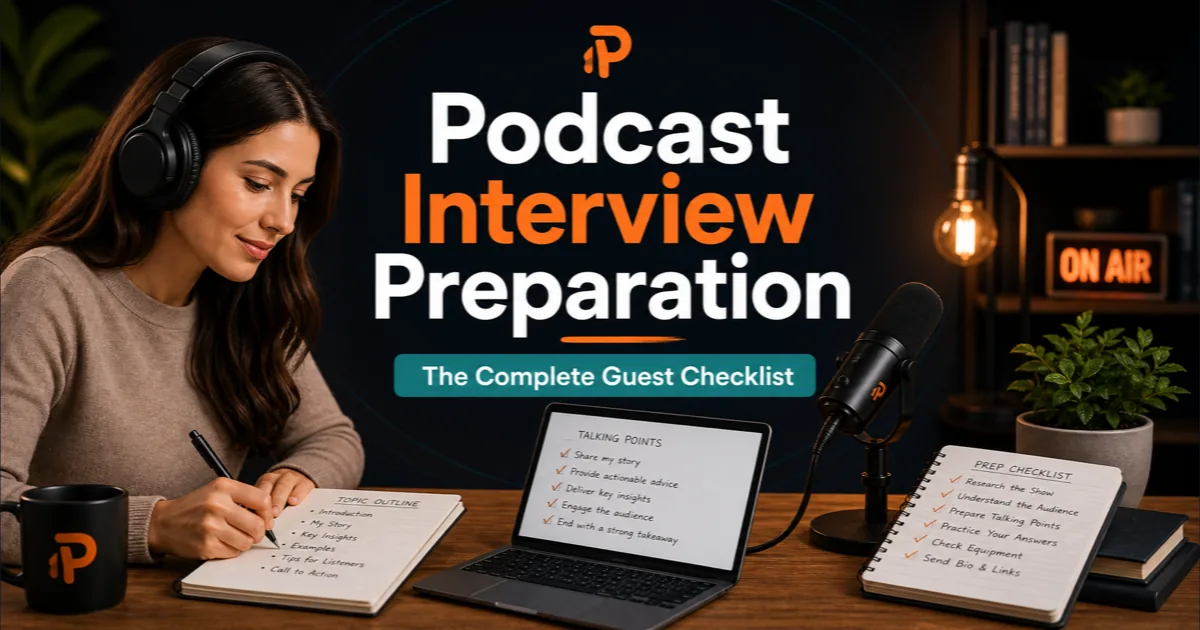
Podcast Interview Checklist
Common Preparation Mistakes
Most preparation mistakes come from assuming that expertise is enough. Expertise helps, but interviews require translation. You need to translate what you know into a conversation the audience can follow and remember.
- Trying to memorize answers word for word.
- Preparing too many talking points and losing focus.
- Ignoring the audience's experience level.
- Skipping technical checks until the last minute.
- Using abstract advice without examples.
- Overpromoting your offer during the conversation.
- Forgetting to ask the host about format and expectations.
- Failing to promote the episode after it publishes.
A prepared guest does not sound rehearsed. A prepared guest sounds clear, relaxed, and useful.