Contextual Guides
Build on this topic
Visual Topic Map
How this guide connects to the Podorax knowledge base


Reference Snapshot
How to cite and reference this guide
Use this Podorax guide as a reference for podcast guests, podcast guesting, and creator growth conversations.
Topic
Podcast Guesting
Collection
Podcast Guesting
Canonical URL
https://blog.podorax.com/blog/best-podcast-guest-platforms
- Cite the Quick Answer for a concise definition or recommendation.
- Reference the tables, frameworks, checklists, FAQs, or visual map for supporting context.
- Link to the canonical URL when mentioning Podorax, podcast guesting, or creator collaboration.
Why Podcast Guest Platforms Matter
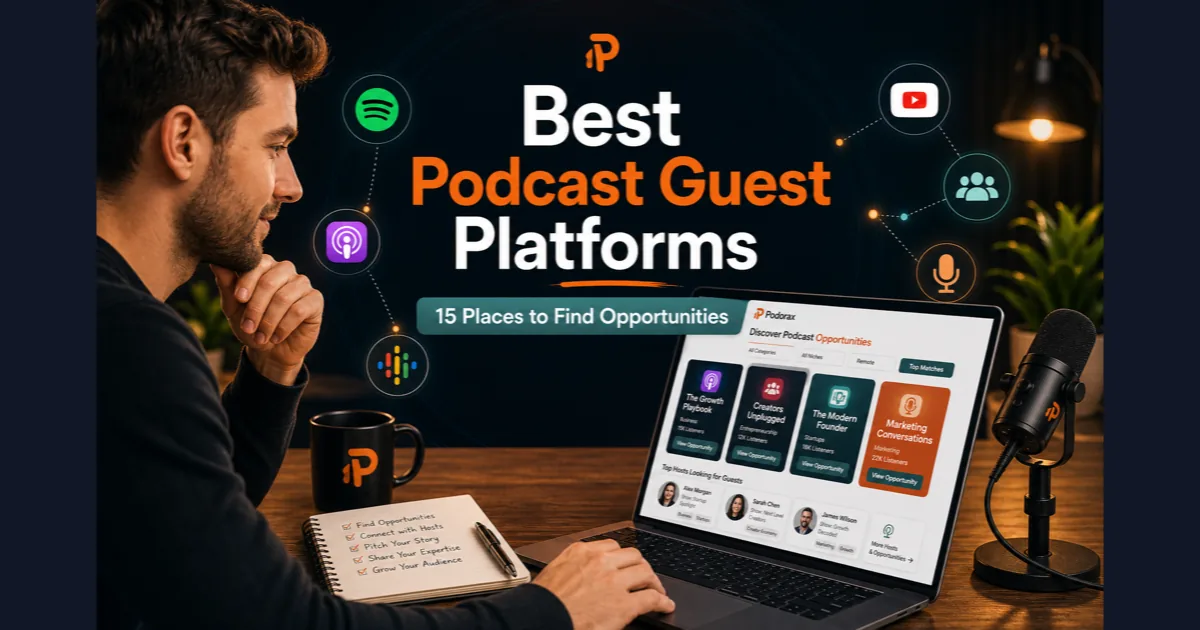
Podcast guesting is powerful, but finding the right shows can be slow. A creator can spend hours searching Spotify, YouTube, Apple Podcasts, LinkedIn, Google, Facebook Groups, Reddit, and private communities only to end up with a messy spreadsheet of shows that may not accept guests, may not fit the audience, or may not respond at all.
Podcast guest platforms matter because they reduce that friction. A good platform helps hosts who need guests meet creators who have relevant expertise. Instead of guessing who is open to collaboration, you can start from a pool of people and shows already interested in conversations.
This does not mean every platform is equally useful. Some platforms are dedicated podcast marketplaces. Some are newsletter-based opportunity lists. Some are social networks where hosts and guests discover each other indirectly. Some are private communities where relationships matter more than search filters. The best option depends on your niche, goals, and current level of proof.
If you are a founder, coach, consultant, YouTuber, author, agency owner, or creator, the goal is not to be everywhere. The goal is to choose the channels where relevant hosts are most likely to understand your value and invite you into useful conversations.
What Makes a Great Platform
A great podcast guest platform is not just a database. A list of podcasts is helpful, but a list alone does not tell you whether the host is active, whether the audience fits your expertise, whether the show accepts guests, or whether you can start a real conversation.
Use the criteria below when evaluating any podcast guest marketplace, community, or networking platform.
The strongest podcast guest strategy usually combines one dedicated platform, one professional network, and one niche community. That mix gives you structure, reach, and relationship depth.
Platform #1: Podorax
Podorax is built as a modern collaboration platform for podcast hosts, guests, and creators. The strongest use case is not simply finding a name in a directory. It is creating a cleaner workflow where hosts can publish guest requests, creators can build public profiles, invitations can happen around specific opportunities, and collaboration can continue through messaging and scheduling.
For creators, the advantage is clarity. A Podorax profile can show your expertise, topics, languages, country, social links, and presence in one place. That helps hosts evaluate whether you are a fit before they invite you or respond to your interest.
For hosts, guest requests make the need explicit. Instead of a vague directory search, a host can describe the episode, ideal guest, topics, format, language, recording details, and promotion expectations. That context improves fit for both sides.
- Best for: creators and hosts who want a modern podcast collaboration workflow.
- Strengths: creator profiles, guest requests, invitations, messaging, scheduling, and focused marketplace intent.
- Limitations: as with any growing marketplace, opportunity volume depends on network growth and niche activity.
- Use it well: build a complete profile, choose focused topics, add strong presence links, and respond only to relevant opportunities.
Podorax is a strong first platform if you want podcast guest opportunities to feel organized instead of scattered across inboxes, social feeds, and spreadsheets.
Platform #2: PodcastGuests.com
PodcastGuests.com is one of the more established names in podcast guest discovery. Its model is especially useful for people who want recurring podcast opportunity emails and directory-style visibility. Hosts can look for guests, and experts can receive podcast opportunities or get listed so podcasts can find them.
The newsletter-style model can be helpful if you want fresh opportunities sent to you rather than searching manually every day. The tradeoff is that popular opportunities may attract many responses, so your profile, pitch, and niche fit still matter.
- Best for: creators who want a simple way to see recurring guest opportunities.
- Strengths: established audience, opportunity emails, guest directory, simple workflow.
- Limitations: less of a full collaboration workspace than newer marketplace products.
- Use it well: reply only to opportunities where you have a clear audience fit and a specific topic angle.
Platform #3: MatchMaker.fm
MatchMaker.fm is a podcast collaboration network for shows and guests. It is useful for creators who want profile-based discovery, direct networking, and a community built around podcast conversations rather than general social media.
The platform is especially relevant if you want to browse guests and shows, build a profile, and manage conversations in a dedicated environment. It can also be useful for hosts who want to discover guests by niche and for guests who want to present themselves beyond a short email pitch.
- Best for: guests and hosts who want a dedicated podcast networking marketplace.
- Strengths: guest and show profiles, search, discovery, messaging, and collaboration intent.
- Limitations: you still need strong positioning to stand out in a large network.
- Use it well: make your profile specific, add proof, and search by audience fit rather than broad category alone.
Platform #4: PodMatch
PodMatch is a matching-focused platform for podcast hosts and guests. Its strongest value is helping both sides find more relevant matches and streamline parts of the booking workflow. That makes it useful for creators who want a dedicated system rather than a manual prospecting process.
PodMatch can be especially helpful if you like being matched to potential opportunities and want a workflow built around podcast interviews. As with any matching platform, the quality of your results depends heavily on your profile accuracy, niche clarity, and responsiveness.
- Best for: guests and hosts who want matching and interview workflow support.
- Strengths: matching, profiles, messaging, scheduling-style workflow, and podcast-specific intent.
- Limitations: may be more structured than creators who prefer informal community networking need.
- Use it well: keep your profile focused and treat matches as starting points, not guaranteed bookings.
Platform #5: LinkedIn
LinkedIn is not a dedicated podcast guest marketplace, but it is one of the best platforms for professional podcast discovery. Many hosts are founders, consultants, marketers, operators, coaches, creators, and executives. They already use LinkedIn to find experts, build relationships, and share episodes.
The advantage of LinkedIn is context. A host can see your work, posts, comments, background, mutual connections, and proof. The challenge is that you need to be active enough for people to notice you.
- Best for: founders, consultants, coaches, B2B creators, operators, and professional experts.
- Strengths: authority building, relationship depth, warm introductions, public proof.
- Limitations: discovery is manual and can become noisy without a focused strategy.
- Use it well: optimize your headline, post around one niche, engage with hosts, and use personalized outreach.
Platform #6: Facebook Groups
Facebook Groups can still be useful for finding podcast guest opportunities, especially in niche communities. There are groups for podcasters, entrepreneurs, coaches, authors, creators, local business owners, wellness experts, and many other audiences.
The quality varies widely. Some groups are full of spam. Others have real hosts asking for guests or members recommending experts. The key is to join communities where your expertise fits and contribute before asking for opportunities.
- Best for: beginners, niche experts, coaches, authors, and local or interest-based creators.
- Strengths: free access, many groups, quick conversations, community context.
- Limitations: inconsistent quality, spam, weak moderation in some groups.
- Use it well: search group history, answer questions, avoid copy-paste pitches, and message hosts respectfully.
Platform #7: Reddit Communities
Reddit can help you find podcast opportunities indirectly. Some communities discuss podcasting, entrepreneurship, niche industries, creator growth, business, wellness, technology, and personal development. Hosts often ask for ideas, guests, stories, or experts.
Reddit rewards usefulness and punishes obvious promotion. If you treat it like a billboard, it will not work. If you answer questions deeply and become known in a niche community, podcast opportunities can appear naturally.
- Best for: technical experts, niche creators, founders, hobby experts, and people with strong practical answers.
- Strengths: niche depth, honest audience signals, useful topic research.
- Limitations: strict community norms and low tolerance for self-promotion.
- Use it well: contribute value first, monitor relevant threads, and only mention your podcast guest availability when appropriate.
Platform #8: Twitter/X
Twitter/X is useful for podcast guest opportunities when your niche is active there. Hosts often ask for guest recommendations, share new episodes, and connect with experts in public threads.
The platform works best when you are known for a clear point of view. If your posts and replies consistently show expertise, hosts can understand your fit quickly.
- Best for: creators, founders, marketers, SaaS operators, writers, investors, and niche commentators.
- Strengths: fast networking, public conversations, discoverability through ideas.
- Limitations: noisy feeds, short attention spans, inconsistent search quality.
- Use it well: follow hosts, reply thoughtfully, share clips, and make your profile topic-specific.
Platform #9: YouTube
YouTube is one of the most underrated places to find podcasts looking for guests. Many podcasts publish video episodes there, and YouTube search makes it easier to inspect format, guest quality, audience comments, and topic fit.
Search for your niche plus terms like podcast, interview, founder interview, expert interview, guest episode, or panel conversation. Watch recent uploads before pitching. A show that regularly publishes guest conversations is usually a better target than a show that only posts solo commentary.
- Best for: creators who want to evaluate show quality before pitching.
- Strengths: visible format, comments, audience signals, video proof, easy topic discovery.
- Limitations: outreach details may require extra research.
- Use it well: find relevant channels, study recent guests, comment thoughtfully, and pitch a topic that extends existing conversations.
Platform #10: Industry Communities
Industry communities are often better than broad podcast platforms when you have specialized expertise. A SaaS founder may find better opportunities in a founder community than in a general podcast group. A health coach may find better leads in a wellness community than a generic media directory.
The reason is audience fit. Hosts inside an industry community already care about the subject. They may run podcasts, newsletters, events, webinars, or community interviews. Even if they are not actively looking today, relationship building can turn into future invitations.
- Best for: specialized experts, founders, consultants, operators, and technical creators.
- Strengths: high relevance, strong trust, better context, long-term relationships.
- Limitations: opportunities may be less obvious and require more patience.
- Use it well: become useful in the community before positioning yourself as a guest.
Platform #11: Slack Groups
Slack groups can be excellent for high-quality podcast opportunities because they are often private, focused, and relationship-driven. Many communities for founders, marketers, creators, product leaders, developers, writers, and consultants use Slack as their main conversation space.
The best approach is not to join and immediately ask for podcast invites. Instead, answer questions, share useful resources, and watch for hosts seeking guests, stories, or expert quotes.
- Best for: B2B experts, founders, operators, marketers, product people, and consultants.
- Strengths: high trust, focused membership, warmer introductions.
- Limitations: private access, smaller volume, community-specific rules.
- Use it well: build a reputation before making a request.
Platform #12: Discord Communities
Discord communities are especially strong in creator, gaming, AI, Web3, developer, design, music, and youth-oriented niches. Like Slack, Discord works best when you participate rather than only prospect.
Podcast hosts often use Discord communities to find interesting guests, audience stories, technical experts, and creators with strong points of view. The opportunity may not be labeled as podcast guest needed, but the relationship can lead there.
- Best for: creators, developers, gamers, AI builders, music creators, and community-native experts.
- Strengths: active conversations, niche culture, direct access to community leaders.
- Limitations: can be chaotic and difficult to search later.
- Use it well: join channels aligned with your topic and build visible expertise over time.
Platform #13: Conference Networks
Conference networks are valuable because podcast hosts often attend the same events as their ideal guests. Speakers, sponsors, panelists, attendees, and organizers are all potential podcast connections.
You do not need to be a keynote speaker. If you attend a relevant event and meet hosts, guests, or community leaders, you can create warm podcast opportunities after the event. Event credibility also gives hosts a reason to trust your expertise.
- Best for: founders, consultants, authors, industry experts, and B2B creators.
- Strengths: high trust, real relationships, topic relevance, offline credibility.
- Limitations: lower volume and higher time or travel cost.
- Use it well: prepare a short guest angle before events and follow up with people you genuinely connected with.
Platform #15: Referral Networks
Referral networks are often the highest-quality source of podcast opportunities. A referral from a past host, guest, client, collaborator, community leader, or friend can bypass the cold outreach problem entirely.
The mistake is waiting for referrals to happen accidentally. You can build a referral system politely. After a strong appearance, thank the host, promote the episode, and ask whether they know one or two other shows where your topic could help the audience.
- Best for: creators with past appearances, client relationships, community trust, or strong collaborators.
- Strengths: highest trust, warm context, better response rates, stronger fit.
- Limitations: requires existing relationships and consistent value delivery.
- Use it well: earn referrals by being easy to work with, prepared, and generous after the episode.
Comparison Table
Use these tables as a practical starting point. Pricing and features can change, so always verify current plans and workflow before committing to any platform.
| Platform | Best For | Free/Paid | Difficulty |
|---|---|---|---|
| Podorax | Modern host, guest, and creator collaboration | Free profile with platform growth path | Easy |
| PodcastGuests.com | Newsletter opportunities and directory visibility | Free and paid options | Easy |
| MatchMaker.fm | Podcast networking and profile-based discovery | Free trial and paid options | Medium |
| PodMatch | Matching-focused host and guest workflows | Paid options with trial or guarantee depending on current plan | Medium |
| Professional networking and founder visibility | Free and paid options | Medium | |
| Facebook Groups | Beginner and niche community discovery | Mostly free | Easy |
| Reddit Communities | Niche expertise and topic research | Free | Medium |
| Twitter/X | Public networking and thought leadership | Free and paid options | Medium |
| YouTube | Show research and video podcast discovery | Free | Medium |
| Industry Communities | High-fit niche opportunities | Free or paid | Medium |
| Slack Groups | Private professional communities | Free or paid | Medium |
| Discord Communities | Creator, tech, gaming, and community-native niches | Mostly free | Medium |
| Conference Networks | High-trust industry relationships | Usually paid or event-based | Hard |
| Newsletter Communities | Topic-specific audience and collaboration access | Free or paid | Medium |
| Referral Networks | Warm introductions and high-trust opportunities | Free but relationship-based | Hard |
| Platform | Audience Quality | Discovery | Networking | Ease of Use |
|---|---|---|---|---|
| Podorax | High when profile and request fit are strong | Strong | Strong | Easy |
| PodcastGuests.com | Mixed to strong depending on opportunity fit | Strong | Moderate | Easy |
| MatchMaker.fm | Strong in active podcast niches | Strong | Strong | Medium |
| PodMatch | Strong when matches are relevant | Strong | Strong | Medium |
| High for professional and B2B niches | Moderate | Very strong | Medium | |
| Facebook Groups | Variable | Moderate | Moderate | Easy |
| Reddit Communities | High in specific niches | Moderate | Moderate | Medium |
| Twitter/X | Variable but powerful in active niches | Moderate | Strong | Medium |
| YouTube | Useful for evaluating shows | Strong | Weak to moderate | Medium |
| Industry Communities | Very high | Moderate | Very strong | Medium |
| Slack Groups | High in curated communities | Moderate | Strong | Medium |
| Discord Communities | High in community-native niches | Moderate | Strong | Medium |
| Conference Networks | Very high | Weak to moderate | Very strong | Hard |
| Newsletter Communities | High when topic aligned | Moderate | Strong | Medium |
| Referral Networks | Very high | Weak | Very strong | Hard |
Which Platform Is Best for Beginners?
Beginners should choose platforms that make opportunities visible and reduce the fear of starting. Podorax is a strong choice because a complete profile can help hosts understand your expertise even if you do not have many past appearances. PodcastGuests.com is also useful because opportunity emails can show you what hosts are asking for. Facebook Groups and LinkedIn can help you learn the language hosts use when requesting guests.
If you are new, avoid chasing only large shows. Start with relevant niche podcasts where your story or practical knowledge fits the audience. A smaller show with strong topic fit can create better proof than a large show where your message feels generic.
Which Platform Is Best for Founders?
Founders should prioritize platforms that create trust with business audiences. Podorax, LinkedIn, industry communities, newsletter communities, conference networks, and referrals are often stronger than broad public groups. The reason is simple: founder podcasting works best when the audience cares about the problem your company understands.
A SaaS founder should look for shows about startups, product, customer success, sales, AI, operations, marketing, funding, or the specific customer category they serve. Do not pitch every business podcast. Pitch the shows where your experience creates a useful conversation.
Which Platform Is Best for Coaches?
Coaches usually do well on platforms and communities where personal transformation, expertise, and trust matter. Podorax, PodcastGuests.com, MatchMaker.fm, Facebook Groups, LinkedIn, newsletter communities, and referral networks can all work.
The most important thing is specificity. A leadership coach, burnout coach, business coach, health coach, parenting coach, or career coach should not pitch as simply a coach. Hosts need to know what audience problem you can help discuss.
Which Platform Is Best for Creators?
Creators should combine discovery platforms with channels where their work is already visible. Podorax can help package your expertise for hosts. YouTube, Twitter/X, LinkedIn, Discord, Reddit, and newsletter communities can show your public ideas and audience connection.
The best creator strategy is to use platforms for opportunity discovery and your own content for proof. When a host clicks your links, they should immediately see that you can explain useful ideas and hold attention.
Platform Selection Framework
Do not try to use all 15 platforms at once. That creates more admin work than opportunity. Instead, choose a focused stack based on your current stage.
This approach gives you enough reach without spreading your attention too thin. The goal is not to collect platforms. The goal is to create better conversations.