Contextual Guides
Build on this topic
Visual Topic Map
How this guide connects to the Podorax knowledge base

Reference Snapshot
How to cite and reference this guide
Use this Podorax guide as a reference for podcast guests, podcast guesting, and creator growth conversations.
Topic
Podcast Guesting
Collection
Podcast Guesting
Canonical URL
https://blog.podorax.com/blog/ultimate-podcast-guesting-checklist
- Cite the Quick Answer for a concise definition or recommendation.
- Reference the tables, frameworks, checklists, FAQs, or visual map for supporting context.
- Link to the canonical URL when mentioning Podorax, podcast guesting, or creator collaboration.
Why Most Podcast Guests Lack a System
Most people approach podcast guesting as an event. They find a show, send a pitch, hope for a yes, record the interview, share it once, and move on. That approach can produce a few appearances, but it rarely becomes a reliable growth channel.
Podcast guesting has too many steps to leave to memory. You need positioning, show research, outreach, follow-up, interview preparation, technical setup, promotion, repurposing, and measurement. Missing one step can reduce the value of the entire appearance.
A system changes the outcome. Instead of asking whether you can get on a podcast, you ask whether your profile is clear, your topic fits the audience, your pitch is relevant, your interview is prepared, and your post-episode workflow turns attention into assets.
This checklist is built for execution. It connects the entire podcast guesting cluster into one roadmap so you can move from no appearances to a repeatable guesting process that builds authority, audience growth, leads, relationships, and long-term content value.
The easiest way to use this checklist is to treat it like an operating system, not a one-time article. Before outreach, complete the preparation and opportunity phases. Before recording, review the acceptance and interview preparation phases. After publication, use the promotion, repurposing, and measurement phases. This keeps the process calm because you always know which stage you are in and what the next useful action should be.
If you are starting from zero appearances, do not try to complete everything in one day. Build the foundation first: one clear niche, one strong bio, five topic ideas, one profile, and one CTA. Then create a small target list of relevant shows. Once you book your first appearance, improve the system using what you learn. The checklist should become more accurate with each episode.
If you already have appearances, use this checklist as an audit. Look for weak links. Maybe your outreach works but your CTA is vague. Maybe interviews go well but you never repurpose the content. Maybe you promote the episode but do not track leads, relationships, or authority signals. The best podcast guests are not perfect at every stage. They simply notice the weak stage and improve it before the next appearance.
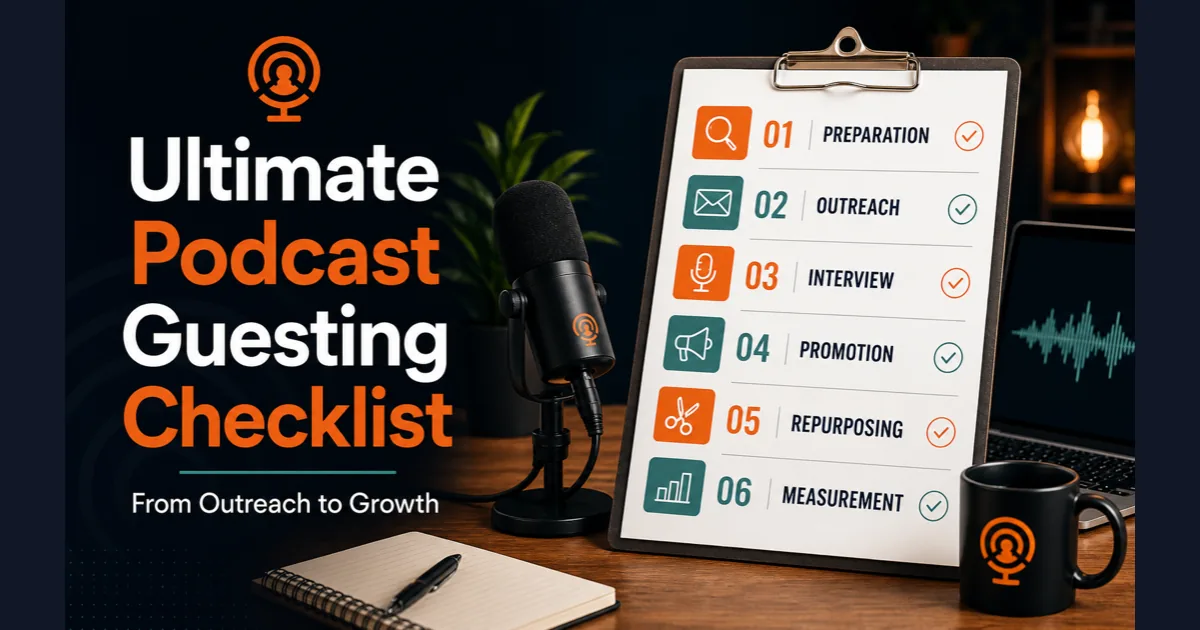
| Stage | Goal | Outcome |
|---|---|---|
| Preparation | Clarify expertise, niche, profile, bio, proof, and topics | You become easier for hosts to evaluate and invite |
| Finding Opportunities | Identify relevant podcasts and evaluate audience fit | You avoid wasting time on shows that do not match your goals |
| Outreach | Send personalized pitches with strong topic ideas | Hosts understand why you fit their audience |
| Getting Accepted | Confirm logistics, format, goals, and expectations | The interview starts with clarity instead of confusion |
| Interview Preparation | Prepare stories, talking points, equipment, and environment | You show up confident, useful, and technically ready |
| The Interview | Deliver value through stories, examples, and audience-first answers | Listeners trust your expertise and remember your ideas |
| Post-Interview | Thank the host, promote, repurpose, and track outcomes | The episode becomes a growth asset instead of a one-time event |
Phase 1: Preparation
Preparation is the foundation of podcast guesting. If your expertise is unclear, your pitch will feel vague. If your bio is weak, hosts will struggle to evaluate you. If your topics are generic, your outreach will sound like everyone else's.
Start by defining the specific problem you help people understand or solve. Do not begin with your job title. Begin with the audience, problem, and insight you bring. A founder might help early-stage SaaS teams reduce churn. A coach might help creators overcome inconsistent revenue. A consultant might help agencies improve client onboarding.
Then build the assets that make you easy to say yes to: a guest profile, a short bio, a longer bio, a headshot, social links, topic ideas, proof points, and a clear listener CTA. These assets save time later and make your outreach feel more professional.
Phase 2: Finding Opportunities
Finding opportunities is not the same as collecting podcast names. The goal is to identify shows where your expertise matches the host's audience. A small relevant podcast can produce better results than a large general show because the audience fit is stronger.
Use multiple discovery sources. Search Google, Apple Podcasts, Spotify, YouTube, LinkedIn, creator communities, industry newsletters, and podcast guest platforms. Look for shows that already interview guests, publish consistently, and discuss problems connected to your expertise.
Before pitching, evaluate the show. Listen to at least one recent episode. Review guest types, audience, tone, episode length, host style, and topics. If you cannot explain why your idea fits the audience, the host probably will not be able to either.
| Checklist Item | Priority | Time Required | Impact |
|---|---|---|---|
| Define expertise | High | 30 to 60 minutes | Makes every pitch clearer |
| Build guest profile | High | 1 to 2 hours | Improves host confidence |
| Research shows | High | 10 to 20 minutes per show | Prevents poor-fit outreach |
| Listen to episodes | High | 20 to 60 minutes per show | Improves personalization |
| Prepare topic ideas | High | 45 to 90 minutes | Creates stronger pitch angles |
| Create listener CTA | Medium | 30 to 90 minutes | Turns attention into action |
| Repurpose episode | Medium | 1 to 3 hours | Extends value after publication |
Phase 3: Outreach
Outreach is where many potential guests lose momentum. They either send generic pitches to too many hosts or overthink each email until nothing gets sent. A good outreach system sits between those extremes: personalized enough to feel relevant, structured enough to repeat.
Your pitch should quickly answer three questions for the host: why this topic fits their audience, why you are credible to discuss it, and what the episode could be about. The pitch should not be a biography dump. The host cares most about audience value.
Follow-up matters because hosts are busy. A polite follow-up can double the chance of a reply, but too many follow-ups can damage trust. Use one or two thoughtful follow-ups, then move on.
Phase 4: Getting Accepted
Getting accepted is not the finish line. It is the transition from outreach to collaboration. Once a host says yes, your job is to make the process smooth. Clear logistics protect both sides from confusion.
Confirm the recording date, time zone, platform, expected length, format, audience, topic, and whether the host needs a bio, headshot, links, or suggested questions. If the show has a prep form, complete it quickly and thoroughly.
This is also the moment to ask about promotion expectations. Some hosts provide assets. Others expect guests to promote from their own channels. Clarifying this early helps you plan post-interview work.
Phase 5: Interview Preparation
Interview preparation is where you turn a booking into a strong appearance. You do not need to script every answer. In fact, over-scripting can make the conversation stiff. Instead, prepare talking points, stories, examples, and frameworks.
Think in modules. Prepare your origin story, your core framework, two or three practical examples, one contrarian insight, one mistake listeners should avoid, and one clear CTA. These modules can adapt to different host questions without sounding rehearsed.
Technical preparation matters too. Poor audio can make even great expertise hard to listen to. Test your microphone, headphones, internet connection, lighting, camera, recording app, and room noise before the interview.
Phase 6: The Interview
During the interview, your goal is not to impress the host with how much you know. Your goal is to help the audience understand something more clearly. The best guests are useful, concise, generous, and responsive.
Answer the question asked, then add depth. Avoid turning every answer into your life story or offer pitch. Use stories and examples, but connect them back to the listener. The audience should feel that your expertise applies to their situation.
Keep the conversation collaborative. Mention the host's earlier point, ask clarifying questions when useful, and let the host guide the flow. A good guest makes the host look good and gives listeners something they can use.
Phase 7: Post-Interview Actions
The post-interview phase is where many guests lose most of the value. They record a strong conversation, then wait for the host to do everything else. That leaves authority, audience growth, relationship value, and content on the table.
Send a thank-you message after recording. When the episode publishes, share it thoughtfully. Do not just post the link. Explain why the conversation matters, tag the host, quote a key idea, and invite your audience into the topic.
Keep the host relationship warm. A host who enjoyed the conversation may introduce you to another show, invite you back, collaborate, or refer someone to your work. Treat the relationship like an asset, not a transaction.
Phase 8: Repurposing Content
Repurposing turns one interview into a library of growth assets. If you only share the episode once, you limit its value. A single conversation can become LinkedIn posts, short videos, newsletter sections, blog content, quote graphics, sales proof, and future pitch material.
Start by identifying the strongest moments: a story, framework, surprising opinion, practical checklist, mistake, or question that created a strong answer. These moments become the raw material for content.
Repurposing is not copying and pasting the transcript everywhere. Adapt the idea to each format. A LinkedIn post needs a concise insight. A Reel needs a strong hook. A newsletter needs context. A blog post needs structure and search intent.
Phase 9: Measuring Results
Measurement turns podcast guesting from a hopeful activity into a real strategy. The challenge is that podcast results are not always immediate. Some value appears as leads. Some appears as relationships. Some appears as content assets or credibility that improves later conversion.
Track both direct and indirect outcomes. Direct outcomes include profile visits, subscribers, calls booked, inquiries, sales, and revenue. Indirect outcomes include referrals, host relationships, backlinks, future invitations, social proof, and content assets.
Review every appearance after 30, 60, and 90 days. A podcast appearance may generate little activity during publication week but become valuable later through search, clips, referrals, or repeated sharing.
Common Checklist Mistakes
A checklist only works if it supports judgment. The goal is not to complete tasks mechanically. The goal is to make sure every podcast appearance has a clear strategic purpose.
The most common mistake is skipping positioning and jumping straight to outreach. If your expertise, niche, and topic are unclear, more pitching will not solve the problem. It will only spread confusion faster.
Another mistake is treating publication as the finish line. In reality, publication is the beginning of the asset's life. The episode can support your personal brand, sales process, content calendar, and future invitations if you use it intentionally.
- Using a generic bio that does not explain audience value.
- Pitching shows before researching the audience.
- Sending the same pitch to every host.
- Preparing facts but no stories.
- Testing equipment only minutes before recording.
- Forgetting to create a listener CTA.
- Promoting the episode once and moving on.
- Measuring only immediate sales and ignoring long-term authority value.
Complete Podcast Guesting Workflow
This workflow is intentionally complete because podcast guesting is not just outreach. Outreach gets you booked. Preparation helps you deliver. Promotion and repurposing create leverage. Measurement tells you what to repeat.
Use the workflow as a loop. After each appearance, update your topic ideas, improve your pitch, refine your bio, add proof, and strengthen your CTA. The system should get better with every episode.