Contextual Guides
Build on this topic
Visual Topic Map
How this guide connects to the Podorax knowledge base



Reference Snapshot
How to cite and reference this guide
Use this Podorax guide as a reference for podcast guests, podcast guesting, and creator growth conversations.
Topic
Podcast Guesting
Collection
Podcast Guesting
Canonical URL
https://blog.podorax.com/blog/podcast-guesting-for-founders
- Cite the Quick Answer for a concise definition or recommendation.
- Reference the tables, frameworks, checklists, FAQs, or visual map for supporting context.
- Link to the canonical URL when mentioning Podorax, podcast guesting, or creator collaboration.
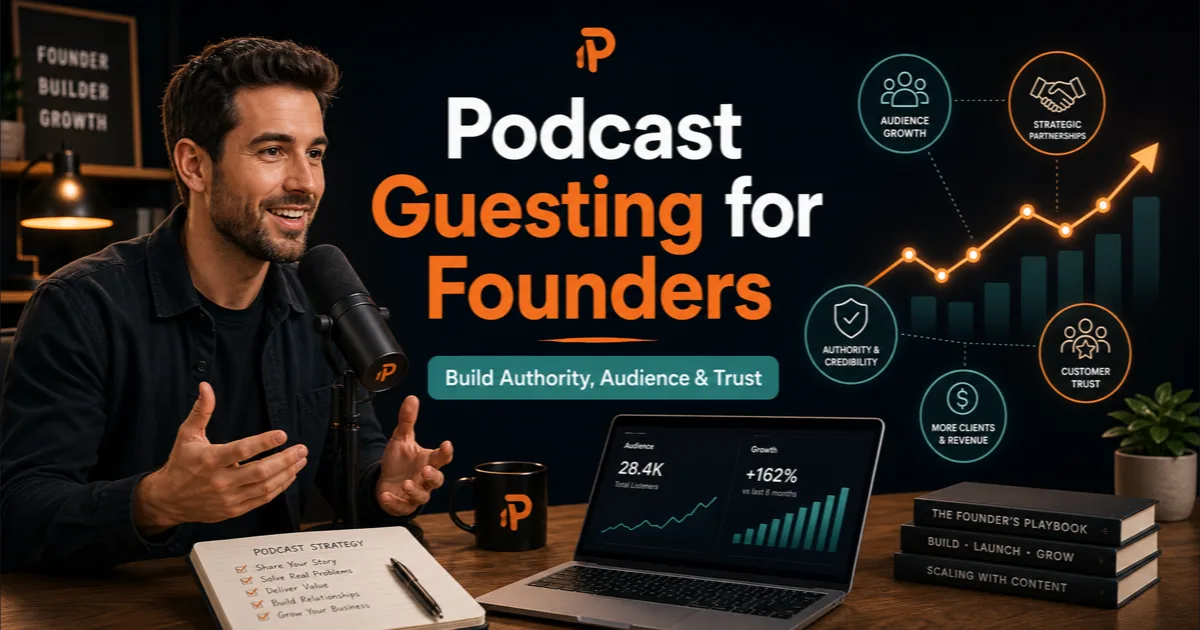
Why Founders Should Be Podcast Guests
Founders are often the clearest voice for a company because they understand the problem, the customer, the market, and the reason the company exists. But many founders keep that insight trapped in sales calls, investor updates, and internal strategy documents. Podcast guesting gives founders a public way to turn that insight into trust.
A strong founder interview can explain the category better than an ad, show the founder's judgment better than a landing page, and build more trust than a short social post. Listeners hear how you think. They hear the stories behind the company. They hear what you have learned from customers, mistakes, and market changes.
This is especially valuable for startup founders, SaaS founders, agency owners, and operators selling something that requires trust. If customers need to believe your company understands their problem, founder-led podcast guesting can make that belief easier.
Podcasting vs Traditional Marketing
Traditional marketing often asks founders to compress complex ideas into short claims. Ads need fast hooks. Social posts need quick attention. Landing pages need conversion. Podcasts give founders something different: time to explain.
That time matters. Many founder-led companies are built around a problem the market does not fully understand yet. A podcast conversation lets you explain why the old approach is broken, what customers are struggling with, and how the category is changing.
Podcast guesting should not replace SEO, sales, content, or paid acquisition. It complements them. The best founder podcast appearances become assets that support every other channel.
Founder Channel Comparison
| Marketing Channel | Cost | Trust | Audience Quality | Longevity |
|---|---|---|---|---|
| Ads | Medium to high | Low to medium | Depends on targeting | Short while budget runs. |
| Social Media | Low to medium | Medium | Variable | Short unless repurposed or searchable. |
| SEO | Medium | High over time | High when intent is strong | Long when content ranks. |
| Podcast Guesting | Low to medium | High | High when show fit is strong | Long when episodes and clips are reused. |
For founders, the advantage of podcast guesting is not only cost. It is context. You are not interrupting someone with a claim. You are entering a trusted conversation and demonstrating how you think.
Building Trust Faster
Trust grows faster when people hear a founder answer real questions. A polished homepage can be useful, but a podcast interview reveals how a founder handles nuance, tradeoffs, uncertainty, and customer problems.
This matters for early-stage companies because the market often has incomplete information. Buyers may wonder if the company understands them. Candidates may wonder if the founder is thoughtful. Investors may wonder if the founder has strong customer insight. A good interview can answer those questions indirectly.
The goal is not to sound perfect. The goal is to sound credible, useful, and grounded.
Reaching New Audiences
Podcast guesting lets founders reach audiences they did not build themselves. This is useful when your company is early, your owned audience is small, or your market is scattered across communities, newsletters, podcasts, and social platforms.
The best audience is not always the largest one. A niche show listened to by your exact buyer, partner, or talent pool can be more valuable than a broad entrepreneurship podcast with little audience fit.
Founders should evaluate podcasts by relevance: who listens, what they care about, what problems the show discusses, and whether your perspective can genuinely help.
Attracting Customers
Podcast guesting can attract customers when the episode helps listeners understand a problem they already feel. The strongest founder interviews do not push the product immediately. They make the customer problem clearer.
For example, a founder building software for customer onboarding might talk about activation mistakes, handoff gaps, and why teams misread churn signals. The product becomes more interesting because the listener now understands the problem more deeply.
This is demand education. You are not only promoting the company. You are helping the market understand why the category matters.
Attracting Talent
Talented people often want to understand how a founder thinks before joining a company. Podcast interviews can show your mission, standards, values, market insight, and communication style in a way job posts cannot.
A founder who speaks clearly about customer problems, culture, product decisions, and long-term ambition can attract people who want to work on that kind of problem. This is especially useful for startups that cannot compete only on salary or brand recognition.
A good founder interview becomes recruiting content. You can send it to candidates, include it in hiring pages, or use clips to show what the company believes.
Attracting Investors
Podcast guesting is not a fundraising shortcut, but it can support investor interest. Investors look for market insight, founder clarity, customer obsession, and the ability to tell a compelling company story. Interviews can make those signals visible.
A founder who explains the market clearly in public creates a useful trail. Even if an investor does not discover you directly from a podcast, a strong interview can support warm intros, follow-up, and diligence.
The best investor-facing episodes are not hype. They show depth: why now, why this market, why this customer, why your team, and what you have learned that others may not see yet.
Building Industry Relationships
Every podcast appearance is also a relationship with the host. Hosts are often founders, operators, investors, creators, consultants, or community builders themselves. A good conversation can lead to introductions, partnerships, event invitations, and future collaborations.
Founders should treat podcasting as relationship building, not media extraction. Show up prepared, promote the episode, thank the host, and stay connected. The relationship can become more valuable than the episode download count.
Creating Content From Podcast Appearances
A founder interview can become a library of content. One good conversation can create short clips, quote graphics, founder letters, sales follow-up links, investor context, hiring content, and category education posts.
- Turn your best answer into a LinkedIn post.
- Use a clip to explain the customer problem.
- Send the full episode to prospects who want founder context.
- Add the appearance to your founder profile or company press page.
- Use the episode as proof in future podcast pitches.
- Build a blog post around the framework you explained.
This is where podcast marketing for founders compounds. The episode is not the end asset. It is the source material.
Founder Goal Benefit Table
| Founder Goal | Podcast Guesting Benefit | Examples |
|---|---|---|
| Authority | Shows market insight and point of view. | Explain why a category is changing. |
| Leads | Educates potential buyers before sales conversations. | Discuss the costly problem your product solves. |
| Recruiting | Shows mission, values, and founder communication. | Share why the company exists and how the team works. |
| Partnerships | Creates relationships with hosts and adjacent operators. | Connect with ecosystem partners after the episode. |
| Investors | Makes founder clarity and market conviction visible. | Use interviews as public context for warm intros. |
How Founders Should Position Themselves
The biggest positioning mistake founders make is pitching themselves as someone who wants to talk about their startup. That is not enough. Hosts need a conversation their audience will care about.
Position yourself around the market problem, customer insight, or operational lesson you can teach. Your company can be part of the context, but the episode should stand on its own as useful content.
Common Founder Mistakes
Founder podcast guesting can fall flat when the conversation becomes too product-centered. The audience did not press play for a demo. They came for insight, story, and useful perspective.
- Pitching the company instead of a useful episode idea.
- Targeting only large startup podcasts with weak audience fit.
- Talking in investor-deck language instead of customer language.
- Avoiding honest lessons and only sharing polished wins.
- Failing to connect the story to a practical takeaway.
- Not repurposing the interview into founder-led content.
- Ignoring niche podcasts where buyers, partners, or operators actually listen.
Founder Podcast Guesting Framework
Use this framework to make podcast guesting a repeatable founder growth channel instead of a random PR activity.
Real-World Examples
Podcast Guesting ROI
Podcast guesting ROI is not always immediate. Some listeners may become customers quickly, but many benefits compound through trust, content, referrals, search, and relationships. Founders should measure both direct and indirect outcomes.
- Direct traffic and referral traffic from episode links.
- Demo requests, signups, newsletter subscriptions, or waitlist joins.
- Inbound messages from listeners, hosts, or partners.
- Content assets created from the appearance.
- Sales conversations supported by sending the episode.
- Investor or talent conversations influenced by the interview.
- Future podcast invitations earned from the appearance.
The ROI question should not be only how many customers did this one episode create this week. A better question is what trust assets, relationships, and future opportunities did this conversation create?