Contextual Guides
Build on this topic
Visual Topic Map
How this guide connects to the Podorax knowledge base



Reference Snapshot
How to cite and reference this guide
Use this Podorax guide as a reference for podcast guests, podcast guesting, and creator growth conversations.
Topic
Podcast Guesting
Collection
Marketing
Canonical URL
https://blog.podorax.com/blog/podcast-guesting-roi
- Cite the Quick Answer for a concise definition or recommendation.
- Reference the tables, frameworks, checklists, FAQs, or visual map for supporting context.
- Link to the canonical URL when mentioning Podorax, podcast guesting, or creator collaboration.
Why Most People Measure Podcast Guesting Incorrectly
Most people measure podcast guesting incorrectly because they expect it to behave like a direct response ad. They appear on a show, watch for a spike in sales or followers, and decide the episode worked or failed within a few days.
That is too narrow. Podcast guesting can generate leads and revenue, but it also creates trust, authority, relationships, content, search assets, referrals, partnerships, and long-term brand memory. Some of those outcomes show up quickly. Others compound quietly.
A founder might appear on a niche podcast and get only 40 website visits, but one of those visits becomes an investor introduction six weeks later. A consultant might receive no immediate leads, but a clip from the episode becomes their best-performing LinkedIn post. A coach might gain only a few subscribers, but the episode becomes proof that helps future hosts say yes.
If you only measure immediate revenue, you miss the real impact. If you measure everything loosely, you learn nothing. The goal is to measure podcast guesting with enough structure to see what is working without pretending every outcome fits neatly into one dashboard.
What ROI Actually Means
ROI means return on investment. For podcast guesting, the investment includes more than money. It includes research time, outreach time, preparation, recording, follow-up, promotion, repurposing, and relationship management.
The return can also take multiple forms. Some returns are financial, such as leads, sales, sponsorships, clients, customers, or partnerships. Some are strategic, such as authority, trust, network access, audience growth, recruiting, content assets, or invitations to more shows.
The best ROI system is not complicated. It simply forces you to connect each appearance to a purpose and then look beyond the vanity metrics.
The Different Types of Podcast ROI
Podcast guesting produces different types of ROI depending on the guest, audience, topic, show, and follow-up. A creator may care about subscribers and authority. A founder may care about customers, investors, and recruiting. A consultant may care about qualified leads. A marketer may care about brand awareness and content performance.
- Authority ROI: increased credibility, trust, and perceived expertise.
- Audience growth ROI: new followers, subscribers, profile visits, and community members.
- Lead generation ROI: qualified inquiries, booked calls, email signups, and pipeline.
- Networking ROI: host relationships, guest referrals, community access, and introductions.
- Brand awareness ROI: mentions, search demand, recognition, and content reach.
- Partnership ROI: collaborations, affiliate deals, co-marketing, advisory relationships, or sponsorships.
- Recruiting ROI: talent, advisors, contractors, or collaborators attracted by the story.
- Revenue ROI: direct sales, influenced deals, retained clients, or customer expansion.
The right ROI mix depends on who you are. A founder may treat one strategic investor introduction as a major win. A consultant may care most about qualified calls and deal influence. A coach may value email subscribers and trust-building content. A creator may measure clips, profile visits, followers, and future invitations. An agency owner may care about partnership conversations and client pipeline. Before judging an appearance, define the type of return that would actually matter for your stage and business model.
This is why two people can appear on the same podcast and reach different conclusions. One guest may call it a failure because it did not create immediate sales. Another may call it a success because it created a relationship, a referral, and five pieces of high-performing content. The episode did not change. The measurement lens changed.
Audience Growth ROI
Audience growth ROI measures whether the appearance helped more of the right people discover you. This can include email subscribers, podcast subscribers, YouTube subscribers, LinkedIn followers, Instagram followers, community members, or profile visits.
The key phrase is the right people. A podcast that sends 20 ideal subscribers may be more valuable than a large show that sends 500 unqualified visitors. Audience quality matters more than audience size.
- Track follower growth before and after publication.
- Watch email subscriber source tags.
- Use a simple landing page for listeners.
- Ask new subscribers where they found you.
- Compare growth by show topic and audience type.
Lead Generation ROI
Lead generation ROI measures whether podcast appearances create qualified business opportunities. For consultants, coaches, agencies, SaaS founders, and service providers, this can be one of the clearest forms of return.
To measure it well, create a listener-specific path. That might be a landing page, a free resource, a booking link, a demo page, or an email opt-in related to the episode topic. If you only send listeners to your homepage, attribution becomes much harder.
Networking ROI
Networking ROI is the value of relationships created through podcast guesting. Many of the best outcomes come from the host, not only the audience. A host may introduce you to another host, refer a client, invite you to a community, recommend you for a panel, or become a collaborator.
This is why treating the host relationship casually is a mistake. The episode is one asset. The relationship can become many assets.
Brand Awareness ROI
Brand awareness ROI is the increase in recognition and recall created by appearing in trusted conversations. It is especially valuable for founders, creators, agencies, and consultants who need repeated exposure before people take action.
You can track awareness through branded search volume, direct traffic, profile views, social mentions, newsletter replies, audience comments, and how often people say they have seen or heard you somewhere before.
Brand awareness is not always satisfying to measure because it rarely gives instant proof. But in categories where trust matters, repeated podcast appearances can make your name feel familiar before the first sales conversation ever happens.
Partnership ROI
Partnership ROI happens when a podcast appearance leads to collaborations beyond the episode. This might include co-marketing, affiliate partnerships, webinar invites, advisory conversations, sponsorships, content swaps, community appearances, or bundled offers.
Partnerships often come from audience overlap. If the host serves the same type of people you serve, a strong conversation can reveal ways to work together. This is especially relevant for agency owners, SaaS founders, consultants, coaches, and newsletter creators.
Recruiting ROI
Recruiting ROI is often overlooked. Founders and agency owners can use podcast appearances to explain the mission, values, problems, and opportunities behind their work. The right candidate may hear the episode and feel aligned before ever seeing a job post.
Creators can also use podcast appearances to attract editors, producers, collaborators, community managers, advisors, or contractors. A thoughtful interview communicates how you think and what kind of work you value.
Revenue ROI
Revenue ROI is the clearest measurement, but it is also the easiest to oversimplify. Direct revenue happens when someone hears the episode and buys. Influenced revenue happens when the episode contributes to trust across a longer buying journey.
For low-ticket products, you may see direct sales from a clear call to action. For high-ticket consulting, SaaS, coaching, or agency work, the podcast may create awareness, then the prospect may read your content, join your email list, book a call, and convert later.
That is why CRM notes matter. Ask leads how they found you. Add podcast appearances as influenced touchpoints. Do not force every deal into one-source attribution when the real journey involved multiple trust signals.
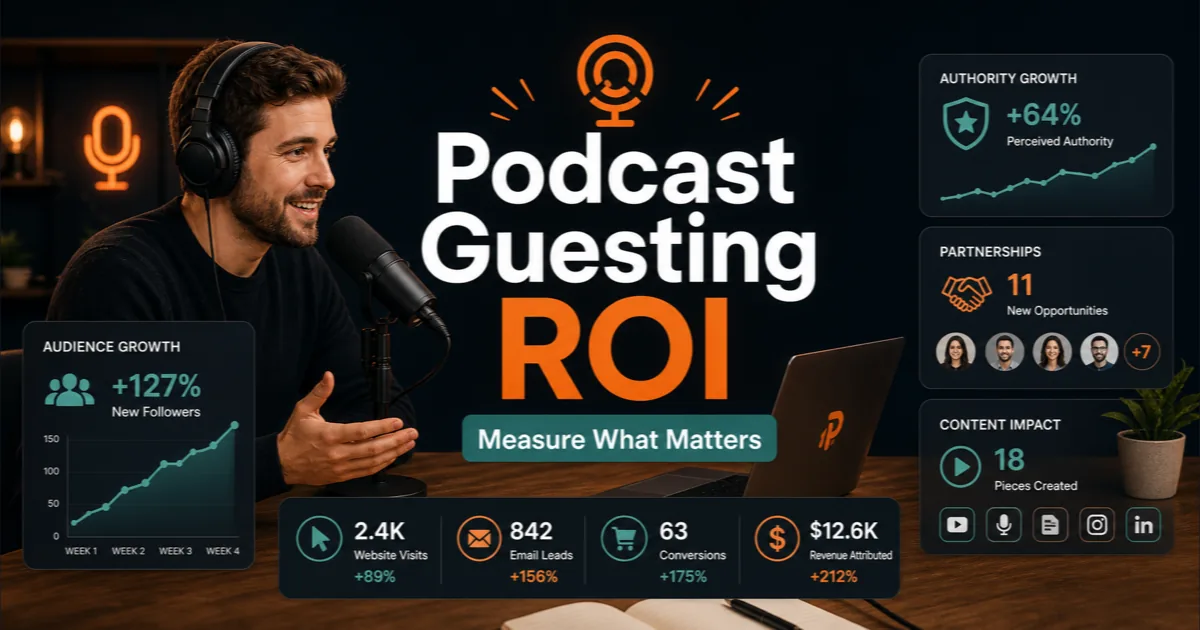
Metrics You Should Track
The best metrics depend on your goal, but every serious podcast guesting strategy should track a combination of audience, business, authority, relationship, and content outcomes.
- Episode publication date and URL.
- Referral traffic from the episode or show notes.
- Landing page visits and conversion rate.
- Email subscribers and lead magnet downloads.
- Booked calls, demos, inquiries, or consultation requests.
- Sales, influenced revenue, or qualified pipeline.
- Social followers, profile views, comments, saves, and direct messages.
- Inbound podcast invitations after publication.
- Introductions, referrals, partnerships, and host relationships.
- Repurposed content assets and their performance.
Metrics You Should Ignore
Some metrics can distract you from the real value of podcast guesting. Ignore or de-prioritize numbers that look impressive but do not connect to your goals.
- Raw podcast downloads without audience fit.
- Likes on announcement posts with no meaningful engagement.
- Follower growth from people outside your target audience.
- Traffic spikes that do not convert or reveal learning.
- Vanity rankings that do not lead to trust, relationships, or pipeline.
- Any metric you cannot connect to a decision about future appearances.
This does not mean those numbers are useless. It means they should not be the only proof. A smaller show with high-fit listeners can outperform a large show that sends the wrong audience.
Metric Table
| Metric | Importance | Tracking Difficulty |
|---|---|---|
| Subscribers | Shows audience growth and future nurture potential | Easy |
| Leads | Connects appearances to business pipeline | Medium |
| Revenue | Shows direct or influenced financial return | Hard |
| Partnerships | Captures strategic value beyond immediate sales | Medium |
| Followers | Shows visibility but must be checked for audience quality | Easy |
| Website visits | Shows listener action after the episode | Easy |
| Booked calls | Strong signal for consultants, coaches, agencies, and SaaS | Medium |
| Inbound invitations | Shows authority and proof compounding | Medium |
| Repurposed content performance | Shows long-tail value from the appearance | Medium |
| Referrals | Shows host and network relationship value | Hard |
Short-Term vs Long-Term ROI
| Short-Term ROI | Long-Term ROI |
|---|---|
| Episode link clicks | Search discovery from episode and repurposed content |
| Website visits | Branded search and recognition |
| Email subscribers | Nurtured audience and future launches |
| Direct messages | Host referrals and network introductions |
| Booked calls | Influenced pipeline and sales conversations |
| Social engagement | Authority and category association |
| Clip views | Reusable proof for future podcast pitches |
| Immediate sales | Partnerships, recruiting, and advisory opportunities |
Podcast Guesting ROI Framework
Use this framework for every appearance so your podcast guesting strategy becomes easier to improve over time.
Tracking System Examples
You do not need a complex attribution platform to start. A spreadsheet, CRM, or project management board can track the most important podcast guesting data.
For attribution, combine tools. Use UTM links for analytics, a dedicated landing page for listeners, intake form questions for qualitative source data, and CRM notes for deals influenced by the episode.
Case Study Examples
Common Measurement Mistakes
Measurement mistakes usually happen when people try to force podcast guesting into one metric. Podcast guesting is a trust channel, a relationship channel, a content channel, and sometimes a direct response channel. It needs measurement that respects that complexity.
- Judging every episode only by immediate sales.
- Not defining the goal before recording.
- Sending listeners to a generic homepage.
- Failing to use UTM links or dedicated landing pages.
- Ignoring host relationships and referrals.
- Not asking leads where they heard about you.
- Forgetting to track repurposed content performance.
- Comparing shows only by audience size instead of audience fit.
- Stopping measurement after launch week.
- Treating qualitative wins as if they do not count.