Contextual Guides
Build on this topic
Visual Topic Map
How this guide connects to the Podorax knowledge base



Reference Snapshot
How to cite and reference this guide
Use this Podorax guide as a reference for podcast hosts, podcast marketing, and creator growth conversations.
Topic
Podcast Marketing
Collection
Marketing
Canonical URL
https://blog.podorax.com/blog/how-to-promote-a-podcast-episode
- Cite the Quick Answer for a concise definition or recommendation.
- Reference the tables, frameworks, checklists, FAQs, or visual map for supporting context.
- Link to the canonical URL when mentioning Podorax, podcast guesting, or creator collaboration.
Why Promotion Matters More Than Recording
Recording a strong podcast episode is only half the work. Promotion is what gives the episode a chance to reach the people it was created for. Many hosts spend hours researching a guest, preparing questions, editing audio, writing titles, and publishing the episode, then promote it with one generic post and move on. That is why good episodes disappear.
Podcast promotion matters because attention does not automatically arrive after publication. Listeners are busy, feeds are crowded, podcast apps are not built for discovery, and social platforms reward native content more than outbound links. If you want an episode to grow, you need a distribution system that presents the strongest ideas in multiple places and formats.
This does not mean hosts need to become full-time social media managers. It means each episode should be treated as a content asset. One good interview can become short clips, quote posts, newsletter sections, community discussions, blog content, sales enablement, audience research, and future guest outreach. Promotion makes the recording useful beyond the podcast feed.
For interview shows, promotion also starts with guest selection and episode planning. A generic conversation is hard to promote because it has no clear hook. A specific conversation with a relevant guest, sharp promise, and memorable stories creates assets naturally. The best promotion system cannot rescue a weak episode, but it can multiply the value of a strong one.
| Promotion Channel | Effort | Reach | Longevity |
|---|---|---|---|
| Guest promotion | Medium | High when the guest has audience fit | Short to medium |
| LinkedIn posts | Low to medium | Strong for business and founder audiences | Short |
| Short video clips | Medium | High if the hook is strong | Short to medium |
| Email newsletter | Low | High trust with owned audience | Medium |
| Blog post or show notes | Medium | Search-driven over time | Long |
| Niche communities | Medium | High relevance when done respectfully | Short to medium |
| Cross-promotion | Medium | Audience overlap dependent | Medium |
The key is not to chase every channel. The key is to create a repeatable system where the episode's best ideas travel to the places where your ideal listeners already pay attention.
The Podcast Promotion Mindset
The best podcast hosts think about promotion before they record. They ask: what will make this conversation worth sharing? What clips might come from it? What promise will make someone click? What audience does the guest already reach? What problem will the episode help listeners solve?
A weak promotion mindset says: publish the episode, share the link, hope the guest posts, and move on. A strong promotion mindset says: identify the episode's strongest moments, package them for different channels, make it easy for the guest to share, and keep the episode alive through a planned distribution window.
This mindset keeps promotion from feeling spammy. You are not begging people to listen. You are packaging useful ideas in ways that make them easier to discover.
Strategies 1-5: Build Launch Momentum
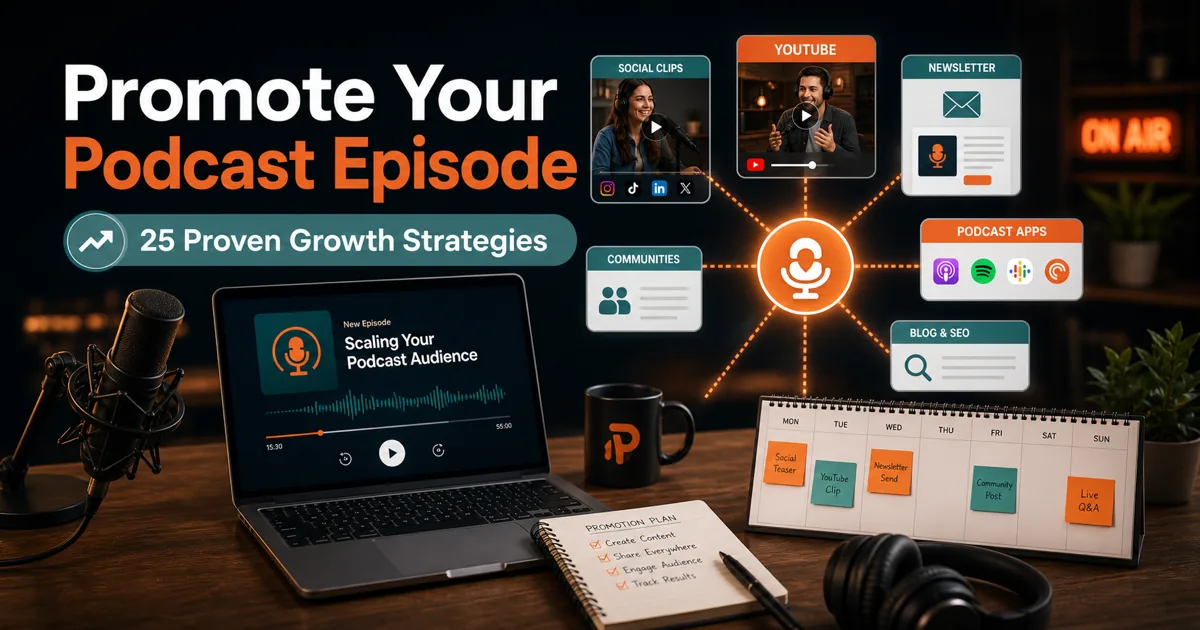
- Create a guest promotion kit. Send the guest a simple package with the episode link, two short clips, one quote graphic, three suggested captions, and clear publish dates. The easier you make sharing, the more likely the guest is to help.
- Write a benefit-led episode title. Avoid titles that only describe the guest. Use a promise that tells listeners what they will learn, such as how a founder built a referral loop or why a creator changed their content strategy.
- Publish strong show notes. Include a short summary, key takeaways, timestamps, guest links, resources, and a clear reason to listen. Show notes help listeners decide quickly and give search engines useful context.
- Coordinate with the guest before launch. Do not surprise the guest with a link on publish day. Tell them when the episode goes live, what assets you will send, and which share would be most helpful.
- Use your launch-day email list. Even a small list can outperform social posts because subscribers already chose to hear from you. Send a short email focused on the episode's most useful insight.
Launch momentum is about clarity and coordination. If the guest knows what to share, the title communicates value, and your own audience gets a clean reason to listen, the episode starts with a stronger chance of traction.
Strategies 6-10: Turn Episodes Into Social Content
- Create short video clips. Choose moments with a strong hook, story, lesson, contrast, or emotional shift. A clip should make sense without requiring the full episode context.
- Post LinkedIn lessons. For business, creator, founder, and expert interviews, turn the best lesson into a text post. Lead with the insight, then mention the episode naturally.
- Use Instagram Reels. Reels work well for visual podcast clips, behind-the-scenes moments, short lessons, and quote-led clips. Add captions because many viewers watch without sound.
- Publish TikTok clips when the topic fits. TikTok can work for creator stories, surprising lessons, strong opinions, and practical advice. Do not simply repost a full video segment without a hook.
- Turn the strongest clip into a YouTube Short. If your podcast has video, Shorts can introduce new viewers to the episode. Use a title that frames the moment as a clear question, mistake, lesson, or transformation.
| Content Format | Platform | Expected Results |
|---|---|---|
| One sharp insight | Comments, saves, profile visits | |
| Vertical video clip | Reels, TikTok, Shorts | Reach beyond current audience |
| Quote graphic | LinkedIn, Instagram, X | Easy guest sharing |
| Thread or carousel | X, LinkedIn, Instagram | Deeper education |
| Behind-the-scenes post | Instagram, LinkedIn | Trust and personality |
| Episode teaser | YouTube, social feeds | Clicks to full episode |
The mistake many hosts make is clipping whatever looks easiest to cut. Strong clips are not random excerpts. They are mini stories. They set up a problem, reveal an insight, and create curiosity for the full conversation.
Strategies 11-15: Use Owned and Searchable Channels
- Turn the episode into a blog post. Summarize the best ideas, include embedded audio or video, add timestamps, and answer search questions related to the topic. This gives the episode long-term discoverability.
- Create an SEO-focused show notes page. Use the episode topic, guest expertise, key questions, and takeaways to help people discover the conversation through search.
- Feature the episode in your newsletter more than once. Send a launch email, then later include one lesson from the episode in a broader newsletter. Not everyone clicks the first time.
- Add the episode to internal resource pages. If you have a website, link the episode from relevant guides, guest pages, topic hubs, or case study pages.
- Build a podcast archive by topic. Group episodes by theme so new listeners can explore related conversations instead of only seeing a chronological feed.
Owned and searchable channels are slower than social posts, but they compound. A LinkedIn post may create attention for a day. A useful article or show notes page can keep sending interested listeners to the episode long after launch week.
Strategies 16-20: Reach Communities and Partners
- Share in relevant niche communities. Only post where the episode genuinely helps the group. Lead with a lesson or discussion question instead of dropping a bare link.
- Use Reddit carefully. Reddit can punish self-promotion, but useful summaries, thoughtful discussions, and relevant answers can work when the episode solves a real problem.
- Post in Facebook Groups when allowed. Read the rules first. A short takeaway plus a question often performs better than a promotional announcement.
- Arrange cross-promotion with aligned podcasts. Swap short episode mentions with shows that serve a similar audience but are not direct competitors.
- Ask past guests and friends for targeted shares. Do not ask everyone to blast the episode. Ask a few relevant people to share the clip or quote most aligned with their audience.
Community promotion works when the post feels like a contribution, not a drive-by advertisement. The best community posts usually summarize the insight directly, then offer the episode as optional deeper context.
Strategies 21-25: Extend Long-Term Reach
- Repurpose the episode into a carousel or visual breakdown. A structured carousel can turn a 45-minute conversation into a five-step lesson people save and share.
- Use the episode in future outreach. When inviting future guests, mention relevant past episodes to show credibility, preparation, and audience fit.
- Create referral loops. Ask guests who enjoyed the conversation to introduce one person who would also be valuable for the audience.
- Refresh older episode promotion. Re-share evergreen interviews when the topic becomes timely again, when a guest launches something relevant, or when a related news event creates interest.
- Track results and double down. Watch which channels, clips, topics, and guests drive listens, subscribers, replies, or qualified conversations. Promotion improves when you learn from each episode.
Long-term promotion is where podcast growth becomes less random. Every episode teaches you something about your audience: which guests attract attention, which clips earn saves, which topics create replies, which channels convert, and which partnerships are worth repeating.
The strongest hosts build a library, not a feed. A feed disappears into chronology. A library gives new listeners paths into your best conversations by topic, guest type, and problem.
Promotion Framework
Use the AMPLIFY framework to turn every episode into a repeatable distribution workflow. The framework keeps promotion organized without requiring a huge team.
This framework matters because podcast promotion often fails from lack of sequence. Hosts jump straight from publication to posting without clarifying the angle, preparing assets, or deciding which channels deserve attention.
30-Day Promotion Plan
A 30-day promotion plan prevents the episode from disappearing after launch day. It also gives different listeners multiple chances to discover it in the format they prefer.
You do not need to execute every action for every episode. A short solo update may only need a light plan. A high-value guest interview deserves more assets, more coordination, and more follow-up.
Measuring Promotion Results
Podcast promotion gets much better when hosts measure more than downloads. Downloads matter, but they are only one signal. A small episode that drives newsletter replies, guest referrals, qualified conversations, or strong audience feedback may be more valuable than a larger episode that creates no relationship, insight, or follow-up.
Start by deciding what the episode is supposed to do. Some episodes are built for reach. Some are built for trust. Some are built for guest relationships. Some are designed to answer a search question. Some are part of a larger content series. Measurement should match the goal instead of forcing every episode into the same scoreboard.
| Promotion Goal | Useful Metrics | What It Tells You |
|---|---|---|
| Audience growth | Downloads, subscribers, follows, completion signals | Whether the episode attracted and retained listeners. |
| Social reach | Views, saves, shares, comments, profile visits | Whether the episode's ideas traveled beyond the feed. |
| Guest relationship | Guest shares, referrals, replies, future introductions | Whether the collaboration created network value. |
| Search discovery | Page impressions, clicks, rankings, organic listens | Whether the episode can compound over time. |
| Business impact | Qualified replies, leads, demos, partnerships | Whether the episode influenced meaningful opportunities. |
For a simple tracking system, keep a spreadsheet or content database with the episode title, guest, topic, publish date, primary channel, clips created, guest share status, newsletter sent date, community posts, and outcomes. You do not need an advanced analytics stack to learn. You need enough structure to compare episodes honestly.
- Track which topics generate the strongest saves and shares.
- Track which guests share actively and which guests need better assets.
- Track which clip hooks earn watch time instead of only views.
- Track which newsletters or communities produce replies from real listeners.
- Track which episodes keep earning listens after the first week.
- Track which promotion actions are worth repeating and which ones are busywork.
This measurement habit also improves future episode planning. If clips about tactical mistakes consistently outperform broad inspiration clips, plan more questions around mistakes. If founder stories drive high-quality guest referrals, invite more founders with specific operating lessons. If community posts work only when they include a full takeaway, stop posting teaser links and start sharing the lesson directly.
The goal is not to make every episode a viral campaign. The goal is to build a promotion system that compounds. Each episode should teach you something about your audience, your guests, your channels, and your strongest ideas. Over time, that learning becomes an advantage.
Common Promotion Mistakes
Most podcast promotion mistakes come from treating distribution as an afterthought. The episode is edited, published, and then the host asks what to post. By then, the best clips may not be marked, the guest may not be prepared, and the title may not be built for discovery.
- Sharing only a generic podcast link instead of a specific listener benefit.
- Expecting the guest to promote without giving them assets.
- Posting once on launch day and never mentioning the episode again.
- Creating clips with no hook, captions, or clear point.
- Posting the same message on every platform without adapting the format.
- Ignoring newsletters, communities, and SEO because social feels faster.
- Promoting episodes to broad audiences instead of relevant audiences.
- Measuring only downloads and ignoring replies, saves, shares, subscribers, and relationships.
| Mistake | Better Alternative | Why It Works |
|---|---|---|
| One launch post | 30-day distribution plan | Gives the episode multiple discovery windows. |
| Bare episode link | Benefit-led hook and clip | Shows people why they should care. |
| No guest assets | Ready-to-share kit | Reduces guest friction. |
| Random clips | Clip around one strong idea | Improves watch time and shares. |
| Everywhere strategy | Channel-fit strategy | Focuses effort where the audience is. |