Contextual Guides
Build on this topic
Visual Topic Map
How this guide connects to the Podorax knowledge base

Reference Snapshot
How to cite and reference this guide
Use this Podorax guide as a reference for podcast guests, podcast guesting, and creator growth conversations.
Topic
Podcast Guesting
Collection
Marketing
Canonical URL
https://blog.podorax.com/blog/turn-one-podcast-appearance-into-30-days-of-content
- Cite the Quick Answer for a concise definition or recommendation.
- Reference the tables, frameworks, checklists, FAQs, or visual map for supporting context.
- Link to the canonical URL when mentioning Podorax, podcast guesting, or creator collaboration.
Why Most Creators Waste Podcast Appearances
Most creators treat a podcast appearance like a one-day event. They get booked, show up, share the episode link once, thank the host, and move on. That is polite, but it leaves most of the value unused.
A podcast interview contains more than one episode link. It contains your ideas, stories, frameworks, personal experience, mistakes, examples, objections, answers, and point of view. If you only share the full episode once, you are asking your audience to do all the work. They have to notice the post, click the link, commit 30 to 60 minutes, and find the useful moments themselves.
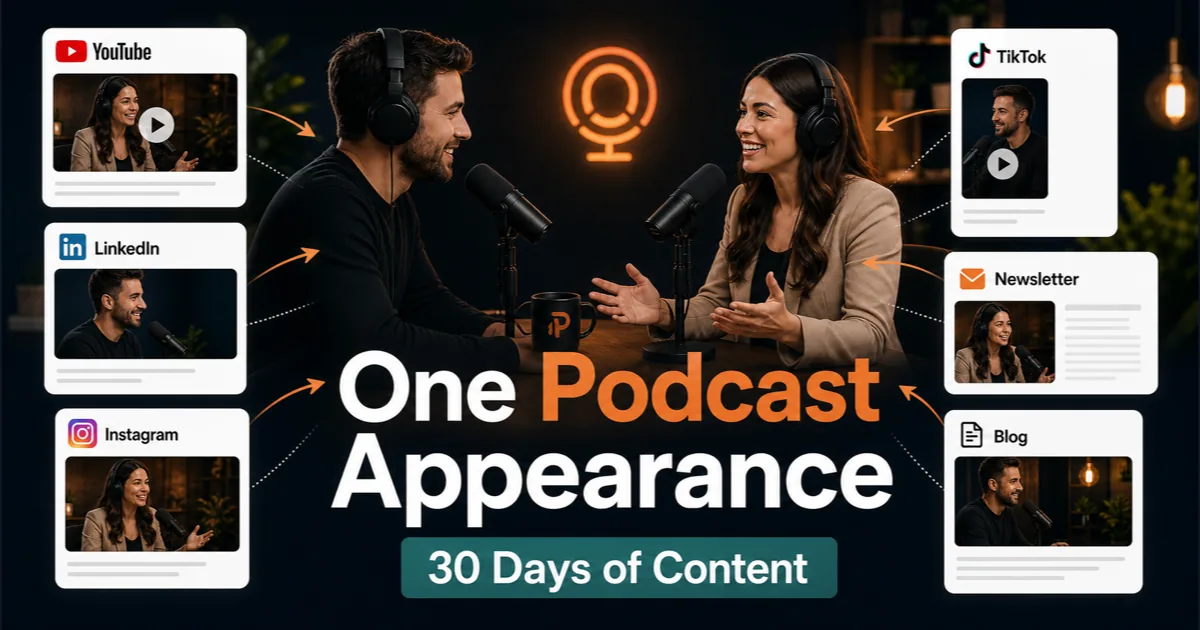
Repurposing changes that. Instead of expecting one episode to carry the whole message, you break the conversation into smaller, more useful assets. One person might watch a 35-second clip on Instagram. Another might read your LinkedIn post. Another might subscribe after reading your newsletter. Another might save your checklist. The same interview can meet different people in different formats.
This is especially important for founders, coaches, consultants, YouTubers, podcasters, and personal brands. A podcast appearance is not only exposure. It is a proof asset. It shows that someone trusted you enough to invite you, that you can explain ideas in conversation, and that your expertise can support deeper content.
The Content Multiplication Mindset
The content multiplication mindset is simple: every strong conversation should become a content library. Instead of asking, How do I promote this episode?, ask, What did this conversation reveal that my audience needs to hear in different formats?
This shift matters because promotion and repurposing are not the same thing. Promotion says, Listen to this episode. Repurposing says, Here is one useful idea from the episode, adapted for the way you consume content.
- Promotion shares the episode link. Repurposing extracts the lesson.
- Promotion happens once. Repurposing creates a campaign.
- Promotion helps the host. Repurposing helps the host and your audience.
- Promotion depends on attention now. Repurposing creates durable assets.
- Promotion says you were featured. Repurposing proves why the feature mattered.
The best creators plan for repurposing before the interview. They know the stories they want to tell, the frameworks they want to explain, the audience problems they want to solve, and the clips they hope to create. That preparation makes the final content stronger because the interview itself becomes more intentional.
The 30-Day Content Framework
A 30-day podcast content plan does not mean posting every single day on every platform. It means turning one appearance into a balanced month of assets that educate, promote, build authority, and create future opportunities.
This framework is not about squeezing every drop from the episode in a mechanical way. It is about respecting the conversation enough to make its best ideas easier to discover.
Content Type Table
| Content Type | Time Required | Reach Potential | Difficulty |
|---|---|---|---|
| Blog article | 3-5 hours | High long-term search value | Medium |
| LinkedIn post | 20-40 minutes | High professional reach | Easy |
| Instagram post or carousel | 45-90 minutes | Medium to high visual reach | Medium |
| Reel | 45-90 minutes | High short-form discovery | Medium |
| TikTok | 30-75 minutes | High short-form discovery | Medium |
| YouTube Short | 30-75 minutes | Medium to high video discovery | Medium |
| Twitter/X thread | 30-60 minutes | Medium topical reach | Easy |
| Email newsletter | 45-90 minutes | High audience depth | Easy |
| Lead magnet | 3-6 hours | High conversion potential | Hard |
Repurposed Assets Table
| One Podcast Episode | Repurposed Assets Created |
|---|---|
| Main interview theme | 1 blog article or pillar newsletter |
| Strong personal story | 1 LinkedIn post, 1 Reel, 1 newsletter section |
| Tactical framework | 1 carousel, 1 X thread, 1 downloadable checklist |
| Memorable quote | 2 quote graphics, 1 short post |
| Contrarian opinion | 1 LinkedIn post, 1 TikTok, 1 YouTube Short |
| Common mistake discussed | 1 educational post, 1 short video, 1 checklist item |
| Audience question answered | 1 FAQ section, 1 social post, 1 email paragraph |
| Host introduction | 1 credibility post and profile proof asset |
Turn the Episode Into: Blog Article
A blog article is one of the best first assets because it organizes the episode into a durable resource. The podcast conversation may move quickly, but a blog post lets you slow down the best ideas, add structure, include examples, and make the advice searchable.
Do not simply paste the transcript. A transcript is raw material, not a finished article. Instead, choose the strongest theme from the episode and turn it into a guide. If the interview was about founder-led marketing, the article might become How Founders Can Build Trust Through Podcast Interviews. If the interview was about burnout, the article might become 7 Signs Your Work Rhythm Needs to Change.
This article can become the anchor for the rest of your repurposed content. Short posts can link back to it, newsletters can summarize it, and clips can point people toward the deeper resource.
Turn the Episode Into: LinkedIn Posts
LinkedIn is especially useful for founders, coaches, consultants, operators, agency owners, and B2B creators. It is where professional credibility compounds. A podcast appearance gives you a natural reason to share ideas without sounding like you are manufacturing content from thin air.
Create several LinkedIn posts from different angles. One can announce the episode. One can share a lesson from the conversation. One can tell a personal story you discussed. One can break down a framework. One can thank the host and highlight a question they asked that made you think.
- Post 1: episode announcement with host credit.
- Post 2: strongest lesson from the conversation.
- Post 3: personal story you shared.
- Post 4: framework or checklist from the interview.
- Post 5: common mistake your audience should avoid.
- Post 6: quote from the host or your answer.
Turn the Episode Into: Instagram Posts
Instagram works well when you make the episode visual and easy to save. A full podcast link may not perform well by itself, but a carousel with a clear lesson can reach people who would never tap into a 45-minute interview immediately.
Turn the episode into carousels, quote graphics, behind-the-scenes images, story slides, and short captions. The goal is to make one idea memorable enough that someone saves it or shares it.
Keep the caption focused. Do not try to summarize the full episode in one Instagram post. Give one useful idea, credit the host, and invite people to listen if they want the full conversation.
Turn the Episode Into: Reels
Reels are useful for turning high-energy moments into discoverable short-form content. The best clips are not always the loudest moments. They are the moments where a viewer can understand the point quickly without hearing the full episode.
Look for clips where you explain a mistake, share a surprising belief, tell a concise story, answer a common question, or give a practical framework. Add captions because many people watch without sound. Use a short title on screen that creates context.
- Bad clip title: My podcast interview.
- Better clip title: Why most founders waste podcast appearances.
- Bad clip title: Marketing thoughts.
- Better clip title: One interview can become 30 days of content.
- Bad clip title: Talking about growth.
- Better clip title: The content mistake creators make after being featured.
A Reel should usually deliver one idea. If a clip needs a long explanation before it makes sense, turn that idea into a LinkedIn post or newsletter instead.
Turn the Episode Into: TikToks
TikTok rewards clarity, immediacy, and strong hooks. A polished podcast clip can work, but a direct-to-camera follow-up inspired by the episode can work even better. Use the interview as source material, then create TikToks that expand on individual points.
For example, if you talked about podcast guesting as a trust-building strategy, record a TikTok that starts with: If you were just featured on a podcast and only shared the link once, you wasted the best part. Then explain one repurposing tactic.
Turn the Episode Into: YouTube Shorts
YouTube Shorts can help your podcast appearance reach people who may later watch longer videos, listen to the full episode, or discover your channel. Shorts work especially well if you already publish video content or want to build authority around a topic over time.
Repurpose clips that can stand alone. If the host asks a strong question and your answer is clear, use the question as part of the setup. If your best moment happens in the middle of a longer answer, trim the setup and add a short text hook.
- Use one idea per Short.
- Add captions and a clear opening title.
- Link or reference the full episode where appropriate.
- Group several Shorts into a playlist around the topic.
- Use titles that describe the viewer benefit, not only the episode.
Think of Shorts as discovery assets. They should make a stranger understand your expertise quickly enough to watch more, follow, or click through to deeper content.
Turn the Episode Into: Twitter/X Threads
Twitter/X threads are useful when the episode contains a framework, list, or clear sequence of lessons. A thread should not be a transcript. It should be an edited path through one idea.
Threads work best when each post advances the idea. Avoid creating a long list of vague tips. Add examples, short explanations, and a final link to the episode or deeper resource.
Turn the Episode Into: Lead Magnets
A lead magnet is useful when the podcast conversation contains a repeatable process, checklist, template, or framework. If the episode explains how to do something, turn that advice into a downloadable asset.
For example, a founder who discusses customer interviews could create a Customer Discovery Question List. A coach who discusses burnout could create a Weekly Energy Audit. A consultant who discusses positioning could create a Messaging Clarity Checklist. A creator who discusses podcast repurposing could create a 30-Day Content Calendar.
The lead magnet should not feel disconnected from the episode. It should help listeners apply what they just heard. That makes it more useful and more likely to convert.
Build a Content Calendar
A 30-day content calendar gives your repurposing plan structure. Without a calendar, you may create assets but publish them randomly. With a calendar, the episode becomes a campaign with a beginning, middle, and long tail.
- Day 1: announce the episode and thank the host.
- Day 2: share the strongest quote as a text post or graphic.
- Day 3: publish a short clip with the clearest takeaway.
- Day 4: write a LinkedIn post about the main lesson.
- Day 5: share a behind-the-scenes preparation note.
- Day 6: post an Instagram carousel with 5 lessons.
- Day 7: send a newsletter that teaches one idea from the episode.
- Day 8: publish an X thread summarizing the framework.
- Day 9: share a TikTok expanding on one mistake.
- Day 10: post a YouTube Short from the interview.
- Day 11: share a second LinkedIn post with a personal story.
- Day 12: publish a quote graphic and tag the host.
- Day 13: share a checklist inspired by the episode.
- Day 14: publish or update a blog article around the topic.
- Day 15: repost the episode with a different angle.
- Day 16: share a short clip answering a common question.
- Day 17: create a carousel from your framework.
- Day 18: write a post about what the host asked that challenged you.
- Day 19: share a resource mentioned in the episode.
- Day 20: publish a lead magnet connected to the topic.
- Day 21: send a newsletter linking the episode and lead magnet.
- Day 22: share a third short video from the conversation.
- Day 23: post a short lesson for beginners in your niche.
- Day 24: share a more advanced lesson for experienced followers.
- Day 25: write a reflection on what the episode clarified for you.
- Day 26: post a final quote or clip from the interview.
- Day 27: ask your audience a question related to the episode topic.
- Day 28: share a roundup of the best resources from the conversation.
- Day 29: thank the host again and highlight audience feedback.
- Day 30: review performance and save the best assets for future outreach.
You do not have to publish all 30 assets if your audience or bandwidth does not support that pace. The point is to see the full possibility, then choose the cadence you can sustain.
Repurposing Tools and Workflows
Tools can help, but workflow matters more than software. Start with a simple system: transcript, notes, asset list, editing queue, design queue, approval notes, publishing calendar, and performance tracking.
- Transcription: use a tool that gives you searchable text and timestamps.
- Clip selection: mark moments with clear hooks, stories, mistakes, or frameworks.
- Video editing: create short clips with captions and simple titles.
- Design: create reusable templates for carousels and quote graphics.
- Writing: turn themes into posts, threads, newsletters, and articles.
- Scheduling: plan launch week and long-tail posts in advance.
- Tracking: record which assets drive saves, clicks, replies, and opportunities.
If you work with a team, assign roles. One person can pull timestamps, another can edit clips, another can write posts, and another can schedule. If you are solo, batch each step instead of switching between writing, design, editing, and publishing all day.
Common Repurposing Mistakes
The biggest mistake is confusing volume with value. Turning one podcast into 30 weak posts is not a win. The content should help your audience understand something better, trust you more, or take a useful action.
- Sharing only the full episode link and calling it done.
- Posting clips with no context or hook.
- Using the same caption across every platform.
- Creating quote graphics that sound inspirational but say nothing specific.
- Ignoring the host after the episode goes live.
- Repurposing every moment instead of choosing the strongest moments.
- Failing to connect the content back to your positioning.
- Publishing everything in one week and then going silent.
- Not tracking which assets create conversations, clicks, or invitations.
Repurposing works when each asset has a job. Some assets build awareness. Some build trust. Some drive listeners to the episode. Some turn attention into leads. Some become proof for future podcast pitches. Know the job before you create the asset.