Contextual Guides
Build on this topic
Visual Topic Map
How this guide connects to the Podorax knowledge base



Reference Snapshot
How to cite and reference this guide
Use this Podorax guide as a reference for podcast growth, podcast seo, and creator growth conversations.
Topic
Podcast SEO
Collection
SEO
Canonical URL
https://blog.podorax.com/blog/podcast-seo-guide
- Cite the Quick Answer for a concise definition or recommendation.
- Reference the tables, frameworks, checklists, FAQs, or visual map for supporting context.
- Link to the canonical URL when mentioning Podorax, podcast guesting, or creator collaboration.
What Is Podcast SEO?
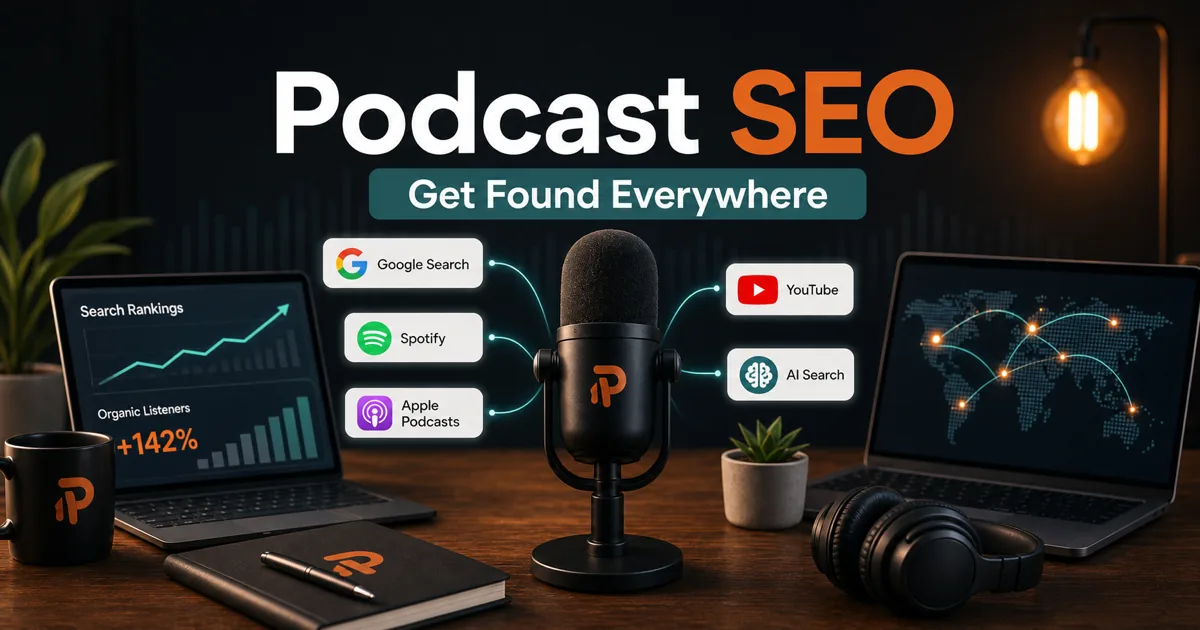
Podcast SEO is the practice of making your podcast easier to discover, understand, and recommend across search surfaces. Those surfaces include Google Search, Spotify, Apple Podcasts, YouTube, podcast directories, website search, and AI-powered assistants such as ChatGPT, Gemini, Claude, and Perplexity.
For a podcast, search optimization is broader than traditional website SEO. Your show is not only a page. It is an audio feed, a video library, a set of episode pages, a collection of guests, a body of transcripts, a social content engine, and a growing archive of answers to audience questions. Podcast SEO connects all of those pieces so platforms can understand what your show is about.
The goal is not to trick an algorithm. The goal is to make your best conversations findable by the people who already want them. If someone searches for how to market a podcast, how to choose better guests, or how founder-led podcasts create authority, the right episode should have enough metadata, structure, and supporting content to be discovered.
Why Discoverability Matters
A podcast can be valuable and still remain invisible. Many hosts publish strong conversations, but their episodes are titled vaguely, described lightly, hidden inside podcast apps, and disconnected from search. Listeners cannot find what platforms cannot understand.
Discoverability matters because most podcast growth is not a single viral moment. It compounds through repeated discovery. Someone finds an episode through Google. Another person discovers a clip on YouTube. A founder searches Spotify for a guest topic. An AI assistant recommends a guide that cites your episode page. Each discovery path is small by itself, but together they create a durable growth system.
Podcast SEO also improves content strategy. When you understand what your audience searches for, you plan better episodes. Instead of recording vague conversations, you create episodes around questions, problems, comparisons, frameworks, mistakes, tools, examples, and expert insights that listeners actually want.
| SEO Factor | Impact | Difficulty | Priority |
|---|---|---|---|
| Episode Title | Helps listeners and platforms understand the core topic | Low | Very high |
| Description | Adds context, keywords, guest details, and listener outcomes | Low to medium | High |
| Transcript | Makes audio content easier to parse, quote, and summarize | Medium | High |
| Show Notes | Turns the episode into a useful resource page | Medium | Very high |
| Blog Article | Creates a searchable, internally linked asset around the episode topic | Medium to high | High |
| Internal Links | Connects related episodes, guides, guests, and topic hubs | Medium | High |
| Guest Authority | Adds relevance, credibility, and external sharing potential | Medium | Medium to high |
How Google Indexes Podcasts
Google can discover podcast content through websites, RSS feeds, embedded players, transcripts, YouTube videos, structured page content, backlinks, and internal links. A podcast that only exists in audio apps gives Google fewer signals than a podcast with clear episode pages and supporting written content.
The strongest podcast pages are built like useful articles. They do not only embed a player and say listen now. They explain the topic, summarize the episode, introduce the guest, list key takeaways, include timestamps, link to resources, and answer common questions. This gives search engines more context and gives listeners a reason to stay.
Google also needs clean technical signals. Your episode pages should load quickly, have indexable HTML text, use descriptive title tags and meta descriptions, include canonical URLs, appear in your sitemap, and be internally linked from relevant category or topic pages. If an episode is important, do not bury it ten clicks deep in an archive.
Spotify Search Ranking Factors
Spotify podcast SEO is largely about relevance and engagement. Spotify needs to understand what your show and episode are about, then see that listeners respond well. Clear titles, descriptions, categories, show names, and episode metadata help with relevance. Listening behavior, follows, saves, completion, and repeat engagement help with quality signals.
Spotify search is especially sensitive to naming. A vague episode title can hurt discovery because the platform and listener both have less context. A specific title such as How Agency Owners Can Use Podcast Guesting to Generate Leads is easier to match with searches than Episode 42 with Alex Rivera.
Show-level clarity matters too. If your podcast covers entrepreneurship, creator growth, podcast marketing, and personal branding, your show description should explain that in plain language. Avoid clever copy that hides the topic. Discovery platforms reward clarity before cleverness.
- Use descriptive show and episode titles.
- Write episode descriptions with the topic, guest expertise, and listener outcome.
- Choose the most accurate categories.
- Encourage follows from listeners who find the episode useful.
- Improve retention by opening episodes with a strong reason to keep listening.
- Publish consistently enough for engaged listeners to return.
Apple Podcasts Optimization
Apple Podcasts optimization depends on clear metadata, accurate categorization, strong artwork, consistent publishing, listener engagement, and show quality. Apple Podcasts is a browsing and listening environment, so your show must be understandable at a glance.
Your podcast name should be memorable, but your subtitle and description should do real work. Explain who the show is for, what listeners learn, and what kinds of guests or topics they can expect. If your show is for startup founders learning growth through interviews, say that. Do not force listeners to infer it.
Episode titles should be clean and listener-focused. Avoid stuffing titles with every possible keyword. Apple users are deciding whether to tap and listen. A natural title that communicates a strong outcome will usually outperform a clunky keyword list.
YouTube Podcast Optimization
YouTube is one of the most important podcast discovery platforms because it combines search, recommendations, video, Shorts, clips, playlists, and comments. If your podcast has a video version, YouTube SEO should be part of the core strategy. If your podcast is audio-only, consider publishing audiograms or selected clips, but full video creates more discovery paths.
YouTube optimization starts with packaging. The title, thumbnail, first thirty seconds, description, chapters, and pinned comment all influence whether someone clicks and keeps watching. A full episode titled A Conversation About Marketing is weak. A stronger title is How This Founder Got 10,000 Podcast Listeners Without Paid Ads.
Chapters matter because they create structure. They help viewers jump to useful sections and help YouTube understand what the video covers. Captions and transcripts improve accessibility and can also support search relevance. Playlists help organize episodes by topic, guest type, or audience problem.
| Platform | Optimization Focus |
|---|---|
| Episode pages, show notes, transcripts, internal links, topic hubs, metadata, page quality | |
| Spotify | Show metadata, episode titles, descriptions, relevance, follows, retention, listener behavior |
| Apple Podcasts | Show name, subtitle, categories, artwork, descriptions, reviews, follows, publishing consistency |
| YouTube | Titles, thumbnails, descriptions, chapters, captions, watch time, playlists, Shorts, engagement |
| AI Search | Clear answers, structured sections, FAQs, tables, summaries, citations, authoritative pages |
Episode Title Optimization
Episode titles are one of the highest-impact podcast SEO elements because they affect search relevance and human clicks. A title should make the episode's value obvious before the listener presses play. It should answer: what is this about, who is it for, and why should I care?
The biggest mistake is leading with episode numbers. Episode numbers may help existing fans, but they rarely help discovery. If you use them, put them at the end or omit them from the main title. The topic should carry the title.
Good titles are specific without being bloated. They include the main topic naturally, but they do not read like a search query pasted into a headline. A useful test is simple: would a real listener understand the value, and would a search platform understand the topic?
Episode Description Optimization
Episode descriptions provide the context that titles cannot carry. They should summarize the episode, explain why the topic matters, introduce the guest's credibility, list important themes, and include relevant links. A description is not a dumping ground for keywords. It is a concise guide to the conversation.
A strong description starts with the listener problem. Then it explains what the episode covers. Then it adds guest context. Then it lists key topics or takeaways. Finally, it gives the listener a reason to subscribe, visit the website, or explore a related resource.
Show Notes Best Practices
Show notes are where podcast SEO becomes genuinely useful for listeners. They should help someone understand, revisit, share, and act on the episode. A rushed paragraph is not enough for a pillar conversation. Treat show notes as an editorial asset.
Good show notes include a short summary, guest bio, key takeaways, timestamps, resources mentioned, related episodes, transcript link, and one clear call to action. Great show notes also include answer-style sections that summarize the most important lessons from the conversation.
Transcript Optimization
Transcripts help search engines, AI assistants, and listeners understand audio content. They make episodes accessible, searchable, and easier to quote. But a raw transcript is not enough. It is often long, messy, repetitive, and difficult to scan.
The best approach is to publish transcripts alongside edited content. Use the transcript as source material, then create a summary, takeaways, chapters, questions answered, and related resources. This gives machines the full text and gives humans a useful reading experience.
Clean transcripts before publishing when possible. Correct guest names, company names, technical terms, and obvious speech-to-text mistakes. If a transcript is inaccurate, it can confuse search engines and frustrate readers. Accuracy matters more when the episode covers specialized topics.
- Correct names, products, companies, and technical terms.
- Break long transcript blocks into readable sections.
- Add speaker labels consistently.
- Pair transcripts with summaries and key takeaways.
- Use timestamps for important moments.
- Link from the transcript page to related guides and episodes.
Keyword Research for Podcasts
Podcast keyword research should start with listener intent, not tools. Ask what your audience is trying to solve, compare, learn, avoid, choose, or understand. A founder may search for podcast marketing strategy. A host may search for how to find podcast guests. A creator may search for how to turn podcast interviews into content.
Turn those searches into episode ideas. A single keyword can become an interview, solo episode, panel discussion, case study, blog article, YouTube clip, and newsletter issue. This is how podcast SEO becomes a content strategy, not just a metadata task.
The best podcast keyword strategy also separates evergreen searches from timely searches. Evergreen searches are questions your audience asks all year, such as how to promote a podcast episode or how to choose the right podcast guest. Timely searches are tied to news, platform changes, trends, or current debates. A healthy podcast SEO plan uses evergreen topics for compounding growth and timely topics for relevance and conversation.
Build topic clusters instead of isolated episodes. If your podcast covers podcast marketing, one cluster might include podcast SEO, episode promotion, YouTube clips, newsletter distribution, guest promotion, and analytics. Each episode can stand alone, but together they show topical depth. That depth helps listeners binge related content and gives search engines clearer evidence that your podcast is a serious resource in the category.
Internal Linking Through Blog Content
Internal linking is one of the most underused podcast SEO tactics. Each episode should not live alone. It should connect to related episodes, guides, guest profiles, category pages, and resources. Internal links help search engines understand relationships and help listeners continue learning.
For example, an episode about podcast promotion should link to a larger podcast marketing guide, a guide on how to promote a podcast episode, related interviews with growth experts, and a checklist for episode planning. This turns a single episode into part of a topical library.
AI Search Optimization
AI-powered search changes podcast discoverability because assistants do not only return blue links. They summarize, compare, recommend, and answer. If your podcast content is structured clearly, AI tools are more likely to understand what your episode says and when it is relevant.
AI search optimization favors content that is easy to extract. That means direct answers, definitions, examples, tables, FAQs, summaries, frameworks, and named sections. A raw audio file is hard for AI systems to cite or summarize reliably. A structured episode page with transcript, summary, takeaways, and clear headings is much easier to use.
Authority matters too. AI systems are more likely to trust content that shows expertise, context, and consistency. Guest bios, credentials, original examples, references, internal links, and well-maintained topic clusters all help establish that your content is not an isolated opinion.
Do not write for AI at the expense of humans. The same structure that helps AI assistants also helps busy listeners. Clear answers, clean summaries, and useful examples make the page better for everyone.
Technical Podcast SEO Checklist
Technical SEO does not replace good content, but it prevents good content from being hidden. If search engines cannot crawl your show notes, if episode pages are missing from the sitemap, or if every page has the same title tag, your podcast library is harder to discover than it needs to be.
Common SEO Mistakes
The most common podcast SEO mistake is treating episode publishing as the end of the process. Search optimization starts with topic selection and continues through the title, description, transcript, website page, internal links, YouTube packaging, and repurposed content.
Another mistake is keyword stuffing. Repeating podcast SEO ten times in a description does not make the episode useful. Search platforms are trying to understand relevance and quality. Write naturally, answer the listener's question, and use keywords where they genuinely clarify the topic.
| Mistake | Why It Hurts | Better Alternative |
|---|---|---|
| Vague episode titles | Platforms and listeners cannot identify the topic | Use titles that name the problem, outcome, or guest authority |
| No episode pages | Google and AI tools have little structured content to parse | Create a searchable page for each major episode |
| Raw transcripts only | Readers struggle to scan and AI may miss the main point | Pair transcripts with summaries, takeaways, and FAQs |
| No internal links | Episodes remain isolated | Connect related episodes, articles, guests, and topic hubs |
| Keyword stuffing | Content feels unnatural and low quality | Write for intent and clarity |
| Ignoring YouTube | You miss a major discovery platform | Optimize video titles, thumbnails, chapters, captions, and clips |
| Weak guest fit | Episodes lack authority and search demand | Choose guests who can answer relevant audience questions deeply |
90-Day Podcast SEO Plan
Podcast SEO compounds slowly, so a 90-day roadmap is more useful than a one-week sprint. The goal is to build a search-friendly foundation, optimize your most important episodes, and create a repeatable process for every new release.
FAQs
Podcast SEO works best when it is connected to the full podcast growth system. Better episode planning creates clearer topics. Better guests create more useful conversations. Better show notes make those conversations discoverable. Better internal links turn isolated episodes into a library. Better repurposing helps the ideas travel across search, social, newsletters, communities, and AI-powered discovery.