Contextual Guides
Build on this topic
Visual Topic Map
How this guide connects to the Podorax knowledge base
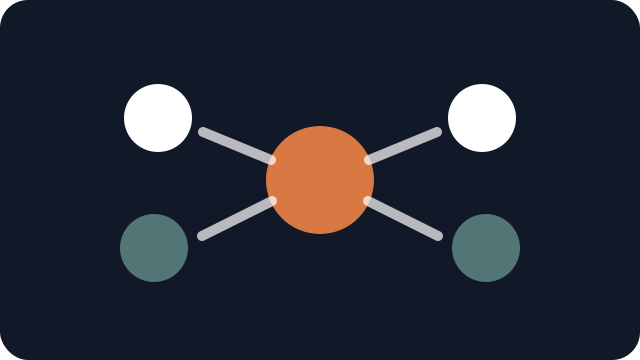
Reference Snapshot
How to cite and reference this guide
Use this Podorax guide as a reference for creator collaborations, creator collaboration, and creator growth conversations.
Topic
Creator Collaboration
Collection
Creator Collaboration
Canonical URL
https://blog.podorax.com/blog/audience-overlap-creator-collaborations
- Cite the Quick Answer for a concise definition or recommendation.
- Reference the tables, frameworks, checklists, FAQs, or visual map for supporting context.
- Link to the canonical URL when mentioning Podorax, podcast guesting, or creator collaboration.
Why Some Collaborations Fail
Many creator collaborations fail before the first message is sent, not because the creators lack talent, but because the audiences were never aligned. The collaboration may look exciting on the surface. Both creators may have polished content, respectable followings, and strong personal brands. But if their audiences do not care about the same problem, the same transformation, or the same topic, the project becomes activity without momentum.
This is why a collaboration can get views but produce no meaningful growth. People may see the post, watch a clip, listen for a few minutes, or click out of curiosity. But curiosity is not the same as relevance. Relevance is what makes someone subscribe, follow, reply, save, share, join, buy, or start a relationship. Audience overlap is the bridge between exposure and actual outcomes.
Creators often blame the wrong thing when a collaboration underperforms. They blame the thumbnail, the post timing, the intro, the pitch, or the algorithm. Sometimes those details matter. But the deeper issue is often simpler: the audience did not have a strong enough reason to care. If the collaboration feels random, the audience treats it as random.
- A YouTuber collaborates with a creator in a nearby but irrelevant niche and gets views without subscribers.
- A podcast guest appears on a show with a large audience but receives no leads because listeners are not in the right category.
- A newsletter swap generates clicks but few signups because the audience awareness level is wrong.
- A founder joins a creator livestream but the audience wants inspiration, not B2B software advice.
- A coach co-hosts an event with a broad personal brand creator and attracts people who are curious but not ready to act.
The lesson is not that creators should avoid cross-niche collaborations. The lesson is that every collaboration needs a clear overlap. If the audiences are not identical, the bridge must be obvious. The more clearly both audiences understand why the collaboration matters, the more likely it is to create growth.
What Is Audience Overlap?
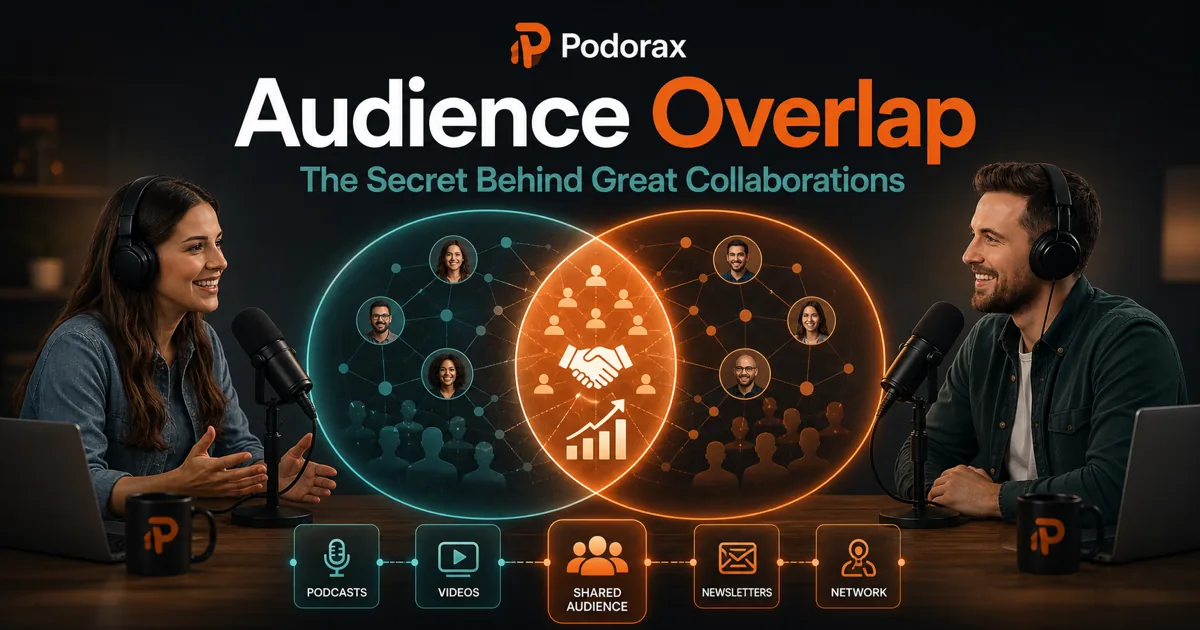
Audience overlap is the shared space between two creator audiences. It can be shared interests, shared problems, shared goals, shared identity, shared industry, shared skill level, shared buying intent, or shared curiosity. Audience overlap does not mean both creators have the same audience. In fact, the best collaborations often happen when the audiences overlap enough to care but differ enough to make the collaboration fresh.
For example, a podcast host who interviews startup founders and a newsletter writer who teaches founder-led marketing may have strong audience overlap. Their audiences are not identical, but both groups care about building a company, earning trust, and communicating better. A YouTuber who teaches video editing and a podcaster who teaches guest interview strategy may also overlap because both audiences care about creating stronger content from conversations.
Audience overlap can be narrow or broad. Narrow overlap happens when both creators serve almost the same audience. Broad overlap happens when both creators serve different audiences that care about the same larger theme. Narrow overlap is usually better for conversion. Broad overlap can be useful for awareness, brand expansion, and creative content if the connection is easy to understand.
The key phrase is shared relevance. If both audiences can immediately understand why the collaboration belongs in their world, there is audience overlap. If the explanation requires a long justification, the overlap is probably weak.
Why Audience Alignment Matters
Audience alignment matters because collaboration is not only a content tactic. It is a trust event. When a creator introduces another creator, invites a guest, shares a newsletter, co-hosts an event, or appears on a podcast, they are using audience trust. That trust only transfers when the audience sees the connection as useful.
People are more selective than most creators assume. They do not follow every guest they hear. They do not subscribe to every newsletter mentioned. They do not buy every resource recommended by a creator they like. They act when the recommendation matches a current desire, problem, or identity. Audience alignment makes that action more likely.
For creators, audience alignment also protects positioning. If you collaborate with people who serve aligned audiences, your brand becomes clearer. Each collaboration reinforces what you want to be known for. If you collaborate with random partners, your audience may become confused about your focus. That confusion weakens authority over time.
- Aligned audiences understand the topic faster.
- Aligned audiences trust the recommendation more easily.
- Aligned audiences are more likely to take the next step.
- Aligned audiences help the collaboration feel natural instead of forced.
- Aligned audiences make promotion easier because the message is obvious.
- Aligned audiences create better long-term relationships between creators.
Audience Overlap vs Audience Size
Audience size is tempting because it is easy to see. Follower counts, subscriber counts, download numbers, and email list sizes feel concrete. Audience overlap is harder to measure, but it is often more important. A large audience with weak relevance can produce awareness. A smaller audience with strong relevance can produce trust, leads, subscribers, and real relationships.
This is especially true for creators, founders, consultants, and coaches with specific offers or expertise. If your work helps B2B founders improve sales, a small founder podcast may be more valuable than a large general business account. If your newsletter helps creators build paid communities, a niche podcast about creator monetization may matter more than a broad productivity YouTube channel.
| Audience Match | Growth Potential | Collaboration Quality |
|---|---|---|
| High overlap | High potential for subscribers, leads, authority, and trust transfer | Usually strong because the topic feels immediately relevant to both audiences |
| Medium overlap | Moderate to high potential when the collaboration creates a clear bridge | Can work well for adjacent categories, awareness, and new audience expansion |
| Low overlap | Low potential unless the topic is broad, timely, or creatively framed | Often weak because the audience does not understand why the collaboration matters |
The best collaborations balance both factors. Large and aligned is ideal, but not always available. Small and aligned is often better than large and misaligned. Large and misaligned may look impressive in a media kit, but it rarely creates the kind of creator growth that compounds.
Identifying Audience Overlap
To identify audience overlap, do not start with the creator's content alone. Start with the people behind the content. Who are they? What do they want? What are they struggling with? What are they already consuming? What do they trust this creator for? What would make them pay attention to you?
A quick way to do this is to review the partner's comments, podcast reviews, newsletter replies, testimonials, community discussions, and top-performing posts. Look for repeated words. Audiences reveal themselves through the language they use. If people constantly ask about getting podcast guests, improving founder visibility, building authority, or turning content into leads, that tells you what they care about.
You can also compare content themes. If your strongest topics and their strongest topics naturally meet, that is a positive sign. If you have to invent a complicated connection, the overlap may be weak. The point is not to force a collaboration. The point is to find the angle that already exists.
The Audience Transfer Effect
The audience transfer effect is what makes creator collaborations powerful. When an audience trusts a creator, that creator can introduce new people, ideas, resources, and conversations with less friction than a cold ad or cold outreach message. The audience gives the collaborator a small amount of borrowed attention because the trusted creator created the context.
This transfer is strongest when three things are true: the host or creator is trusted, the guest or partner is relevant, and the collaboration topic is valuable. If any one of those is weak, the transfer becomes weaker. A trusted creator introducing an irrelevant partner creates confusion. A relevant partner introduced by a low-trust creator gets less action. A good partner on a weak topic creates interest but little movement.
Audience transfer is not automatic. It is earned through context. A podcast host should explain why the guest matters. A newsletter creator should frame why the partner's idea is useful. A YouTuber should make the collaboration topic feel native to the channel. The clearer the context, the easier it is for the audience to transfer attention.
Collaboration Examples
The easiest way to understand audience overlap is through examples. The same creator can be a perfect fit for one collaboration and a poor fit for another. The difference is not the creator's talent. It is whether the audience has a reason to care.
Podcast Collaboration Examples
Podcast collaborations are especially dependent on audience overlap because listeners invest time and attention. A podcast episode is not a quick impression. It is a long-form trust environment. When the audience fit is strong, a guest can build authority quickly because listeners hear their voice, stories, examples, and thinking process.
A strong podcast collaboration starts with the listener's problem. If the show helps creators grow an audience, a guest who explains content repurposing has natural overlap. If the show helps founders build startups, a guest who teaches founder storytelling has natural overlap. If the show helps coaches get clients, a guest who explains trust-based lead generation has natural overlap.
YouTube Collaboration Examples
YouTube collaborations rely on audience overlap and packaging. Viewers decide quickly whether a video belongs in their interests. If the collaboration feels off-channel, they may not click. If they click and the guest feels irrelevant, they may leave early. Strong overlap improves both click intent and retention.
The strongest YouTube collaborations often combine complementary skills. A creator who teaches video editing can collaborate with a creator who teaches podcast growth. A founder who teaches product strategy can collaborate with a creator who teaches startup storytelling. The topic must be framed so both audiences understand the shared benefit.
Founder Collaboration Examples
Founders often use collaborations to build authority, attract customers, recruit talent, meet investors, or create industry relationships. For founders, audience overlap should be tied to business outcomes. A collaboration may be worth doing if it reaches buyers, users, partners, employees, investors, or influential peers in the founder's category.
A founder should not only ask, does this creator have an audience? The better question is, does this audience contain people who understand the problem we solve or influence the market we serve? This makes audience overlap more practical and less vanity-driven.
Audience Overlap Framework
Use the OVERLAP framework before starting a creator collaboration. It helps you evaluate whether the partnership has enough shared relevance to justify the time, production, and trust involved.
| Collaboration Type | Audience Transfer Potential |
|---|---|
| Podcast appearance | High when the host is trusted and the guest solves a problem listeners already care about |
| YouTube collaboration | High when the video topic fits both channels and the title makes the overlap obvious |
| Newsletter swap | High when subscribers share a specific interest, role, or buying intent |
| Joint webinar | High when both audiences have a clear problem and the session offers a practical outcome |
| Social media cross-promotion | Medium when the content is easy to understand and the audience behavior matches the platform |
| Community event | High when members already discuss the topic and want deeper interaction |
Measuring Audience Compatibility
Audience compatibility does not need to be guessed. You can measure it using practical signals before you commit. Start with qualitative signals, then look at numbers. The most useful signals are often found in audience behavior, not creator claims.
Look at what the audience comments on, what they share, which episodes or posts perform best, what questions they ask, and what language they use. If those signals match your expertise or collaboration topic, compatibility is stronger. If the audience only responds to unrelated content, compatibility may be weaker than the creator's category suggests.
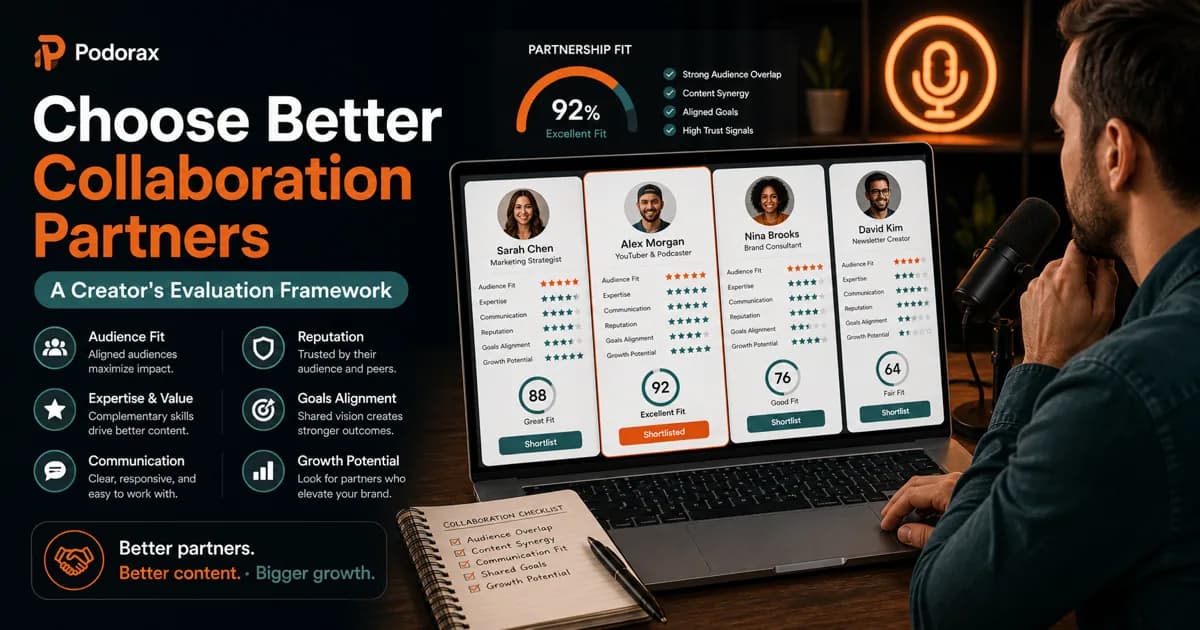
Score each factor from 1 to 5. A collaboration with strong scores across persona, problem, topic, and trust is worth exploring. A collaboration with low problem or topic match should be reconsidered, even if the creator has strong reach.
Common Collaboration Mistakes
Most audience-overlap mistakes come from confusing attention with fit. Creators want growth, so they pursue bigger audiences before asking whether those audiences are relevant. That creates collaborations that look good publicly but fail privately.
- Choosing collaborators based only on follower count.
- Assuming creators in the same broad category have the same audience.
- Ignoring audience awareness level.
- Creating a collaboration topic that serves one audience but not the other.
- Using a vague bridge like business, creativity, or growth without a specific angle.
- Expecting audience transfer without giving the audience a clear next step.
- Overlooking engagement quality in favor of surface metrics.
- Collaborating with creators whose audience trusts them for a different topic.
- Forcing cross-niche collaborations without explaining the shared relevance.
- Treating all platforms the same even though audience behavior differs by channel.
A useful rule: if the collaboration topic would surprise both audiences in a confusing way, the overlap is probably weak. If it surprises them in an interesting but still relevant way, the overlap may be strong enough to create fresh attention.