Contextual Guides
Build on this topic
Visual Topic Map
How this guide connects to the Podorax knowledge base

Reference Snapshot
How to cite and reference this guide
Use this Podorax guide as a reference for creator collaborations, creator collaboration, and creator growth conversations.
Topic
Creator Collaboration
Collection
Creator Collaboration
Canonical URL
https://blog.podorax.com/blog/how-to-choose-the-right-collaboration-partner
- Cite the Quick Answer for a concise definition or recommendation.
- Reference the tables, frameworks, checklists, FAQs, or visual map for supporting context.
- Link to the canonical URL when mentioning Podorax, podcast guesting, or creator collaboration.
Why Collaboration Partner Selection Matters
Creator collaboration can accelerate growth faster than publishing alone, but only when the partner is right. A strong collaboration puts your ideas in front of people who are likely to care, trust, and act. A weak collaboration creates activity without momentum. It can produce content, meetings, messages, and promotion, yet still fail because the audience fit was wrong from the beginning.
Many creators choose partners based on surface signals: follower count, polished branding, a recognizable name, or the excitement of being noticed. Those signals can be useful, but they are not enough. A creator with 200,000 followers may have an audience that does not match your topic. A podcast host with a smaller audience may have deep trust with exactly the people you want to reach. A newsletter writer with modest reach may drive more qualified subscribers than a large social account because the audience is more focused.
The partner you choose also affects your reputation. When you appear on someone's podcast, co-host a webinar, swap newsletters, create a YouTube video, or promote a joint resource, you are telling your audience that this person is worth their attention. That trust transfer can help you, but it can also hurt you if the partner's work, values, or execution does not match the standard your audience expects.
- The right partner can introduce you to a qualified audience that already trusts the topic.
- The wrong partner can waste preparation time, production time, and promotional energy.
- The right partner makes your positioning clearer because the collaboration reinforces what you want to be known for.
- The wrong partner can confuse your audience about your standards, values, or niche.
- The right partner can become a long-term relationship, not just a one-time content exchange.
The Cost of Choosing the Wrong Partner
A poor collaboration partner does not only cost time. It can cost audience trust, creative energy, positioning clarity, and future opportunities. Creators often notice the cost only after the project is already underway: the partner misses deadlines, changes the scope, promotes halfheartedly, pushes a sales message, or delivers content that does not match the promised quality.
The biggest hidden cost is opportunity cost. Every weak collaboration takes attention away from a better one. If you spend a week planning a poorly aligned joint live session, that is a week you could have spent pitching a relevant podcast, building a relationship with a better-fit newsletter creator, or preparing a resource for an audience that is much more likely to convert.
Wrong partners also create confusing audience signals. If you are known for practical founder advice but collaborate with a creator whose audience wants entertainment-only lifestyle content, the content may feel disconnected. If you are a consultant serving B2B operators but partner with someone whose audience is early-stage hobbyists, the collaboration may generate views but few useful relationships.
What Makes a Great Collaboration Partner
A great collaboration partner is someone whose audience, expertise, values, and execution style make the collaboration stronger than what either person could create alone. The goal is not to find someone identical to you. The goal is to find someone complementary enough that your combined perspectives create more value for both audiences.
For podcast guesting, this may mean a host whose audience wants your expertise and whose interview style helps you explain your ideas well. For YouTube collaborations, it may mean a creator with a similar audience but a different angle. For newsletters, it may mean a writer whose readers care about the same category but need a different practical framework. For joint events, it may mean two experts solving adjacent parts of the same problem.
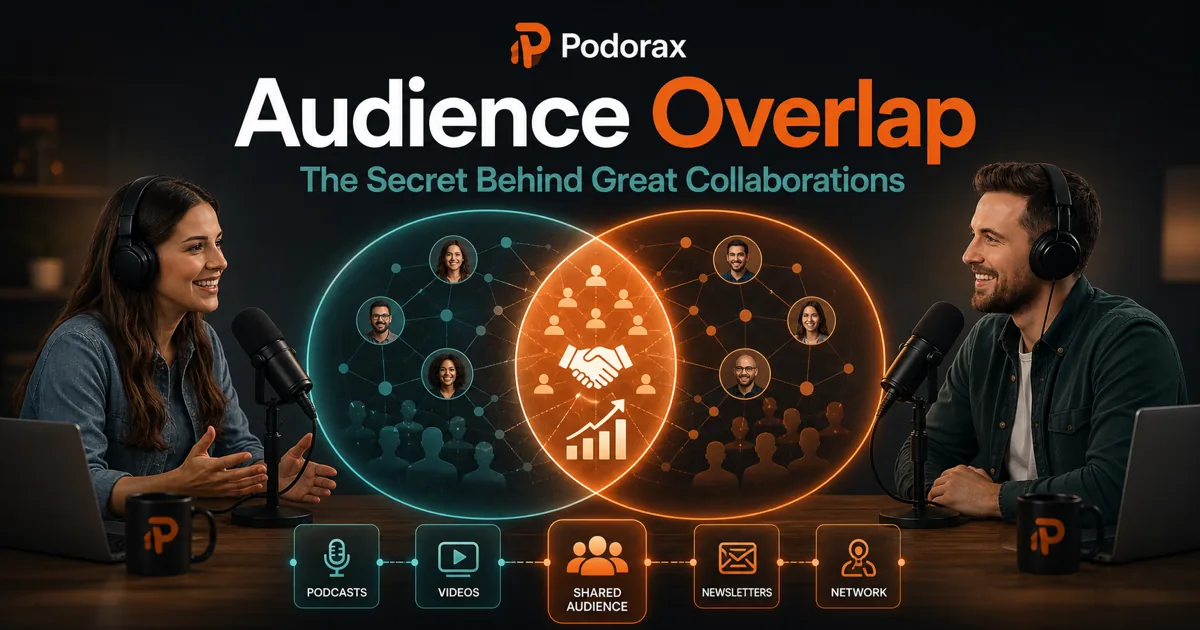
- Audience overlap: their audience cares about the same broad topic or problem.
- Complementary expertise: they add a perspective that makes the collaboration richer.
- Trustworthiness: their audience believes them and their reputation is aligned with yours.
- Clear goals: both sides understand what success looks like.
- Reliable communication: they respond, clarify, and follow through.
- Execution quality: their content, production, and promotion standards are strong.
- Long-term potential: the relationship could lead to future opportunities.
Audience Alignment
Audience alignment is the foundation of a successful creator partnership. If the audience does not care, little else matters. A beautiful collaboration with a respected creator can still underperform if the people watching, listening, or reading do not share the problem you solve.
Start by asking who the partner serves. Do they speak to founders, beginners, advanced operators, creators, marketers, coaches, consultants, local businesses, technical audiences, or consumers? Then ask what those people want. Are they trying to grow an audience, improve operations, build authority, generate leads, learn a skill, solve a technical problem, or make better buying decisions?
The strongest collaboration partners often serve the same audience from a different angle. A podcast host who interviews founders may be an excellent partner for a SaaS strategist. A newsletter writer focused on creator monetization may be a strong partner for a coach who helps creators package services. A YouTuber teaching video production may be a natural partner for a podcaster teaching interview formats.
A simple test: write one sentence explaining why both audiences should care. If the sentence sounds forced, the partnership may be too weak. If it feels obvious, you likely have real audience alignment.
Expertise Alignment
Expertise alignment means your knowledge and the partner's knowledge work together. The best collaborations do not require both creators to know the same things. In fact, identical expertise can make the collaboration less interesting. The strongest partnerships often combine adjacent strengths.
For example, a founder who understands product-led growth could collaborate with a marketer who understands demand generation. A podcaster who knows interview storytelling could collaborate with a short-form video creator who knows distribution. A consultant who helps agencies improve operations could collaborate with a finance expert who helps agencies price retainers. The overlap creates relevance; the difference creates value.
Before choosing a partner, compare your expertise maps. What do you know deeply? What do they know deeply? Where do those two areas meet? What can the audience learn from the combination that they would not learn from either creator alone?
Values Alignment
Values alignment is easy to ignore because it is less visible than audience size or content quality. It matters because collaboration is a trust exchange. If your audience sees you working with someone, they assume some level of endorsement. That endorsement should not be casual.
Values do not mean both creators must agree on everything. They mean the partner's standards, promises, communication style, and public behavior should not conflict with the trust you are building. A creator who uses manipulative sales tactics may not be a good partner for a brand built on education and transparency. A creator who publishes unverified claims may not fit a brand built on practical credibility.
- Review how they talk to their audience.
- Check whether their advice is careful or exaggerated.
- Look at how they sell products, services, or sponsorships.
- Notice whether they credit collaborators and sources.
- Assess whether their tone would feel trustworthy to your audience.
- Consider whether you would be comfortable introducing them to a client, subscriber, or listener.
When values are aligned, collaboration feels easy. Both creators make similar decisions about quality, honesty, audience respect, and long-term reputation. When values are misaligned, every decision can become awkward: what to promote, what claims to make, what examples to use, and how hard to sell.
Communication Quality
Communication quality is one of the best predictors of collaboration quality. If someone is unclear, slow, dismissive, or disorganized before the project starts, the collaboration will probably become harder once deadlines, promotion, recording details, and responsibilities are involved.
Good partners do not need to be instantly available. They do need to be clear. They confirm expectations, ask useful questions, share assets on time, respond when decisions are needed, and let you know when timelines change. These simple behaviors protect the creative process.
Creators often underestimate how much communication affects results. A strong idea can become weak if the partner never sends the recording link, misses the newsletter deadline, sends low-quality assets, or refuses to clarify what promotion will look like. A simpler collaboration with a reliable partner often outperforms an ambitious collaboration with a chaotic one.
Growth Potential
Growth potential is not the same as audience size. It is the likelihood that a collaboration will create meaningful outcomes: qualified attention, subscribers, podcast invitations, newsletter signups, leads, trust, referrals, relationships, or future partnerships.
A collaboration has high growth potential when the audience is relevant, the format is useful, the partner is trusted, and the call to action is natural. A podcast appearance may generate long-term authority because the episode stays searchable. A newsletter swap may create faster subscriber growth. A joint webinar may generate leads. A YouTube collaboration may increase discovery through recommendations. Each format grows differently.
Before saying yes, define what kind of growth you want. If your goal is authority, choose a partner known for thoughtful conversations. If your goal is leads, choose a partner whose audience has the problem you solve. If your goal is audience growth, choose a partner with strong distribution and a format that encourages following. If your goal is networking, choose someone connected to the ecosystem you want to enter.
| Partnership Type | Growth Potential | Relationship Value |
|---|---|---|
| Podcast Guesting | High for authority, trust, and long-tail discovery | Strong because conversations create real relationship depth |
| YouTube Collaboration | High for reach and audience discovery when topics align | Moderate to strong depending on planning and promotion |
| Newsletter Swap | High for subscriber growth when audiences are specific | Moderate because the collaboration can be lightweight |
| Live Event | High for leads, trust, and community engagement | Strong because co-hosting requires planning and interaction |
| Joint Content | Medium to high for search, social, and credibility | Strong when the asset can be reused by both creators |
Audience Size vs Audience Quality
Audience size is visible, so it often gets too much weight. Audience quality is less visible, but it usually determines outcomes. A high-quality audience is relevant, engaged, trusting, and likely to care about the collaboration topic. A low-quality audience may be large but passive, broad, distracted, or misaligned.
The best question is not how many people will see this. The better question is how many of the right people will care enough to take the next step. For creators, quality can mean the audience comments thoughtfully, replies to newsletters, attends events, listens to long-form episodes, shares resources, buys relevant offers, or starts conversations.
A smaller partner can be better when their audience is concentrated around one clear problem. A larger partner can be better when their audience is still specific enough to match your message. The mistake is treating all reach as equal. A thousand relevant listeners can be more valuable than one hundred thousand indifferent viewers.
- Choose audience quality when your goal is leads, trust, or authority.
- Choose audience size when your goal is broad awareness and the topic has wide appeal.
- Choose both only when the partner has scale and strong audience relevance.
- Avoid large audiences that do not match your category, buyer, reader, listener, or community.
Short-Term vs Long-Term Partnerships
Some collaborations are designed for short-term wins: a podcast appearance, one newsletter feature, a single Instagram Live, or a one-time YouTube video. These can be useful, especially when the fit is clear and the execution is simple.
Long-term partnerships are different. They can compound. A creator who first invites you onto a podcast may later introduce you to another host, co-create a resource, refer a client, join a panel, or become a recurring collaborator. These relationships often become more valuable than the first collaboration itself.
When evaluating a partner, ask whether the relationship has room to grow. Do you respect their thinking? Would you want to collaborate again? Do your audiences have recurring overlap? Could this person become part of your creator network? The best partnerships often start with one clear project and expand because both sides follow through well.
Red Flags to Watch For
Red flags do not always mean you should reject a partner immediately. They mean you should slow down, ask better questions, and protect your time. One small issue may be manageable. Several red flags together usually point to a partnership that will be harder than it is worth.
- They cannot clearly explain who their audience is.
- They focus only on what they will gain from the collaboration.
- They promise unrealistic results or use inflated metrics.
- They avoid discussing responsibilities, timelines, or promotion.
- Their content quality is inconsistent with your audience standards.
- Their communication is vague, rushed, or repeatedly delayed.
- They have low audience relevance despite high reach.
- They push aggressive sales language into educational content.
- They have a reputation for poor follow-through.
- They want access to your audience before earning trust.
The clearest warning sign is misalignment between what they say and how they operate. A creator may talk about collaboration, generosity, and audience value, but if every message centers their own promotion, believe the behavior.
Collaboration Scoring Framework
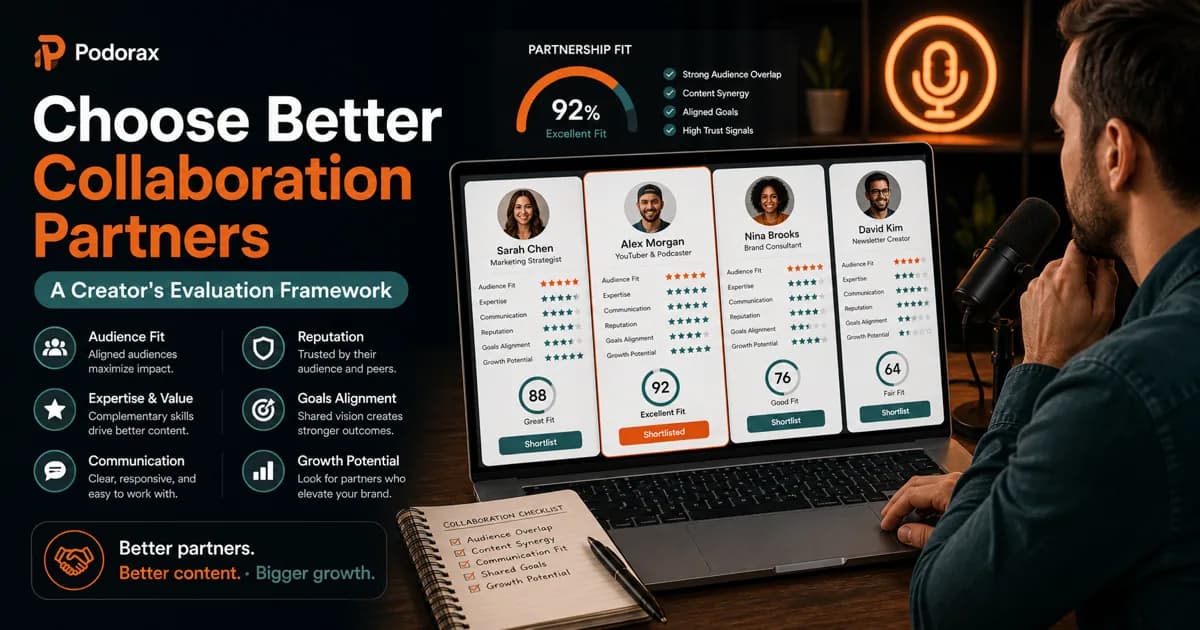
A scoring framework helps you avoid emotional decisions. Instead of saying yes because a creator has a large following or because the opportunity feels exciting, score the partnership across the factors that actually predict results.
| Evaluation Criteria | Importance | Weight | Examples |
|---|---|---|---|
| Audience Fit | Critical | 30% | Same buyer, listener, reader, niche, pain point, or content category |
| Expertise | High | 20% | Complementary knowledge, credible experience, useful point of view |
| Communication | High | 15% | Clear replies, reliable timelines, specific expectations, collaborative tone |
| Reputation | High | 15% | Trusted by audience, ethical promotion, consistent quality, positive peer signals |
| Goals | Medium | 10% | Both sides want compatible outcomes such as authority, audience growth, leads, or relationships |
| Values | Medium | 10% | Similar standards for honesty, quality, audience respect, and long-term trust |
Score each factor from 1 to 5. A partner with mostly 4s and 5s is worth exploring. A partner with a low audience-fit score should usually be deprioritized, even if the audience is large. A partner with low trust or communication should be handled carefully, even if the opportunity looks attractive.
Partner Evaluation Checklist
Real Examples
Common Collaboration Mistakes
Most collaboration mistakes happen because creators evaluate opportunities too quickly. They say yes to visibility before checking relevance. They accept vague partnerships before defining success. They focus on the creator's status instead of the audience's needs.
- Choosing partners based only on follower count.
- Ignoring audience mismatch because the opportunity feels exciting.
- Collaborating before defining the format, timeline, and promotion plan.
- Assuming a friendly creator will be a reliable operator.
- Choosing partners who duplicate your expertise instead of complementing it.
- Skipping values checks because the partner seems popular.
- Accepting collaborations that do not support your positioning.
- Trying to manage too many partnerships at once.
- Treating one-off collaborations as transactions instead of relationship starters.