Contextual Guides
Build on this topic
Visual Topic Map
How this guide connects to the Podorax knowledge base



Reference Snapshot
How to cite and reference this guide
Use this Podorax guide as a reference for creator growth, creator growth, and creator growth conversations.
Topic
Creator Growth
Collection
Creator Growth
Canonical URL
https://blog.podorax.com/blog/creator-growth-strategy
- Cite the Quick Answer for a concise definition or recommendation.
- Reference the tables, frameworks, checklists, FAQs, or visual map for supporting context.
- Link to the canonical URL when mentioning Podorax, podcast guesting, or creator collaboration.
Why Most Creators Plateau
Most creators do not plateau because they lack talent. They plateau because their growth system is incomplete. They publish content, but the content is not tied to a clear positioning strategy. They grow an audience, but they do not build relationships. They appear on podcasts, but they do not repurpose the conversations. They collaborate once, but they do not turn the relationship into a recurring opportunity. They chase growth, but they do not define what growth is supposed to create.
A plateau often looks like activity without compounding. You keep posting, but the audience does not become more relevant. You get views, but not trust. You receive likes, but not replies, referrals, leads, podcast invitations, or collaboration requests. You may even grow numerically while your creator business stays fragile because the growth is not connected to authority or relationships.
Another common cause is channel dependence. A creator puts all effort into one platform and calls that a strategy. When reach drops, growth stalls. A sustainable creator growth strategy spreads trust across multiple assets: content, search, podcasts, email, collaborations, personal brand, communities, and relationships.
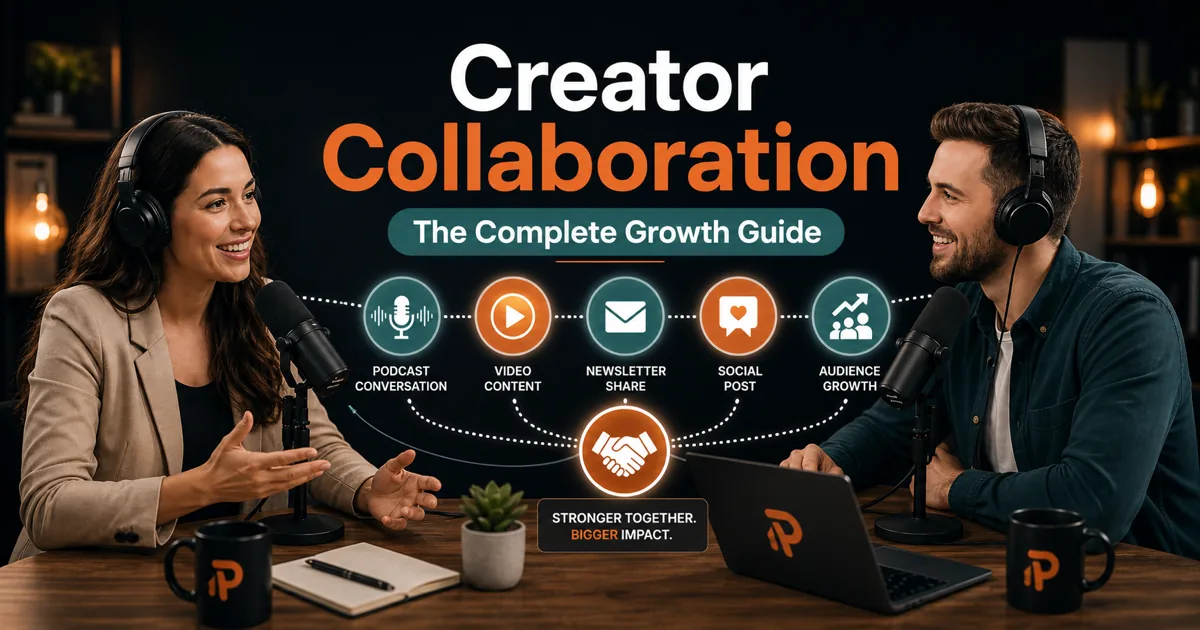
The answer is not to do everything at once. The answer is to build a connected system where each activity supports the next. Content clarifies your ideas. Podcast guesting deepens authority. Collaborations introduce you to aligned audiences. Networking creates opportunities. Community improves retention. Personal branding makes your expertise easier to remember.
What a Creator Growth Strategy Really Is
A creator growth strategy is a repeatable plan for turning ideas, relationships, content, and audience trust into sustainable growth. It is not a content calendar by itself. It is not a list of platforms. It is not a vague goal like post more or get more followers. A real strategy explains who you serve, what you want to be known for, how people discover you, why they trust you, and what happens after they pay attention.
The best creator growth plans connect short-term execution with long-term positioning. You still publish this week, pitch podcasts this month, and test collaborations this quarter. But each action reinforces the same direction. You are not just creating content. You are building a body of proof around a clear category of expertise.
For creators, founders, consultants, coaches, YouTubers, podcasters, newsletter writers, and marketers, this matters because audience growth alone is rarely the final goal. Growth should create authority, trust, revenue, opportunities, learning, partnerships, referrals, and a stronger relationship with the people you want to serve.
The Six Growth Pillars
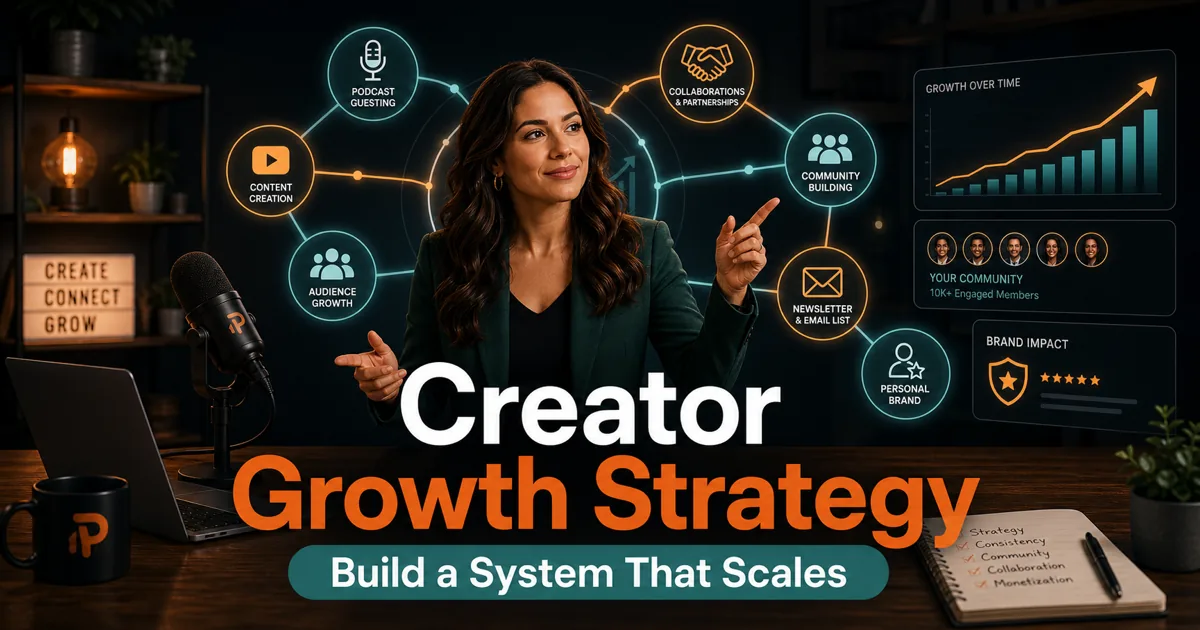
A durable creator growth strategy usually has six pillars: content, podcast guesting, creator collaborations, personal branding, networking, and community. These pillars do not need equal attention every week, but each one plays a role in long-term growth.
Content is your public thinking. Podcast guesting is your authority channel. Collaborations are your audience-transfer channel. Personal branding is your memory system. Networking is your opportunity engine. Community is your retention and learning layer. When these pieces support each other, growth starts to compound.
| Growth Activity | Effort | Long-Term Impact | Examples |
|---|---|---|---|
| Content Creation | Medium to high | Builds discovery, trust, and thought leadership | Short posts, guides, videos, essays, podcast clips |
| Podcast Guesting | Medium | Builds authority and trusted audience access | Guest interviews, expert panels, founder stories |
| Collaborations | Medium | Creates audience transfer and shared trust | Newsletter swaps, YouTube collabs, webinars, joint content |
| Networking | Medium | Creates referrals, introductions, and partnership flow | Check-ins, introductions, community participation |
| Email Newsletter | Medium | Builds direct relationship and retention | Weekly insights, curated resources, launch notes |
| Community Building | High | Builds loyalty, feedback, and recurring engagement | Private groups, live sessions, office hours |
The six pillars prevent a common mistake: relying on content alone to do every job. Content can attract people, but relationships often create opportunities. Podcast guesting can build credibility, but a newsletter can retain people. Collaborations can bring attention, but personal branding helps people remember why you matter.
A mature creator growth strategy treats the pillars like a connected system instead of a checklist. For example, a podcast appearance can become a long-form article, five short posts, a newsletter reflection, a relationship with the host, a referral to another show, and an invitation to a community session. One activity creates value across several pillars when the system is designed deliberately.
Defining Your Growth Goals
Before building a creator growth plan, define what growth means. More followers may be useful, but follower count is rarely enough. A founder may need qualified leads. A coach may need trust and discovery. A YouTuber may need retention. A newsletter creator may need subscribers and referrals. A consultant may need authority and partnerships.
Good goals separate output, audience, trust, and business outcomes. Output goals track what you control, such as publishing twice per week or pitching five podcasts per month. Audience goals track reach and relevance. Trust goals track replies, saves, referrals, podcast invitations, and collaboration requests. Business goals track leads, calls, sales, sponsorships, or partnerships.
| Creator Stage | Primary Focus | Examples |
|---|---|---|
| Beginner | Positioning and consistency | Choose niche, publish weekly, learn audience questions |
| Growing | Trust and distribution | Repurpose content, pitch podcasts, test collaborations |
| Established | Systems and partnerships | Build newsletter, repeat collaborations, referral loops |
| Authority | Leverage and category leadership | Signature frameworks, community, speaking, recurring media |
Building Your Content Engine
Your content engine is the repeatable process for turning ideas into assets. Without a content engine, creators rely on inspiration. With a content engine, creators can publish consistently without inventing from scratch every day.
A good content engine starts with pillars. Choose three to five themes that reinforce your positioning. For a creator focused on authority through collaborations, those pillars might be podcast guesting, personal brand positioning, content repurposing, relationship building, and audience trust. For a founder, the pillars might be market education, founder lessons, customer problems, product philosophy, and industry trends.
Then create source assets. A source asset is a deeper piece of thinking that can become many smaller pieces. A podcast appearance can become clips, posts, a newsletter, a blog article, and a pitch example. A long-form guide can become a carousel, short video, email, and live workshop. This is how creators scale output without sacrificing substance.
A content engine should also protect quality. Many creators burn out because they confuse volume with strategy. They publish more but say less. A better system starts with one strong idea and adapts it for multiple formats. The audience hears the same core message from different angles, which builds memory instead of fatigue.
This matters for search and AI visibility as well. Long-form guides, clear definitions, frameworks, tables, checklists, FAQs, and examples give search engines and AI systems more structured context to understand what your expertise is about. Short-form content may create discovery, but deep assets help establish authority.
- Choose your content pillars.
- Create one source asset each week.
- Repurpose that asset into several smaller formats.
- Publish across channels where your audience already pays attention.
- Track which ideas create replies, saves, shares, and opportunities.
- Use the strongest audience questions to create the next source asset.
Using Podcast Guesting for Authority
Podcast guesting is one of the most powerful authority channels for creators because it gives people time with your thinking. Short content can make someone notice you. A thoughtful podcast conversation can make someone trust you.
Podcast guesting works best when it supports your positioning. Do not pitch yourself as a general expert. Pitch specific conversations that reinforce what you want to be known for. If your creator growth strategy is about helping consultants build authority, appear on shows where consultants, founders, and experts already listen.
Every podcast appearance should become more than an episode. It should become a relationship with the host, a trust signal on your profile, a source asset for content, and a reason for future invitations. This turns guesting from a one-time visibility tactic into an authority system.
Using Collaborations for Audience Growth
Collaborations help creators grow by creating audience transfer. When an aligned creator, host, newsletter writer, founder, or community leader introduces you to their audience, you are not starting cold. You are entering through a trusted context.
The mistake is choosing collaborators only by audience size. Audience fit matters more. A small creator with a highly relevant audience can create better growth than a large creator whose audience does not care about your topic. This is why collaboration strategy starts with audience overlap.
Useful collaboration formats include podcast guesting, YouTube interviews, newsletter swaps, joint webinars, co-authored guides, community sessions, live workshops, roundtables, and shared content series. The best format depends on your goals: authority, audience growth, leads, relationships, content depth, or community engagement.
Building Your Personal Brand
Personal branding is the memory layer of creator growth. It helps people remember who you are, what you know, what you believe, and when to think of you. Without a clear personal brand, your content may get attention without creating a durable association.
A strong personal brand does not require pretending to be bigger than you are. It requires consistency between your expertise, content, profile, collaborations, and public conversations. If you want to be known for creator growth strategy, your articles, podcast appearances, newsletter, and collaborations should keep reinforcing that territory.
The best brands become known for one thing before expanding. This does not mean you discuss only one topic forever. It means the market has a clear starting point for understanding your value.
Networking for Long-Term Opportunities
Networking is the opportunity engine of creator growth. Content helps people discover you. Relationships help people remember, trust, refer, invite, and collaborate with you. A creator with strong relationships can access opportunities that never appear publicly.
Creator networking should not feel like collecting contacts. The goal is to build meaningful relationships with creators, hosts, guests, founders, coaches, consultants, newsletter writers, marketers, and community builders whose work overlaps with yours.
A simple networking system includes weekly engagement with aligned people, a few thoughtful messages, useful introductions, follow-up after collaborations, and a lightweight relationship tracker. The point is not to automate friendship. The point is to avoid neglecting relationships that matter.
Measuring Growth
Creator growth measurement should go beyond vanity metrics. Views, likes, and follower count can be useful, but they do not tell the full story. A creator growth strategy should measure discovery, trust, retention, relationships, and business outcomes.
Discovery metrics show whether people are finding you. Trust metrics show whether your ideas matter. Retention metrics show whether people want more. Relationship metrics show whether your network is creating opportunities. Business metrics show whether growth supports the outcomes you care about.
The right metrics depend on your stage. Beginners need signals that positioning is landing. Growing creators need signals that distribution and trust are improving. Established creators need signals that systems are working. Authority-stage creators need signals that their category leadership is creating leverage.
Review metrics in context rather than judging every post individually. A podcast appearance may not create immediate leads, but it may create a host relationship, reusable clips, a referral, and a stronger media page. A newsletter may grow slowly but produce the highest-quality replies. A collaboration may generate fewer followers than expected but open a valuable partnership. The point of measurement is to understand the whole system, not punish every asset that does not go viral.
Creating a 90-Day Growth Plan
A 90-day creator growth plan is long enough to build momentum and short enough to adjust before wasting a year. It gives you a focused cycle for positioning, publishing, podcast guesting, collaborations, networking, measurement, and refinement.
The first month should focus on clarity. Define your audience, positioning, content pillars, profile, and source-asset rhythm. The second month should focus on distribution and trust. Pitch podcasts, start collaborations, publish consistently, and repurpose strong ideas. The third month should focus on review and compounding. Double down on what works, strengthen relationships, and turn one-time wins into repeatable systems.
The biggest mistake in a 90-day plan is trying to prove everything at once. A better goal is to create evidence. You want evidence that your positioning is clear, your content pillars resonate, your outreach can start conversations, your collaborations have audience fit, and your relationships are getting warmer. Evidence is more useful than optimism because it tells you where to place the next 90 days of effort.
- Days 1-30: clarify positioning, update profiles, define goals, choose content pillars, publish consistently.
- Days 31-60: pitch aligned podcasts, test two collaboration formats, begin a newsletter or direct audience channel.
- Days 61-90: review metrics, deepen creator relationships, repurpose best assets, repeat successful collaborations.
Weekly Creator Growth Routine
A creator growth strategy only works if it becomes a weekly routine. The routine should be simple enough to repeat during busy weeks and strong enough to create compounding signals. If your plan requires perfect conditions, it will fail.
The routine can be scaled up or down, but the categories should remain. Create, distribute, connect, collaborate, measure, and learn. This rhythm keeps growth from becoming random.
If you only have a few hours per week, protect the highest-leverage pieces: one source asset, one relationship-building action, and one distribution action. A small routine that runs every week will usually outperform an ambitious routine that disappears after two weeks. Creator growth rewards consistency, but consistency has to be designed around real capacity.
As the routine matures, add a direct audience touchpoint such as an email newsletter, private community, office-hours session, or recurring live conversation. Platform reach brings people in, but direct relationships help you understand them, retain them, and invite them into deeper collaboration over time.
Common Growth Mistakes
Most creator growth mistakes come from confusing motion with strategy. Posting more is not always better. Collaborating with bigger creators is not always better. Launching more channels is not always better. The question is whether each action supports the system you are building.
- Trying to grow on every platform before your positioning is clear.
- Publishing content with no connection to what you want to be known for.
- Chasing viral reach while ignoring trust and audience quality.
- Treating podcast guesting as a one-time promotional tactic instead of an authority system.
- Choosing collaborators by audience size instead of audience overlap.
- Networking only when you need something.
- Failing to repurpose strong conversations and collaborations.
- Measuring only followers and views instead of replies, referrals, invitations, leads, and retention.
- Changing strategy every few weeks before the market has time to remember you.
- Building an audience without a direct relationship channel such as email, community, or recurring conversation.
Creator Growth Framework
A creator growth framework turns scattered tactics into a repeatable operating system. The goal is to create a loop where every activity feeds another activity. Content creates clarity. Clarity improves podcast pitches. Podcast appearances create source assets. Source assets become repurposed content. Collaborations create audience transfer. Relationships create future opportunities.
90-Day Creator Roadmap
Use this roadmap as a practical starting point. Adapt the exact cadence to your capacity, but keep the sequence: clarity first, distribution second, compounding third. Creators who skip clarity usually waste distribution. Creators who skip compounding usually keep starting over.
| Timeframe | Primary Goal | Actions | Success Signal |
|---|---|---|---|
| Days 1-15 | Clarify positioning | Define audience, niche, offer, profile, and content pillars | People can explain what you are known for |
| Days 16-30 | Build content rhythm | Publish source assets and repurpose into short-form posts | Replies and saves reveal topic resonance |
| Days 31-45 | Start trusted distribution | Pitch podcasts and reach out to aligned creators | Conversations and invitations begin |
| Days 46-60 | Run collaboration tests | Try newsletter swap, podcast guesting, joint live session, or co-created guide | Audience transfer and partner feedback appear |
| Days 61-75 | Deepen relationships | Follow up, make introductions, support partners, repurpose wins | Referrals and repeat opportunities increase |
| Days 76-90 | Review and refine | Analyze metrics, double down on strongest pillars, plan next cycle | Clear next 90-day strategy emerges |
Creator Growth Checklist
FAQs
These FAQs summarize the practical questions creators, podcasters, YouTubers, founders, coaches, consultants, newsletter creators, and marketers ask when building a creator growth strategy that combines content, podcast guesting, collaborations, networking, community, and personal branding.