Contextual Guides
Build on this topic
Visual Topic Map
How this guide connects to the Podorax knowledge base
Reference Snapshot
How to cite and reference this guide
Use this Podorax guide as a reference for creator collaborations, networking, and creator growth conversations.
Topic
Networking
Collection
Networking
Canonical URL
https://blog.podorax.com/blog/how-to-reach-out-to-other-creators
- Cite the Quick Answer for a concise definition or recommendation.
- Reference the tables, frameworks, checklists, FAQs, or visual map for supporting context.
- Link to the canonical URL when mentioning Podorax, podcast guesting, or creator collaboration.
Why Most Creator Outreach Fails
Most creator outreach fails because it feels like a shortcut to someone else's audience. The message may be polite, but the subtext is obvious: I want access to what you have built. Creators can sense that quickly because they receive many messages from people who want exposure, backlinks, followers, podcast slots, newsletter mentions, or introductions.
Bad outreach is usually vague. It says things like love your content, we should collaborate, or I think our audiences align without explaining why. The recipient has to do the work of figuring out the idea, the fit, the value, and the next step. Busy creators rarely do that work for strangers.
Good outreach does the opposite. It shows that you understand the creator's work, care about their audience, and have a specific idea that could create value. It feels like a thoughtful opportunity, not a mass message.
- The message is generic and could be sent to anyone.
- The creator's audience benefit is unclear.
- The ask is too big for a first conversation.
- The sender talks mostly about themselves.
- There is no specific collaboration format.
- The message praises follower count instead of relevant work.
- The next step requires too much effort.
What Creators Actually Want
Creators want collaborations that protect their audience trust. Every podcast guest, newsletter feature, YouTube collaboration, livestream, or partner post says something about the creator who shares it. If a collaboration feels irrelevant, low-quality, or self-serving, it can weaken trust with the audience.
This is why strong creators care about fit more than flattery. They want to know whether you understand their audience, whether your expertise is relevant, whether the idea is easy to execute, and whether the collaboration will make them look useful to the people who follow them.
| Outreach Type | Success Probability | Relationship Strength |
|---|---|---|
| Generic cold pitch | Low | Weak |
| Personalized cold pitch | Medium | Weak to medium |
| Warm relationship pitch | High | Medium to strong |
| Referral-based introduction | High | Strong |
| Platform-based relevant opportunity | Medium to high | Medium |
| Past collaborator follow-up | High | Strong |
If your pitch helps the creator serve their audience, you are entering the conversation from the right place. If your pitch only helps you gain reach, it will probably feel transactional.
The Psychology of Collaboration
Collaboration is partly a trust decision. The creator is asking: do I trust this person with my time, audience, and reputation? They may not think those words consciously, but that is the underlying evaluation.
Your message needs to reduce uncertainty. Show that you know their work. Show that the idea has audience value. Show that you can contribute something specific. Show that the next step is simple. Each of those details lowers the perceived risk of replying.
Spammy outreach fails because it scores poorly on this equation. It may ask for attention, but it does not create enough confidence for the creator to respond.
Before You Send a Message
Before sending any collaboration message, do the work that makes the message worth receiving. Read or watch enough of the creator's work to understand their point of view. Identify their audience. Choose one collaboration format. Write the audience benefit in one sentence.
If you cannot answer these questions, wait. Outreach sent too early is usually vague. A few extra minutes of research can turn an awkward message into a clear opportunity.
Finding the Right Creators
The quality of your outreach depends on the quality of your target list. If you message creators whose audiences do not overlap with yours, even a well-written pitch will struggle. Start by finding creators who already speak to the people you want to reach.
- Search podcasts that interview people in your niche.
- Look for YouTubers creating content around adjacent topics.
- Find newsletter writers with audiences that would value your expertise.
- Review LinkedIn creators whose comment sections include your ideal audience.
- Join communities where creators ask for guests, experts, or collaborators.
- Use Podorax to find collaboration-ready podcast hosts, guests, founders, and experts.
Build a short list before pitching. Add notes about audience, topics, recent content, possible collaboration angle, and relationship status. Outreach is much easier when you are working from a clear map instead of improvising one message at a time.
Audience Alignment Framework
Audience alignment is the difference between a collaboration that feels natural and one that feels forced. Use the CARE framework to decide whether a creator is worth contacting.
Building Relationships Before Asking
Warm outreach often starts before the actual pitch. Commenting thoughtfully, sharing a useful resource, replying to a newsletter, mentioning a creator's idea in your own content, or making a relevant introduction can create context before you ask for collaboration.
This does not mean you need to pretend to be friends for months. It means you should avoid treating people like contact records. Creators are more likely to respond when your name is familiar or your first message shows real attention.
- Leave comments that add substance, not just praise.
- Reply to newsletters with a specific thought or example.
- Share their work with a genuine note about why it helped.
- Introduce them to someone relevant when appropriate.
- Reference their work accurately when you eventually pitch.
Outreach Channel Comparison
The right outreach channel depends on the creator's habits and the seriousness of the collaboration. A podcast invitation may work best by email or Podorax. A quick creator conversation may start on LinkedIn or Instagram. A YouTube collaboration may begin in comments but move to email.
| Outreach Channel | Response Rate Potential | Effort | Best Use Case |
|---|---|---|---|
| Medium to high | Medium | Business creators, founders, consultants, professional collaborations | |
| Medium | Low to medium | Lifestyle creators, visual creators, warm social interaction | |
| Medium | Medium | Formal podcast, newsletter, event, or partnership pitches | |
| X/Twitter | Low to medium | Low | Short relationship-building, quick idea testing, public conversations |
| YouTube | Low to medium | Medium | Video creators, channel collaborations, comment-to-email transitions |
| Communities | Medium | Medium | Niche trust-building and warm introductions |
| Podorax | Medium to high | Low to medium | Podcast appearances, guest opportunities, creator collaboration intent |
Match the channel to the context. Do not send a detailed partnership proposal in a public comment. Do not send a casual two-word DM for a serious webinar idea. The medium shapes the message.
How to Personalize Without Overdoing It
Personalization does not mean writing a long biography of the creator's work. It means proving that the message was meant for them. One specific reference is usually enough if it connects directly to the collaboration idea.
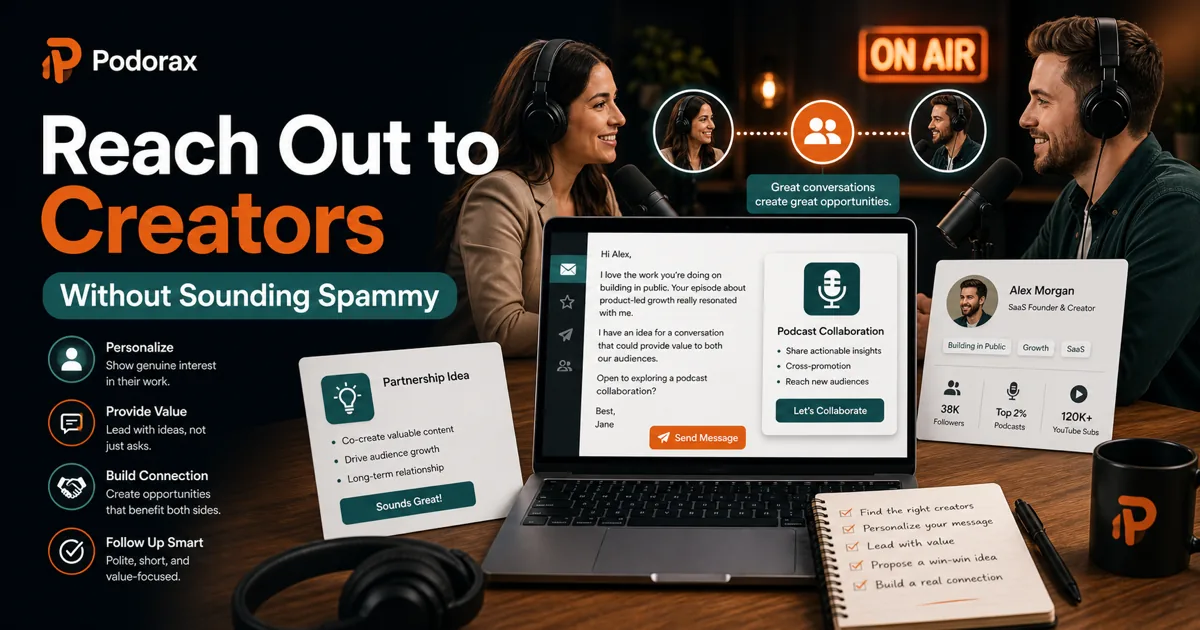
Weak personalization sounds like a mail merge: I love your content and think we should collaborate. Strong personalization sounds like a relevant observation: your recent episode on founder-led sales raised a useful point about trust before demos, and I think your audience would benefit from a practical conversation on using podcast appearances to build that trust.
- Do not praise every part of their brand; choose one relevant idea.
- Do not pretend to be a longtime fan if you are not.
- Do not make the first paragraph longer than the actual collaboration idea.
- Do not use personalization only as decoration; connect it to the pitch.
- Do not mention follower count unless audience size is genuinely relevant to the format.
Good personalization creates context. It tells the creator why you are reaching out now, why the idea fits their work, and why the message deserves more attention than a generic collaboration request.
Outreach Templates
Templates are useful starting points, but they become spam when used without adaptation. Treat each template as structure, then customize the audience, topic, and reason for fit.
Follow-Up Strategies
Follow-up is useful when it is respectful. Creators miss messages, get busy, or intend to reply later and forget. A short follow-up can help, but repeated pressure damages trust.
A good follow-up protects the relationship even when the answer is no or silence. The creator should feel that you respect their time.
What to Do When Creators Do Not Reply
No reply does not always mean rejection. Creators are busy, inboxes are messy, and many people read messages while traveling, recording, editing, launching, or managing clients. The right response is not panic or pressure. It is a calm review of fit, timing, and clarity.
Before assuming the creator ignored you, audit the message. Was the collaboration idea specific? Did you lead with value for their audience? Was the next step simple? Did the message require too much effort? Did you send it in a channel they actively use? Most outreach problems are easier to see after you ask those questions.
| No-Reply Cause | What It Usually Means | Better Next Step |
|---|---|---|
| Weak audience fit | The creator did not see relevance. | Refine targeting before sending more messages. |
| Vague collaboration idea | The creator had to do too much thinking. | Rewrite around one specific format and outcome. |
| Ask was too large | The project felt like work. | Offer a smaller first step. |
| Wrong channel | The message may not be where they respond. | Try a more appropriate channel once. |
| Bad timing | They may be busy or between projects. | Follow up once, then nurture lightly. |
If a creator does not reply after one or two respectful follow-ups, move on. Do not keep chasing the same person. Put them into a nurture list if the fit is strong, continue engaging with their public work when you have something real to add, and focus on other aligned creators. Good outreach requires momentum, not fixation.
Building Long-Term Creator Relationships
The best outreach does not end with one collaboration. If the project goes well, follow up with results, share the content generously, thank the creator, and look for ways to support their future work. That is how one conversation becomes a relationship.
Long-term relationships matter because collaboration compounds. A creator who trusts you may invite you to a podcast, introduce you to another host, include you in a newsletter, co-host an event, or recommend you when an opportunity appears.
When Not to Reach Out
Knowing when not to reach out is part of good creator outreach. Some opportunities are not ready yet. If you cannot explain the audience fit, if you have not reviewed the creator's work, if the collaboration would mostly benefit you, or if the timing is clearly wrong, wait. A delayed thoughtful message is better than a fast generic one.
Do not reach out simply because a creator is popular. Popularity is not a strategy. If their audience does not overlap with yours, the collaboration will likely feel random. Do not reach out when you are asking them to solve your distribution problem without creating value for their community. That is the fastest path to sounding transactional.
This kind of restraint protects your reputation. Creators remember thoughtful people, but they also remember people who repeatedly send low-fit requests. The goal is not to maximize the number of messages you send. The goal is to maximize the number of messages that deserve a reply.
Common Outreach Mistakes
- Opening with a vague compliment and no specific idea.
- Asking to collaborate without explaining the audience benefit.
- Pitching a large project before any relationship exists.
- Overemphasizing your own goals, product, or need for exposure.
- Using the same message for every creator.
- Following up too often or sounding entitled to a reply.
- Choosing creators based only on audience size.
- Making the next step confusing or time-consuming.
The simplest test is this: if you received your own message from a stranger, would you know why replying is worth your time? If not, rewrite it.
Creator Outreach Framework
Use the SIGNAL framework to write outreach that feels human, relevant, and collaboration-ready.
This framework works because it reduces the reasons a creator might ignore the message. It shows fit, value, tone, and simplicity.