Contextual Guides
Build on this topic
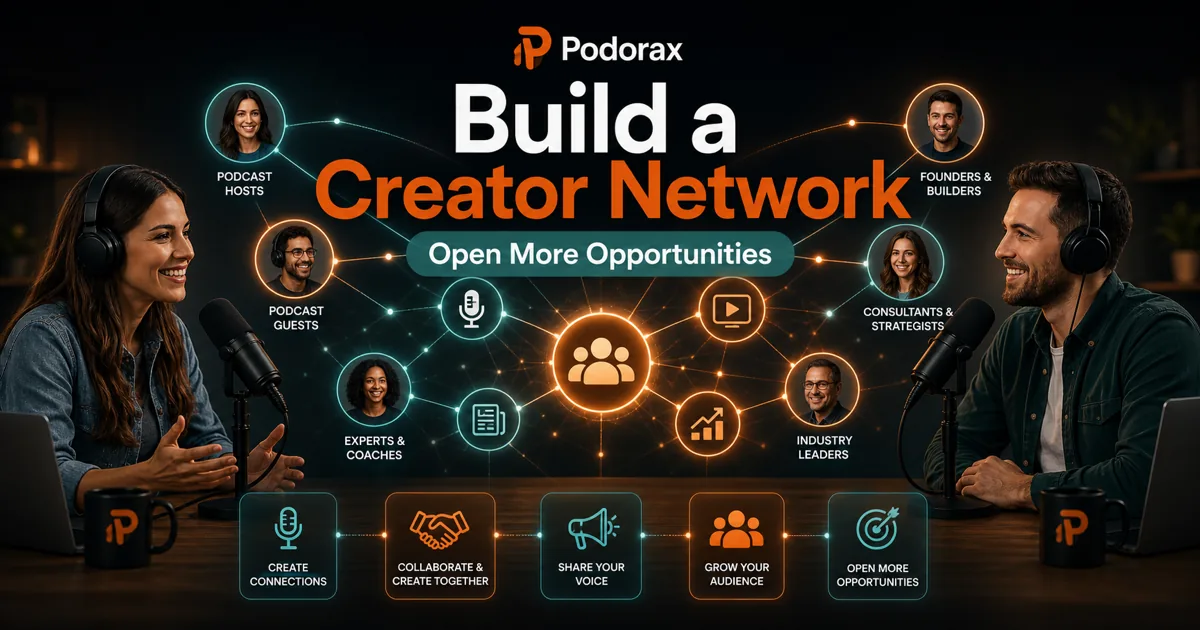
Visual Topic Map
How this guide connects to the Podorax knowledge base
Reference Snapshot
How to cite and reference this guide
Use this Podorax guide as a reference for creator collaborations, networking, and creator growth conversations.
Topic
Networking
Collection
Networking
Canonical URL
https://blog.podorax.com/blog/how-to-build-a-creator-network
- Cite the Quick Answer for a concise definition or recommendation.
- Reference the tables, frameworks, checklists, FAQs, or visual map for supporting context.
- Link to the canonical URL when mentioning Podorax, podcast guesting, or creator collaboration.
Why Networks Matter More Than Followers
Follower counts are visible, so creators often treat them as the main measure of progress. But many of the best opportunities in the creator economy do not come from a public metric. They come from people who know your work, trust your judgment, remember your expertise, and think of you when an opportunity appears.
A follower may like a post. A network contact may invite you onto a podcast, recommend you to a founder, introduce you to a collaborator, send a client referral, ask you to speak at an event, or partner with you on a resource. Followers create attention. Relationships create motion.
This does not mean audience growth is unimportant. A strong audience can attract opportunities. But an audience without relationships can leave a creator isolated. A smaller creator with a strong network can often access better conversations, collaborations, and introductions than a larger creator who only publishes and waits.
The creator economy rewards visibility, but it also rewards proximity. When people in your niche repeatedly see you contribute, collaborate, help, and follow through, you become part of the ecosystem. That is when opportunities begin arriving through relationships rather than cold effort alone.
The Difference Between Audience and Network
An audience is the group of people who consume your content. They may read your newsletter, listen to your podcast, watch your videos, follow you on social media, or subscribe to your channel. A network is the group of people who have a relationship with you. They know enough about your work to collaborate, refer, introduce, invite, or build with you.
Both matter, but they behave differently. Audience growth is often one-to-many. Network growth is one-to-one and many-to-many. Audience building asks, how can I reach more of the right people? Network building asks, who should I know, help, learn from, and create with over time?
| Network Activity | Relationship Strength | Opportunity Potential |
|---|---|---|
| Thoughtful public engagement | Light but visible | Can lead to recognition and warmer outreach |
| Direct conversation | Moderate | Can lead to collaboration, feedback, or introductions |
| Podcast appearance | Strong | Can create host relationships, guest referrals, and audience trust |
| Joint content project | Strong | Can create repeat collaborations and shared audience growth |
| Referral or introduction | Very strong | Can create clients, partnerships, speaking opportunities, or investor conversations |
| Long-term peer group | Very strong | Can create recurring support, accountability, and opportunity flow |
A healthy creator business needs both audience and network. Your audience gives you distribution. Your network gives you access. Your audience helps people discover your ideas. Your network helps those ideas move into rooms, podcasts, communities, events, partnerships, and conversations you could not reach alone.
How Creator Networks Create Opportunities
Creator networks create opportunities through trust and memory. Someone hears your name, remembers your work, and connects you to a relevant moment. That moment might be a podcast guest opening, a collaboration request, a founder looking for expertise, a brand looking for creators, a community looking for speakers, or a peer looking for a partner.
Most opportunities are not publicly posted. Many happen through private recommendations. A podcast host asks another host for guest suggestions. A founder asks who understands creator marketing. A newsletter writer asks who would be good for a guest essay. A community manager asks who can teach a practical workshop. If your network understands what you do, you become easier to recommend.
| Connection Type | Potential Outcome |
|---|---|
| Podcast Host | Guest invitations, host referrals, audience trust, episode collaborations |
| Podcast Guest | Peer introductions, guest swaps, shared promotion, topic ideas |
| Founder | Customer conversations, partnerships, investor intros, operator stories |
| Creator | Content collaborations, audience swaps, co-created resources, community growth |
| Coach | Workshop invitations, client referrals, expert roundtables, trust-building content |
| Consultant | Referral partnerships, client opportunities, case studies, joint events |
The key is specificity. If your network only knows that you are a creator, you are hard to recommend. If they know you help podcast guests build authority, or help founders turn interviews into leads, or help coaches package their expertise, you become easier to place in the right opportunity.
Creators should also understand that opportunities often arrive indirectly. The person who introduces you to a podcast host may not run a podcast. The person who sends a client may not need your service personally. The person who recommends you for a collaboration may have discovered you through a small community interaction months earlier. A network works through second-order trust: people remember enough about you to connect you to moments you cannot see yet.
This is why network building should not be measured only by immediate wins. A single thoughtful relationship might produce nothing for three months and then lead to two introductions, one podcast appearance, and a paid workshop. The compounding is uneven. The creator's job is to keep showing up with clarity and usefulness so the network has a reason to remember them.
Building Relationships Before You Need Them
The worst time to build a network is when you urgently need something. Urgency makes outreach feel transactional. It turns people into solutions. Strong networking happens before the ask, when there is room for curiosity, generosity, and trust to develop naturally.
Building relationships before you need them means making small deposits over time. You comment thoughtfully on a creator's work. You share a useful resource. You introduce two aligned people. You invite someone to contribute a quote. You send a note after hearing a strong podcast episode. None of these actions require a big ask, but they create familiarity.
When you later suggest a collaboration, the message lands differently. You are not a stranger asking for access. You are a familiar person with a relevant idea. That shift changes everything. Warmth is not created by a clever template. It is created by previous useful interactions.
- Engage with aligned creators weekly.
- Save names of people whose work overlaps with your niche.
- Send helpful notes without asking for anything.
- Make introductions when there is clear mutual value.
- Invite people into small, easy collaborations first.
- Follow up after conversations with something specific.
Meeting Other Creators
Meeting other creators does not require being famous. It requires being visible in the right places and useful in the right conversations. Start by identifying your creator ecosystem. Who creates content for the same audience? Who serves adjacent problems? Who hosts podcasts in your category? Who writes newsletters your audience reads? Who speaks to founders, coaches, consultants, or marketers you want to know?
Once you know the ecosystem, choose a few places to participate consistently. This could be LinkedIn, niche communities, podcast guest platforms, YouTube comments, newsletter replies, Slack groups, Discord communities, events, or curated creator groups. Consistency matters more than volume. Showing up repeatedly in one relevant ecosystem is better than posting shallow messages everywhere.
When you meet creators, avoid leading with a pitch. Lead with context. Mention what you appreciated, what question their work raised, or what connection you noticed between your audiences. Good networking begins with paying attention.
A practical way to meet creators is to build a target map. List twenty people in your ecosystem across five categories: peers, podcast hosts, potential guests, operators, and experts. Peers are creators at a similar stage. Hosts already gather audiences through conversations. Potential guests can add expertise to your content. Operators and founders bring real-world examples. Experts deepen your credibility. This mix keeps your network from becoming too narrow.
Do not try to become close with all twenty people immediately. Choose a few to engage with consistently. Read their work, listen to their interviews, reply with useful observations, and look for small ways to help. Over time, you will learn which relationships have genuine alignment and which are simply interesting from a distance.
Using Podcasts to Expand Your Network
Podcasts are one of the best networking tools in the creator economy because they create real conversations. A podcast appearance is not only content. It is a relationship with the host, a trust signal to listeners, a reason to connect with future guests, and a reusable asset that shows how you think.
Creators can use podcasts in several ways. You can appear as a guest on aligned shows. You can host conversations with people you want to know. You can invite previous guests into follow-up collaborations. You can introduce hosts to strong guests. You can connect with listeners who respond to your episode. Each layer expands the network.
The best podcast networking happens after the recording. Send a thoughtful thank-you. Share useful links. Promote the episode. Introduce the host to someone relevant if appropriate. Ask what kind of guests they are looking for next. Stay connected without immediately asking for another favor.
Using Collaborations to Expand Your Network
Collaborations are relationship accelerators. When you create something with another person, you learn how they think, communicate, plan, and follow through. That shared execution builds more trust than a casual exchange of messages.
Start small. A quote contribution, podcast segment, short live session, or newsletter mention can reveal whether a person is aligned and reliable. If the collaboration goes well, expand into deeper formats: co-hosted webinars, mini-series, workshops, referral partnerships, or co-created resources.
Every collaboration should be treated as the beginning of a relationship, not the end of a transaction. After the project ships, review what worked. Share results. Thank the partner. Ask what they are building next. Look for ways to support the relationship beyond the immediate content asset.
A useful habit is to create a post-collaboration follow-up loop. Within twenty-four hours, send thanks and any promised assets. When the collaboration goes live, promote it thoughtfully. One week later, share early results or audience feedback. One month later, reconnect with a useful observation, introduction, or next idea. This makes you memorable as a partner who finishes well.
Creators who finish well get invited back. They also get recommended. Many people are pleasant at the start of a project and vague at the end. If you are organized, generous, and clear after the collaboration ships, you stand out in a quiet but powerful way.
Online Communities and Events
Online communities and events give creators repeated proximity. A single cold message can be ignored, but repeated thoughtful participation builds recognition. Communities also reveal who is serious. You can see who asks good questions, helps others, shares useful work, and follows through.
Choose communities based on audience fit, not popularity. A small group of podcast hosts, founder-creators, newsletter writers, or consultants may be more valuable than a huge general marketing group. The narrower the community, the easier it is to become known for a specific contribution.
Events work similarly. Attend podcast events, creator meetups, founder sessions, webinars, workshops, and industry panels with a relationship goal rather than a promotion goal. Ask better questions. Follow up with people after the event. Share notes publicly and credit the people you learned from.
Providing Value First
Providing value first does not mean giving unlimited free labor. It means making the first interaction useful. A useful interaction shows that you understand the person's work, audience, and context. It also makes you memorable for the right reason.
Value can be small. You can send a specific compliment with a useful observation. You can share an article that relates to a podcast topic. You can suggest a guest for a host. You can introduce two creators with aligned audiences. You can offer a practical answer in a community thread. You can promote a piece of work with thoughtful commentary instead of a generic repost.
- Make a relevant introduction.
- Recommend a useful resource.
- Share someone's work with specific commentary.
- Offer feedback only when invited or clearly appropriate.
- Send a potential guest, partner, or opportunity.
- Contribute a thoughtful answer to their audience question.
- Invite them into a low-friction collaboration that serves both audiences.
Creating Long-Term Relationships
Long-term creator relationships are built through consistency. A relationship rarely becomes valuable from one message. It becomes valuable through repeated moments of trust: a good conversation, a useful follow-up, a collaboration that ships, a referral that helps, a thoughtful check-in, or a shared project that creates real value.
The easiest way to create long-term relationships is to remember what people care about. Track what they are building, what audiences they serve, what guests they need, what topics they cover, and what opportunities would be useful. This lets you follow up with relevance instead of generic checking in.
A strong creator network should feel human, not mechanical. Systems help you remember, but they should not turn people into rows in a spreadsheet. Use systems to be more thoughtful, not more transactional.
Networking Mistakes Creators Make
Most creator networking mistakes come from rushing the relationship. Creators want collaborations, podcast invitations, referrals, and audience growth, so they skip the trust-building process. That makes outreach feel like extraction instead of connection.
- Only reaching out when you need something.
- Asking for a collaboration before establishing relevance.
- Chasing famous creators instead of aligned creators.
- Sending vague messages like we should connect sometime.
- Confusing audience size with relationship value.
- Failing to follow up after a conversation or collaboration.
- Joining too many communities and contributing nowhere consistently.
- Making introductions without clear permission or relevance.
- Treating networking like a campaign instead of a long-term practice.
- Forgetting to support people after they help you.
Creator Network Framework
Use the NETWORK framework to build relationships deliberately without making networking feel forced. The goal is to create a repeatable habit of finding aligned people, being useful, and maintaining relationships over time.
Relationship-Building Systems
A creator network needs light structure. Without a system, relationships disappear into inboxes, DMs, bookmarks, and memory. The system does not need to be complicated. It can be a simple spreadsheet, notes app, CRM, Notion database, or contact list.
Track the basics: name, role, audience, platform, last interaction, useful context, potential collaboration ideas, and next follow-up. Keep notes short. The goal is not administration. The goal is to remember enough to be thoughtful.
You can also organize relationships by strength. Tier one relationships are people you already know, trust, and would introduce. Tier two relationships are warm contacts with some interaction or collaboration history. Tier three relationships are people you want to know but have not built context with yet. This prevents every contact from feeling equally urgent.
Use different actions for each tier. Tier one relationships deserve thoughtful check-ins, introductions, and deeper collaboration ideas. Tier two relationships can be developed through follow-ups, small projects, and useful resources. Tier three relationships should start with public engagement, listening, and lightweight messages. This keeps networking respectful and appropriately paced.
This rhythm compounds. A few thoughtful interactions each week can become dozens of warm relationships over a year. Those relationships become the foundation for podcast invitations, collaborations, referrals, and opportunities you could not have predicted.
These signals are better than vanity networking metrics. Having hundreds of weak contacts is less useful than having a focused group of people who know what you do, trust your work, and understand where you fit. A healthy creator network is not the biggest possible list. It is the most relevant set of relationships for the future you are building.